They all go past the inner wall of the frame.Is this the one where you put the tower past the inner wall of the frame?


They all go past the inner wall of the frame.Is this the one where you put the tower past the inner wall of the frame?

All outboards or all CO outboards? You've got me concerned!They all go past the inner wall of the frame.

Could you install a coilover shock/spring on a stock LJ Dana 44 rear axle with this outboarding mod?
In searching the net I can't seem to find a difference between the two mods. If that's is the case why wouldn't you just install coilovers, where you can dial in your rear suspension so much more.
Is there a huge downside to coilovers on the rear and just outboarded shocks on the front?
You think you don't have room. I put 12" Fox 2.0 on a TJ Unlimited with stock Rubicon axles and not terrible offset wheels. He is a member on here if you want to verify how nicely it rides. @L J
All outboards or all CO outboards? You've got me concerned!
C/OAll outboards or all CO outboards? You've got me concerned!

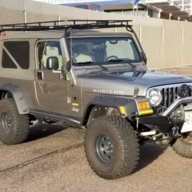

This is very cool. Would you be willing to take more pics? Particularly of the back side frame and how it was gusseted, and a profile from the rear showing how far the coil over and hoop protrude in front of the frame. This kind of work deserves an entire build thread for just the rear suspension.I apologize for the poor pics/lighting but this is mrblaine's work on my LJ (stock width axle, rear 2.0 coilover, no wheel spacers, 3.75 bs wheel and 35x12.5 tires):
View attachment 122190
View attachment 122196
It rides better than stock and better than I thought possible considering the tire size and suspension. It puts a smile on my face every time I drive it. To give an idea of the quality of the overall build I feel more comfortable at 80 mph on the freeway with no hands on the wheel than I did with both hands on the wheel when my LJ was stock.
I believe it's just the CO outboards due to the diameter of the CO.
It shouldn’t weaken it at all. If the welds are done right, the metal should fatigue before the welds do.How much does that weaken the rear frame?
How much does that weaken the rear frame?
Not the correct question since it does weaken the frame. The correct question is does it weaken the frame enough to ever be a problem and the answer is a qualified no. Qualified in that good fabrication practices need to be followed, sound welds, decent fitment, full welds all the way around the opening, and a good frame to start with.How much does that weaken the rear frame?
Yes, I've seen one on JF where the welds were cracking up the sides. The whole bottom was not welded correctly.In all these years, has anyone ever shown a frame failure on an outboard?
If it didn't weaken it, we could have an entire frame made out of a layer of 1/4" and a layer of 3/16" without top and bottom flanges. It wouldn't last long.It shouldn’t weaken it at all. If the welds are done right, the metal should fatigue before the welds do.
If the rear of your frame is hit hard enough to actually accomplish that, your frame is toast. Outboarded or not.

Getting ready to French cut my frame. A lot of great info here. How far in do you cut. All the way back so that the shock tower rest flat against the frame or almost all the way and leave like 1/4" gap?

There are two insides of the frame. The inside face that you would see if you were sitting under the rig and looking out and the inside of the frame tube that you can't see unless you look in one of the holes randomly punched in the frame. You really don't want to cut through the inside of the frame that you can see looking out, but you do want to get very close to the inside face of the inside wall of the frame. Critical distinction.The bottom edge is cut flush to the inside of the frame. The top is left with about a 1/4" lip to push the top of the tower out a bit. This is where it is so important to tack everything in place and cycle the axle before committing. You will be making multiple small adjustments at every step.