Cut a bit too small so the tower starts low. Then open up the frame cut little by little to raise and point the tower where it needs to go. It doesn't take much to make a big change.


You have it. Yes, you are making a cut in the frame that only allows adjustment upward. If you can figure out how to set the height of the tower, you can also figure out how to set it slightly low so you can sneak up on the final fitment by removing material from the sides of the cut. I typically wind up starting about 1/2-3/4" low and getting the mount into the frame cut. That lets me adjust the cut forward or rearward to more center the shock in the opening at ride height.Thank you all for your advice. One other thing I'm not completely clear on. I understand that we have to tack in and flex test a lot. My question is how do you do that since it requires cutting into the frame with a somewhat triangle shaped shock tower? From the first cut and tack in I can only go up since moving the shock tower down would leave a gap around the tower. I did read other post including @mrblaine on how to measure and track adjustments. I just don't really understand how I can make small adjustments to the setup.
Do you also leave 1/4" or so more at the top of the frame so the shock tower tilts out? Sounds counter to moving the top of the shock inward as far as possible.There are two insides of the frame. The inside face that you would see if you were sitting under the rig and looking out and the inside of the frame tube that you can't see unless you look in one of the holes randomly punched in the frame. You really don't want to cut through the inside of the frame that you can see looking out, but you do want to get very close to the inside face of the inside wall of the frame. Critical distinction.
I start with more than 1/4" so I can lean the top of the tower in or out as needed.Do you also leave 1/4" or so more at the top of the frame so the shock tower tilts out? Sounds counter to moving the top of the shock inward as far as possible.

Tilting out clears the shock body from the bracket, tilting in clears the shock body from the tire. You have to find the sweet spot.Do you also leave 1/4" or so more at the top of the frame so the shock tower tilts out? Sounds counter to moving the top of the shock inward as far as possible.
Correct, you want the bolt to face front to rear instead of the stock side to side.Thank you both. This makes sense.
Another question.
My stock lower shock mounts held the shock bolt parallel to the axel.
My new ones hold the lower bolt perpendicular to the axel. This seems to make sense given the the rear axel can move side to side more than backwards and forward. Is this the correct orientation?
I've been looking into this an wonder how everyone feels about the 5160 Bilstein, for the rear of the TJ and an outboard.Outboarding allows for a better length shock to maximize the amount of usable travel. This removes the shock as a limiting factor for travel. If you have a 2” lift, you’ll benefit from an increase in down travel by outboarding, not sure if any uptravel gains are to be had by this. In outboarding for a 4” lift, a 12” fox shock can be used, and when used with a resivor provides a significant improvement in ride and capability as these shocks can be tuned and valves by someone such as @pcoplin. Tuning gives you the ability to adjust the ride stiffness, rebound, and compression. For 2” of life I wouldn’t consider outboarding to be worth the cost/effort for the amount of work and money it takes to done right...can you do it? Sure. But to do it right would mean much more work than just placing a tower and a longer shock. You can probably get all the usable travel from a 2” lift with an over the counter Rancho, adjustable ones being my personal favorite as I have ran them on many things. But there’s another level when you go high and need more adjustable parameters. I’ll let some others chime in, just know that @mrblaine invented shock outboarding for TJs, so if he decides to give input here or you read what he’s said on other threads he’s going to be the correct voice. What I will say is that outboarding is a solution to a problem, and if you’re not having a problem then there isn’t anything to be gained. The question to ask is what am I trying to achieve with this modification? Stability and ride can be improved with outboarding but only when done correctly and with that goal in mind when setting it up. As @mrblaine has said on other threads discussing this, you can outboard and severely downgrade the shocks performance if not set up right, it all comes down to your goals and what problems you are trying to solve! Hope this helps.
Not the correct question since it does weaken the frame. The correct question is does it weaken the frame enough to ever be a problem and the answer is a qualified no. Qualified in that good fabrication practices need to be followed, sound welds, decent fitment, full welds all the way around the opening, and a good frame to start with.

This is exactly what i was wondering after seeing pictures of how much the towers are sunk into the frame. I'm guessing the gas tank skid and body are what keeps it it place? I keep having visions of an outboarded tj getting its rear frame section yanked over when stuck in the mud and getting pulled out by some yahoo at a side angle off the rear bumper
Lots of good stuff here.thanks guys. Heck its clear enough to try myself if i needed the travel.I just get squeamish thinking about having a section of frame being basically flat stock.
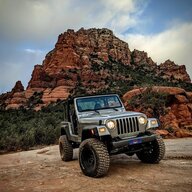
This is exactly what i was wondering after seeing pictures of how much the towers are sunk into the frame. I'm guessing the gas tank skid and body are what keeps it it place? I keep having visions of an outboarded tj getting its rear frame section yanked over when stuck in the mud and getting pulled out by some yahoo at a side angle off the rear bumper
Lots of good stuff here.thanks guys. Heck its clear enough to try myself if i needed the travel.I just get squeamish thinking about having a section of frame being basically flat stock.
Take a look on the other side of the frame rail directly next to the shock towers. There is a huge, very robust Double walled crossmember. That's where all of the strength of the rear frame section comes from.

This is exactly what i was wondering after seeing pictures of how much the towers are sunk into the frame. I'm guessing the gas tank skid and body are what keeps it it place? I keep having visions of an outboarded tj getting its rear frame section yanked over when stuck in the mud and getting pulled out by some yahoo at a side angle off the rear bumper
Lots of good stuff here.thanks guys. Heck its clear enough to try myself if i needed the travel.I just get squeamish thinking about having a section of frame being basically flat stock.
I will assume you've been on the internet long enough to know that if there were an issue, the detractors would waste no time posting up pics of all the failures. See any?
I only brought it up because that is my first impression.and was glad to see your post that i quoted. I'll take your word and real world reputation over a google search any day. Heck there was a time when idiots all over the web were fawning over the 2" lift,1.25 body and 35's lcog garbage my jeeps p.o. left for me.
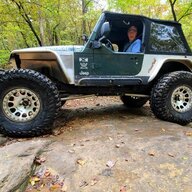
I apologize for the poor pics/lighting but this is mrblaine's work on my LJ (stock width axle, rear 2.0 coilover, no wheel spacers, 3.75 bs wheel and 35x12.5 tires):
View attachment 122190
View attachment 122196
It rides better than stock and better than I thought possible considering the tire size and suspension. It puts a smile on my face every time I drive it. To give an idea of the quality of the overall build I feel more comfortable at 80 mph on the freeway with no hands on the wheel than I did with both hands on the wheel when my LJ was stock.
I believe it's just the CO outboards due to the diameter of the CO.
Are those mounts available? Are they one off?
Are those mounts available? Are they one off?
The only reason to do coil overs is to design in a ride height that isn't available otherwise. It also allows you the option to change ride height easily with a spring swap, or if the adjustment is minor and temporary, move the adjusters a bit. They are not cheaper, easier, or better.Thank you. Been reading everything I can find. I appreciate the link.
Im researching for next winters project. As soon as Gerald gets me the links next week I'm starting on the Savvy mid arm install. Trying to figure out if Coil overs make sense with the savvy kit or if I should stick with just outboard with the spring perches moved back.