Novak Conversions Jeep Wrangler TJ engine mounts

Dyno Testing Bolt-ons On The 4.0

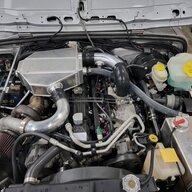
What is the i.d. of the piping in front of the throttle body? If smaller, which I assume it is, it is a potential choke point, but then the question is at what point in the RPM/power range does it begin choking the intake.

I'll guess that the stock intake setup is capable of flowing the needed air for a stock-ish engine, but I'll also bet the intake air source (heated under hood air) is detrimental, and that a cowl intake sucking ambient air is better. It would be interesting to see a stock box sucking heated under hood air vs ambient.

My measurements when doing my cai mod
https://wranglertjforum.com/threads/what-did-you-do-to-your-tj-today.1784/post-1282347
 
  • Like
Reactions: BlueC
In general and not specific to our inline 6 motors, the overall ability of the motor to flow air is the limiting factor. In most cases, it's the head, but many things affect flow of air through the head like how much/long the cam is opening the valves, how big the valves are, how much the rocker arm ratio is affecting cam inputs, etc. external bolt on things like TB size, intake design, etc. affect that flow too.

You can reach that peak flow/hp a few different ways. You can always do it via rpms if the motor will allow it. That's how Honduhs make impressive n/a rpm and still suck. Increased displacement i.e. a stroker will move the peak power lower down the rpm band. Forced displacement (tarbo or/and blower) is another way but outside the parameters of this discussion.

So if your whole head/intake/exhaust setup flows enough for your motor at it's 5k redline and you stroke it, you'll make the same peak hp, just lower in the rpm range. But if your peak flow was more than your engine needed even at redline and you stroke it, you'll (hopefully) move the peak power down into the range you can rev to and make more peak power.

There are some gross generalizations in there but for the sake of the concept I think that tracks? So for our Jeep motors, the flow of the intake/TB/exhaust/head was sufficient for the intended use as well as the low redline we have. Bolt ons generally don't do a ton as compared to a high revving motor (but still does something, especially higher in rpm where Jerry starts frowning).

Also, there is no such thing as "flows enough." It's just a logorithmic scale kinda thing with diminishing returns.

The point I want to get across is generally speaking, stroking doesn't necessarily make more hp (although it can and does many times), it just moves the peak power to the left. That "to the left" might well push it in to your useable rev range.

 
Last edited:
When I purchased the ‘01 TJ 4.0L approximately 5 years ago the fuel injectors were starting to show signs of leaking I planned to install the 4 hole injectors, but decided to upgrade to the flow matched 12 hole injectors.
To be honest I only noticed a slight difference even after resetting the ECU.
About a year ago I was having a rough idle problem and after some troubleshooting; I found the stock TB throttle shaft was worn causing an air leak and since new OEM throttle bodies are not available; I installed a new BBK 62 mm throttlebody. That is a 6mm increase in the ID of the opening.
After resetting the ECU; the fuel trim adjusted itself to the increased air flow and while I am not sure how much HP increase there was; I can tell you there was a bump in torque.
You ask… how can I determine that.
There is a long tall bridge on the way to the Jacksonville airport around Blount Island Terminal; with the A/C on I previously had to downshift to keep speeds above 55 mph, but now I can maintain 65-70 mph approaching the top of the bridge.
To give you some more vehicle info; the Jeep has 32” tires on 17” rims with 4.10 gears, stock exhaust and no other modifications.
 
  • Like
Reactions: Jezza and ColoJeep
With our modern CNC machines I wonder if it's possible to design a new head for the 4.0.

Move the intake or exhaust to the other side for one... although I think the pushrods get in the way.

-Mac
 
I wonder if it's possible to design a new head for the 4.0

Possible, absolutely. Practical/feasible, not a chance. For the price of a one-off modern design cross-flow head for a Jeep 4.0, you could probably do 2 LS swaps or 1.5 HEMI swaps. If you just had to have an I-6, there are Toyota, Nissan and Chevy options that could likely be swapped for about the same as a LS, or even the new MoPar Hurricane I-6.
 
What is the i.d. of the piping in front of the throttle body? If smaller, which I assume it is, it is a potential choke point, but then the question is at what point in the RPM/power range does it begin choking the intake.

I'll guess that the stock intake setup is capable of flowing the needed air for a stock-ish engine, but I'll also bet the intake air source (heated under hood air) is detrimental, and that a cowl intake sucking ambient air is better. It would be interesting to see a stock box sucking heated under hood air vs ambient.

Considering them amount of heat soak from the exhast manifold/headers into the intake, I don't think a cold intake is that much help.
 
The point I want to get across is generally speaking, stroking doesn't necessarily make more hp (although it can and does many times), it just moves the peak power to the left. That "to the left" might well push it in to your useable rev range.


Thinking of an NA gas motor as an air pump, as is often said, this makes sense. If your stroker has 15% more displacement and volume of pumped air varies linearly with displacement, then you might expect the stroker to produce the power of a stock motor at about 15% less RPM (to the Left). BUT, if your intake setup can provide the airflow, that power should continue to climb with RPM (provided enough fuel) until the motor flys apart.

Seems pretty simple. Am I getting this right?
 
With our modern CNC machines I wonder if it's possible to design a new head for the 4.0.

Move the intake or exhaust to the other side for one... although I think the pushrods get in the way.

-Mac

It would have to be a cast aluminum part. A chunk of solid aluminum that size would be several thousand dollars before any machining starts.
 
Considering them amount of heat soak from the exhast manifold/headers into the intake, I don't think a cold intake is that much help.

At full throttle the air spends almost no time in the intake manifold. Engine Masters did an episode on cooling the intake manifold and it made zero difference at full throttle.
 
Thinking of an NA gas motor as an air pump, as is often said, this makes sense. If your stroker has 15% more displacement and volume of pumped air varies linearly with displacement, then you might expect the stroker to produce the power of a stock motor at about 15% less RPM (to the Left). BUT, if your intake setup can provide the airflow, that power should continue to climb with RPM (provided enough fuel) until the motor flys apart.

Seems pretty simple. Am I getting this right?

You also want to add cam as you add displacement. You can have a 283 and a 400 small block operate in the same power band. But the 400 will have a larger cam all other things being the same.

Really,it's total pumping ability that is important. However you manage that.
 
  • Like
Reactions: srimes
Right. Problem is I spend zero time at full throttle going up rocks.

-Mac

If only there was a sensor in the intake we could use to measure air temp changes with both style intakes.Heck maybe there are even members here who have posted their results! then "i think" and "i feel" statements wouldn't matter.
 
Novak Conversions Jeep Wrangler TJ engine mounts