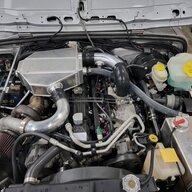
A stroker is almost always going to have a higher compression ratio and that itself will increase power. Most references say 3-4% more hp per unit of additional compression alone assuming the same displacement. The stock 4.0s are in the 8.7-8.8:1 range and most strokers are aiming for 9.3-9.5. These dynamics are why the power isn't just a 15% increase.
Compression ratio is interesting.
What we really care about in engines (at least in regards to efficiency) is the expansion ratio. It just so happens that naturally aspirated gasoline piston engines have the same compression ratio as they do expansion ratio.
Expansion ratio first became important in early steam engines, most notably locomotives. The higher the expansion ratio, the more efficiently power could be extracted from a given mass of steam. However, high expansion ratios required a lot of space, so they came up with compromises to account for it.
The biggest development was using a high pressure cylinder and a low pressure cylinder (or in many cases, opposite sides of a single piston). High pressure steam would be fed into one cylinder and expanded, and then vented into the low pressure cylinder and expanded again. This allowed them to get high extraction ratios and therefore high efficiency, at the cost of power density. The solution for that was to also have an alternate valving which allowed both cylinders to be fed with high pressure steam during times of very high demand (starting, climbing hills, etc.) and simply dumping the medium-low pressure steam straight to the atmosphere instead of expanding it. In that case, they sacrificed expansion ratio (and therefore sacrificing efficiency) to get maximum power. Sort of like running a supercharged engine in boost, except they gave up expansion ratio rather than adding compression to get that power boost.
Forced induction internal combustion engines are another beast, and an easy way to think about them is that they have variable compression and/or expansion ratios.
A supercharged engine is effectively an engine with a compression ratio that can be extended on demand. However, it still has a fixed expansion ratio. Due to that, supercharged engines cannot be any more efficient, and are usually less efficient than their naturally aspirated counterparts. When running in boost, there is a significant amount of medium pressure gas being dumped to atmosphere every time the exhaust valves open. This is a major source of waste.
A turbocharged engine, however, effectively has both variable compression and expansion ratios. A turbocharger turbine acts as an extension of the engine, allowing that medium pressure gas exiting the cylinders to be expanded further in a way that harvests a lot of that energy. Hence we effectively increase the expansion ratio of the engine along with the compression ratio whenever we run boost. (The fact that we use that energy to compress incoming gas is just a matter of convenience. You could just as easily generate electricity or do something else useful from it.)
With a turbocharger as well, taking into account thermodynamics, it is generally possible to develop much higher boost PSI than exhaust backpressure PSI simply because the volume of gas exiting the exhaust is far higher than the volume of gas being compressed. Using an oversimplified model, if we have 2x the volumetric flow of exhaust gas compared to supply gas, then with an ideal turbocharger, we could feed the engine with 20 psi of boost and cause only 10 psi of backpressure.
Last edited: