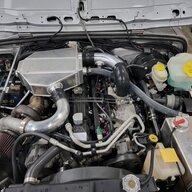
Dyno Testing Bolt-ons On The 4.0

A stroker is almost always going to have a higher compression ratio and that itself will increase power. Most references say 3-4% more hp per unit of additional compression alone assuming the same displacement. The stock 4.0s are in the 8.7-8.8:1 range and most strokers are aiming for 9.3-9.5. These dynamics are why the power isn't just a 15% increase.

Compression ratio is interesting.

What we really care about in engines (at least in regards to efficiency) is the expansion ratio. It just so happens that naturally aspirated gasoline piston engines have the same compression ratio as they do expansion ratio.

Expansion ratio first became important in early steam engines, most notably locomotives. The higher the expansion ratio, the more efficiently power could be extracted from a given mass of steam. However, high expansion ratios required a lot of space, so they came up with compromises to account for it.

The biggest development was using a high pressure cylinder and a low pressure cylinder (or in many cases, opposite sides of a single piston). High pressure steam would be fed into one cylinder and expanded, and then vented into the low pressure cylinder and expanded again. This allowed them to get high extraction ratios and therefore high efficiency, at the cost of power density. The solution for that was to also have an alternate valving which allowed both cylinders to be fed with high pressure steam during times of very high demand (starting, climbing hills, etc.) and simply dumping the medium-low pressure steam straight to the atmosphere instead of expanding it. In that case, they sacrificed expansion ratio (and therefore sacrificing efficiency) to get maximum power. Sort of like running a supercharged engine in boost, except they gave up expansion ratio rather than adding compression to get that power boost.

Forced induction internal combustion engines are another beast, and an easy way to think about them is that they have variable compression and/or expansion ratios.

A supercharged engine is effectively an engine with a compression ratio that can be extended on demand. However, it still has a fixed expansion ratio. Due to that, supercharged engines cannot be any more efficient, and are usually less efficient than their naturally aspirated counterparts. When running in boost, there is a significant amount of medium pressure gas being dumped to atmosphere every time the exhaust valves open. This is a major source of waste.

A turbocharged engine, however, effectively has both variable compression and expansion ratios. A turbocharger turbine acts as an extension of the engine, allowing that medium pressure gas exiting the cylinders to be expanded further in a way that harvests a lot of that energy. Hence we effectively increase the expansion ratio of the engine along with the compression ratio whenever we run boost. (The fact that we use that energy to compress incoming gas is just a matter of convenience. You could just as easily generate electricity or do something else useful from it.)

With a turbocharger as well, taking into account thermodynamics, it is generally possible to develop much higher boost PSI than exhaust backpressure PSI simply because the volume of gas exiting the exhaust is far higher than the volume of gas being compressed. Using an oversimplified model, if we have 2x the volumetric flow of exhaust gas compared to supply gas, then with an ideal turbocharger, we could feed the engine with 20 psi of boost and cause only 10 psi of backpressure.
 
Last edited:
Compression ratio is interesting.

What we really care about in engines (at least in regards to efficiency) is the expansion ratio. It just so happens that naturally aspirated gasoline piston engines have the same compression ratio as they do expansion ratio.

Expansion ratio first came important in early steam engines, most importantly locomotives. The higher the expansion ratio, the more efficiently power could be extracted from a given mass of steam. However, expansion ratio required a lot of space, so they came up with compromises to account for it.

The biggest development was using a high pressure cylinder and a low pressure cylinder (or in many cases, opposite sides of a single piston). High pressure steam would be fed into one cylinder and expanded, and then vented into the low pressure cylinder and expanded again. This allowed them to get high extraction ratios and therefore high efficiency, at the cost of power density. The solution for that was to also have an alternate valving which allowed both cylinders to be fed with high pressure steam during times of very high demand (starting, climbing hills, etc.) and simply dumping the medium-low pressure steam straight to the atmosphere instead of expanding it. In that case, they sacrificed expansion ratio (and therefore sacrificing efficiency) to get maximum power. Sort of like running a supercharged engine in boost, except they gave up expansion ratio rather than adding compression to get that power boost.

Forced induction internal combustion engines are another beast, and an easy way to think about them is that they have variable compression and/or expansion ratios.

A supercharged engine is effectively an engine with a compression ratio that can be extended on demand. However, it still has a fixed expansion ratio. Due to that, supercharged engines cannot be any more efficient, and are usually less efficient than their naturally aspirated counterparts. When running in boost, there is a significant amount of medium pressure gas being dumped to atmosphere every time the exhaust valves open. This is a major source of waste.

A turbocharged engine, however, effectively has both variable compression and expansion ratios. A turbocharger turbine acts as an extension of the engine, allowing that medium pressure gas exiting the cylinders to be expanded further in a way that harvests a lot of that energy. Hence we effectively increase the expansion ratio of the engine along with the compression ratio whenever we run boost. (The fact that we use that energy to compress incoming gas is just a matter of convenience. You could just as easily generate electricity or do something else useful from it.)

With a turbocharger as well, taking into account thermodynamics, it is generally possible to develop much higher boost PSI than exhaust backpressure PSI simply because the volume of gas exiting the exhaust is far higher than the volume of gas being compressed. Using an oversimplified model, if we have 2x the volumetric flow of exhaust gas compared to supply gas, then with an ideal turbocharger, we could feed the engine with 20 psi of boost and cause only 10 psi of backpressure.

Man, look what you have started @Jezza :ROFLMAO:

Seriously, this thread has been really interesting.
 
Russ Pottenger of Bishop Buehl race engines is the name in Jeep stroker engines.

https://www.facebook.com/people/Bishop-Buehl-Racing-Engines/100070084191404/

https://www.jeepstrokers.com/forum/viewtopic.php?t=4823

 
Compression ratio is interesting.

What we really care about in engines (at least in regards to efficiency) is the expansion ratio. It just so happens that naturally aspirated gasoline piston engines have the same compression ratio as they do expansion ratio.

Expansion ratio first became important in early steam engines, most notably locomotives. The higher the expansion ratio, the more efficiently power could be extracted from a given mass of steam. However, high expansion ratios required a lot of space, so they came up with compromises to account for it.

The biggest development was using a high pressure cylinder and a low pressure cylinder (or in many cases, opposite sides of a single piston). High pressure steam would be fed into one cylinder and expanded, and then vented into the low pressure cylinder and expanded again. This allowed them to get high extraction ratios and therefore high efficiency, at the cost of power density. The solution for that was to also have an alternate valving which allowed both cylinders to be fed with high pressure steam during times of very high demand (starting, climbing hills, etc.) and simply dumping the medium-low pressure steam straight to the atmosphere instead of expanding it. In that case, they sacrificed expansion ratio (and therefore sacrificing efficiency) to get maximum power. Sort of like running a supercharged engine in boost, except they gave up expansion ratio rather than adding compression to get that power boost.

Forced induction internal combustion engines are another beast, and an easy way to think about them is that they have variable compression and/or expansion ratios.

A supercharged engine is effectively an engine with a compression ratio that can be extended on demand. However, it still has a fixed expansion ratio. Due to that, supercharged engines cannot be any more efficient, and are usually less efficient than their naturally aspirated counterparts. When running in boost, there is a significant amount of medium pressure gas being dumped to atmosphere every time the exhaust valves open. This is a major source of waste.

A turbocharged engine, however, effectively has both variable compression and expansion ratios. A turbocharger turbine acts as an extension of the engine, allowing that medium pressure gas exiting the cylinders to be expanded further in a way that harvests a lot of that energy. Hence we effectively increase the expansion ratio of the engine along with the compression ratio whenever we run boost. (The fact that we use that energy to compress incoming gas is just a matter of convenience. You could just as easily generate electricity or do something else useful from it.)

With a turbocharger as well, taking into account thermodynamics, it is generally possible to develop much higher boost PSI than exhaust backpressure PSI simply because the volume of gas exiting the exhaust is far higher than the volume of gas being compressed. Using an oversimplified model, if we have 2x the volumetric flow of exhaust gas compared to supply gas, then with an ideal turbocharger, we could feed the engine with 20 psi of boost and cause only 10 psi of backpressure.

Speaking of boost and steam, I wonder what affect water/meth injection has. And if it is robbing btu's with the state change in cylinder
 
Speaking of boost and steam, I wonder what affect water/meth injection has. And if it is robbing btu's with the state change in cylinder

It actually has a dual effect. It is "robbing BTUs" but at the same time, since it flashes to steam, that massive expansion helps to push the cylinder itself just like a steam engine. Alcohol (and gasoline) have exactly that effect as well, except that they also ignite, further propelling the cylinder.

Methanol is very close in composition to ethanol, which I'm sure we're all familiar with in fuel, especially E10. It does decrease power slightly since it doesn't quite have the same BTU content as gasoline, but nowhere near as much as if you cut fuel and air by 10%.

Even if you dilute your gas 10% with water, odds are you are not going to get a 10% efficiency (relative to the mass of gas/water mixture flowing in) reduction because of the steam engine effect of water. That said, we don't do that because at low power, water injection can mess with flame propagation and therefore efficiency at low power (and especially emissions).

In my opinion, E10 is actually ideal for engines where it is possible to get small amounts of water in the fuel, especially boats. Since the E10 causes water to be miscible with the fuel in small amounts, it simply causes the water to be evenly mixed with fuel and get flashed to steam at a controlled rate in the engine. Meanwhile, with ethanol-free fuel, the water is immiscible, meaning it will instead get sucked into the engine as a slug of water, which will appear as a misfire. Multiple of these in a row will cause the engine to stall.
 
  • Like
Reactions: Rickyd and Woodrow
I've always wondered if it would be possible to make a hybrid gasoline steam engine for hyper efficiency.

Imagine a standard four-stroke engine. First, let's modify it so it's now a six stroke engine. Second, let's make everything out of tungsten, and delete the cooling system altogether. Third, let's add a set of direct injectors to the cylinder heads.

The first four strokes are the same as a normal engine (intake, compression, ignition+expansion, exhaust). Then on the 5th stroke, the direct injector injects water into the cylinder just before TDC. The water flashes to steam due to the very high cylinder temperatures and pushes the piston. (The 6th stroke is simply steam exhaust.)
 
The steam effect is also possibly one reason why gasoline direct injection engines are more efficient and powerful for their size than port injection engines. Since the fuel doesn't vaporize until after all of the air has been fed into the cylinder, it doesn't displace nearly as much air. So effectively, you can get a greater mass of air into the cylinder using direct injection instead of port injection.

Direct injection has other ways that make it more efficient that probably eclipse that effect though. One of the distinct advantages of it is that it can create very controlled gradients of fuel and air that allow some unique burn characteristics.

In a traditional port injection (or carbureted) engine, the goal is usually to get an even distribution of fuel and air throughout the entire cylinder. Generally speaking, the more even, the better. There simply isn't enough means to control it to go for gradients than are better than an even distribution. Most gradients found in port injection engines cylinders will reduce efficiency and increase emissions rather than the opposite.

Meanwhile, with direct injection, you have such fine control over the distribution of fuel that you can do fun things with it. This mostly started with diesel engines, but is making its way into gasoline engines as well. (The modern Ford F-150 3.3L and 5.0L NA engines and the 2.7L and 3.5L Ecoboost engines all use both direct and port injection, for example.)

One of the most efficient modes unique to direct injection is a quasi lean-burn mode. Instead of having an even mixture around the whole cylinder, you simply inject a small amount of fuel into the center of the cylinder. Locally, the mixture is rich in the center, but by the cylinder walls, there is just air. This means you can run the throttle fully open even at low loads, reducing or eliminating vacuum pumping losses at low load. It also means that since the flame is concentrated in the center of the cylinder with just an air jacket surrounding it, there is way less heat loss to the cylinder walls. Thus, more of that heat can be used to push the piston instead of of having to be removed by the cooling system. So you get a triple whammy of less vacuum pumping losses, more energy being delivered to the piston, and less cooling loads.
 
  • Like
Reactions: Rickyd and Woodrow
It actually has a dual effect. It is "robbing BTUs" but at the same time, since it flashes to steam, that massive expansion helps to push the cylinder itself just like a steam engine. Alcohol (and gasoline) have exactly that effect as well, except that they also ignite, further propelling the cylinder.

Methanol is very close in composition to ethanol, which I'm sure we're all familiar with in fuel, especially E10. It does decrease power slightly since it doesn't quite have the same BTU content as gasoline, but nowhere near as much as if you cut fuel and air by 10%.

Even if you dilute your gas 10% with water, odds are you are not going to get a 10% efficiency (relative to the mass of gas/water mixture flowing in) reduction because of the steam engine effect of water. That said, we don't do that because at low power, water injection can mess with flame propagation and therefore efficiency at low power (and especially emissions).

In my opinion, E10 is actually ideal for engines where it is possible to get small amounts of water in the fuel, especially boats. Since the E10 causes water to be miscible with the fuel in small amounts, it simply causes the water to be evenly mixed with fuel and get flashed to steam at a controlled rate in the engine. Meanwhile, with ethanol-free fuel, the water is immiscible, meaning it will instead get sucked into the engine as a slug of water, which will appear as a misfire. Multiple of these in a row will cause the engine to stall.

Of course in application , E10 continues to attract/absorb water until it is saturated and falls out of suspension . Then you get the slug of water stalling the engine , corroding the fuel system on a parked vehicle , and lowering performance and fuel economy from the ethanol/water dilution.
 
Of course in application , E10 continues to attract/absorb water until it is saturated and falls out of suspension . Then you get the slug of water stalling the engine , corroding the fuel system on a parked vehicle , and lowering performance and fuel economy from the ethanol/water dilution.

That is indeed true. For very long-term storage, E10 may not be ideal if the can or tank has a direct vent to atmosphere since it is hygroscopic and will pull water from the atmosphere.

For a well-sealed tank or for frequent use, E10 tends to be the better option. E10 tends to be way more tolerant to a given amount of water than E0 is. If you took 10 gallons of E0 and added a cup of water, you'd probably have issues. Meanwhile a cup of water in E10 probably wouldn't cause much of an issue.

I personally run E10 in my boat motor for its resistance to slight water contamination, but I also store my motor with the tank completely drained since I use it maybe once a year.
 
  • Like
Reactions: ColoJeep
Dare I say the best answer is electric? Two Netgain 120 motors with 1310 yokes on their splined output. Custom aluminum skid plate that mounts both motors approximating the current output shaft of the 231. Plenty of room in the engine bay and fuel tank area to 50/50 balance the Jeep with batteries...and hybrid minivan batteries are pretty easy to come by. Three years ago I did weight calculations and I figured I could get over 310 miles highway and still come in slightly less than the existing engine, transmission and gas tank.

-Mac
 
Dare I say the best answer is electric? Two Netgain 120 motors with 1310 yokes on their splined output. Custom aluminum skid plate that mounts both motors approximating the current output shaft of the 231. Plenty of room in the engine bay and fuel tank area to 50/50 balance the Jeep with batteries...and hybrid minivan batteries are pretty easy to come by. Three years ago I did weight calculations and I figured I could get over 310 miles highway and still come in slightly less than the existing engine, transmission and gas tank.

-Mac

That's a left turn off topic Mac. But if you are going to do that, why not eliminate the driveline and put a motor on each axle?
 
  • Like
Reactions: srimes
Dare I say the best answer is electric? Two Netgain 120 motors with 1310 yokes on their splined output. Custom aluminum skid plate that mounts both motors approximating the current output shaft of the 231. Plenty of room in the engine bay and fuel tank area to 50/50 balance the Jeep with batteries...and hybrid minivan batteries are pretty easy to come by. Three years ago I did weight calculations and I figured I could get over 310 miles highway and still come in slightly less than the existing engine, transmission and gas tank.

-Mac

Have you seen this?

 
Episode 3 is up, and we finally start to make some numbers...


Love that you have real numbers, not a lot but dollar for HP is cheap. Maybe a run without a filter and just a tube? with the hood up? and I also noticed that you have the old log manifold, maybe test the equal flow manifold from a 2000 on up?
 
  • Like
Reactions: Rickyd and Jezza
Episode 3 is up, and we finally start to make some numbers...


Great information. I appreciate the time you are taking on this effort. Nicely done!

It does seem to poke a hole in the "stock intake setup does not have a restriction" idea.
 
Last edited: