Novak Conversions Jeep Wrangler TJ engine mounts

Wrangler TJ EV Conversion

When my 4.0 eventually dies, I hope an electric motor swap is a viable option. The quiet is very appealing. And from what we are seeing, the possibility of the swap not interfering with the suspension is exciting.

Yes Sir, suspension are exactly as we find them - no touchy.

- Patrick
 
Assuming it has enough power to go uphill at highway speeds I’d think seriously about it!

Yes Sir, uphill fast also, zoom-zoom.

We have a couple handfuls of videos on YT.

Here's one:
.

Here's one going up a hill from a dead stop:
.

I should make more videos but, wires gotta' get hooked up on the next one....

- Patrick
 
Last edited:
For the nerd set, here's a basic layout of how the HV works and what's it's connected to:
1760860396555.png


Okay guys, I'm trusting you, don't tell anybody else about this, cool...?


- Patrick
 
For the nerd set, here's a basic layout of how the HV works and what's it's connected to:
View attachment 650129

Okay guys, I'm trusting you, don't tell anybody else about this, cool...?


- Patrick

Range is always the question. In this case though, my question is how long could this set up do rock crawling type trails on a single charge? If it could do the Rubicon with charge to spare, that would be interesting.
 
Range is always the question. In this case though, my question is how long could this set up do rock crawling type trails on a single charge? If it could do the Rubicon with charge to spare, that would be interesting.

Weight and dims per battery pack is also important to know. The configuration here is 4 front and 3 rear. How many more can be squeezed in for those willing to modify the body and at what weight penalty to extend the range?
 
Range is always the question. In this case though, my question is how long could this set up do rock crawling type trails on a single charge? If it could do the Rubicon with charge to spare, that would be interesting.

100% agree, but perhaps not for the same reasons. Range for me is, the ONLY thing that isn't as extraordinarily better in an all EV Jeep conversion.

Do I wish I could get the approximately 180 miles that a 18gal gas tank could ferry me (on a GOOD day, 13mpg x 18gal = 234 miles - wishful thinking...) - yes I do.

But, right now, I'm getting 2.4mi/kW and I have a 38.8 kW Pack (the Pack, as confusing as this might sound, is all the battery modules in the vehicle OR the individual battery module, which is made up of a bunch of individual cells or pouches - so confusing...sorry).

So, right now, we have a 38.8kW Pack x 2.4mi/kW = 93.12 mile range WITHOUT regen.

But, we have regen! (regen is when you take your foot off the throttle pedal and let the inertia of the vehicle reverse the motor and turn it into an instant alternator that charges back the Pack).

Regen returns about 18-20% of the power back to the Pack as you go about your day, stop and go. That puts back about 18.65miles for a range of around 110miles.

I should mention, highway is less, about 85mi/kW BECAUSE unlike and ICE vehicle that gets much better highway then 'City' is because the ICE vehicle, old or new, once it's on a highway, the temp is the same, the mix is the same, the cooling is constant (you know, mostly), etc. All that gives the vehicles the optimal chemistry to get better MPG, or at least optimal for vehicles that don't have the aerodynamics of a refrigerator knocked over on its face with 4 wheels.

But for EVs, all EVs, the open road of a highway means that the EV motor is doing it's one job, full out - taking stored energy and providing it to the motor to turn (work). Even with mine and most modern EV motors running at 98.8% efficiency (truly amazing beasts), it's doing a 100% conversion from stored energy to work (driving) and that drains the Pack, efficiently but ruthlessly.

ALL that being said, AND ONLY in the world of Jeep does this dynamic fully benefit the Jeep owner.

The killer, magic ICE off-road vs EV off-road destroyer is: idling.

Off-road, you lose so much to impossibly inefficient motor cooling and just sitting around, running, sipping or gulping gas.

Now, with an EV, there is NO IDELING, ever. And, EVs don't get hot, especially when not running fast. Are you getting it yet, did the bulb light up yet? Took me a LONG while to figure this out, I promise.

If there was a single breed of vehicle that was designed for EV in all it's glory, it would be a Jeep.

Imagine, sitting on a trail, hot day, full A/C, cooler, radio, charging phones or drone batteries, whatever and using less then 2kW of power with almost NO heat. You can drive without your shoes to protect your feet from catching fire from the floorboard. The EV A/C is only using 1.3kW of power to keep you cool while sitting there or going up a hill.

No idling in an EV Jeep. You lose around 5% of your fuel to sitting around. More with the A/C working it's little pistons to death, which, of course, adds more heat and causes more blah blah blah to the whole blah blah blah internal combustion blah blah blah. You get it...

AND, I haven't even started going on and on about torque. You get 100% of your motors torque at 1RPM. For my builds, that's ~173ft/lbs of torque on demand, no ramping up, you just get it every second.

Does that explain what I mean by range is important but for a Jeep, it's clearly not the guiding factor of life. Everything that makes an ICE Jeep inefficient off-road is gone in and EV Jeep. Trust me, the irony of it all is not lost on me either.

Do a quick mental calculation - what do you think your actual MPG off-road is? And, what do you think an average weekend of driving off-road distance is - under 50 miles, by a lot, at least for me.

Also, a E-Jerry Can looks almost exactly like a small Honda or HF generator. 1 gal of gas in your little generator, back at the camp site, will give you about 20 miles of charge while you're sitting there, enjoying your adult beverage, chatting about the day on the trail.

So much to talk about, apology for the rambling on and on.

- Patrick

 
Weight and dims per battery pack is also important to know. The configuration here is 4 front and 3 rear. How many more can be squeezed in for those willing to modify the body and at what weight penalty to extend the range?

Okay, look, I'm not going to answer any more complicated smart questions - it takes way to much time!

GREAT question!

So, we are building everything with Tesla Model S modules. Here's a show of a stack of them, half prepped to go into a Jeep, the rest waiting to get labeled, checked for charge state, tap board added, stuff:
1760899033098.png


Each module had 444 18600 Panasonic 3v battery cells in it. They look like tall D batteries, slimmer.

They are arranged in 74P6S - that means, without going into to much detail, Tesla groups 74-3v-individual cells together to form a Cell.

Quick lesson: When you put 1.5v AA batteries into a flashlight, one after the other, POS end touching the NEG end, in a row, that's called Series and it feeds the flashlight bulb with 3volts (but the same amps as a single AA battery)

If you take two 12v car batteries and you hook them up, POS to POS and NEG to NEG, that's called Parallel, and in this example, you'd get 12v total but with about double the amps.

Series = adding Volts
Parallel = adding Amps

So, in the case of the Tesla Model S modules, you get about 24volt with around 5.3amps per module. String one 74P6S (74 in Parallel, 6 in Series) together, you get 14S1P (14 battery modules in Series, in a 1 Parallel form - yes, you could leave out the '1P' but it looks funny so you leave it in.) That gives the Tesla about 338 volts with around 75kWh total Pack. Tesla's get 2.5 to 5 miles per kW so a good range.

OH, I should mention, kW measures power i.e. the rate at which something uses electricity, whereas a kWh (kilo-Watt-hour) measures energy, the total amount of electricity used, or the capacity to use - so the total number is the equivalent of the size of the gas tank - kinda'. The larger the kWh, the longer the range (mostly) BUT, it also means more area and weight.

People get kW and kWh wrong or backwards ALL THE TIME.

EVs are broken down to these basic battery sizes:
- Diesel Electric locomotives - between 600 V and 1,500v DC for traction motors (added for reference)
- Big Boy - 800v - Cadillac 1000e4, Porsche Taycan, Lucid Air (uses a system over 900 volts!!)
- Modern 'normal' EVs, Tesla, Bolt, etc. - 400v.
- 'Low Voltage', conversions, diy stuff - under 200v (mine are all 144v nominal - half a Tesla full Pack)
- Lower Voltage - mostly in the under 100v range. Golf cart-ish stuff, tons and tons of e-bikes, Austin Mini's, etc.

Back to our story - Yes, JJVW, you could add more Tesla modules BUT, you can't just add 1 here or 2 there. The motor dictates how much you can deliver to it (all electric motors, large and small are the same, it's based on how they our wound). In the case of the Dana Motor (Hyper9HV), it can take ~120v to ~180v - 144 nominal).

So, if you want to have a longer range, you would have to double the back to a full 14 Tesla Modules (55lbs each) and build your system as a 2S14P String (String topography a level of technical difficulty above where our builds are right now, tricky stuff).

So, double the weight which makes the motors have to work harder so you don't get double the range. At best, you'd get about 75 extra miles range, at best AND, you'd have to sacrifice most of your back tub area.

Batteries and battery technology is on a crazy fast track forward these days. ALL our builds make changing or eventually upgrading your Pack easy if a newer form comes out, and they will.

So many words, when will it end....

- Patrick
 
100% agree, but perhaps not for the same reasons. Range for me is, the ONLY thing that isn't as extraordinarily better in an all EV Jeep conversion.

Do I wish I could get the approximately 180 miles that a 18gal gas tank could ferry me (on a GOOD day, 13mpg x 18gal = 234 miles - wishful thinking...) - yes I do.

But, right now, I'm getting 2.4mi/kW and I have a 38.8 kW Pack (the Pack, as confusing as this might sound, is all the battery modules in the vehicle OR the individual battery module, which is made up of a bunch of individual cells or pouches - so confusing...sorry).

So, right now, we have a 38.8kW Pack x 2.4mi/kW = 93.12 mile range WITHOUT regen.

But, we have regen! (regen is when you take your foot off the throttle pedal and let the inertia of the vehicle reverse the motor and turn it into an instant alternator that charges back the Pack).

Regen returns about 18-20% of the power back to the Pack as you go about your day, stop and go. That puts back about 18.65miles for a range of around 110miles.

I should mention, highway is less, about 85mi/kW BECAUSE unlike and ICE vehicle that gets much better highway then 'City' is because the ICE vehicle, old or new, once it's on a highway, the temp is the same, the mix is the same, the cooling is constant (you know, mostly), etc. All that gives the vehicles the optimal chemistry to get better MPG, or at least optimal for vehicles that don't have the aerodynamics of a refrigerator knocked over on its face with 4 wheels.

But for EVs, all EVs, the open road of a highway means that the EV motor is doing it's one job, full out - taking stored energy and providing it to the motor to turn (work). Even with mine and most modern EV motors running at 98.8% efficiency (truly amazing beasts), it's doing a 100% conversion from stored energy to work (driving) and that drains the Pack, efficiently but ruthlessly.

ALL that being said, AND ONLY in the world of Jeep does this dynamic fully benefit the Jeep owner.

The killer, magic ICE off-road vs EV off-road destroyer is: idling.

Off-road, you lose so much to impossibly inefficient motor cooling and just sitting around, running, sipping or gulping gas.

Now, with an EV, there is NO IDELING, ever. And, EVs don't get hot, especially when not running fast. Are you getting it yet, did the bulb light up yet? Took me a LONG while to figure this out, I promise.

If there was a single breed of vehicle that was designed for EV in all it's glory, it would be a Jeep.

Imagine, sitting on a trail, hot day, full A/C, cooler, radio, charging phones or drone batteries, whatever and using less then 2kW of power with almost NO heat. You can drive without your shoes to protect your feet from catching fire from the floorboard. The EV A/C is only using 1.3kW of power to keep you cool while sitting there or going up a hill.

No idling in an EV Jeep. You lose around 5% of your fuel to sitting around. More with the A/C working it's little pistons to death, which, of course, adds more heat and causes more blah blah blah to the whole blah blah blah internal combustion blah blah blah. You get it...

AND, I haven't even started going on and on about torque. You get 100% of your motors torque at 1RPM. For my builds, that's ~173ft/lbs of torque on demand, no ramping up, you just get it every second.

Does that explain what I mean by range is important but for a Jeep, it's clearly not the guiding factor of life. Everything that makes an ICE Jeep inefficient off-road is gone in and EV Jeep. Trust me, the irony of it all is not lost on me either.

Do a quick mental calculation - what do you think your actual MPG off-road is? And, what do you think an average weekend of driving off-road distance is - under 50 miles, by a lot, at least for me.

Also, a E-Jerry Can looks almost exactly like a small Honda or HF generator. 1 gal of gas in your little generator, back at the camp site, will give you about 20 miles of charge while you're sitting there, enjoying your adult beverage, chatting about the day on the trail.

So much to talk about, apology for the rambling on and on.

- Patrick

The potential benefits of an EV TJ are not lost on me. I’ve pondered the pros and cons in the last few years. I asked about the Rubicon in particular because it’s normally at least 1 overnight and probably 9-12 twelve hours of trail time (at least the couple of times I’ve done it). You’re right about trail MPG being abysmal. My stroker uses 7-9 gallons to do the 22 mile trip. But another way of looking at it is I’ve got over 1/2 a tank left after 2 days of wheeling.

You may have heard about the Cybertruck (over 300 miles of range, I believe) that tried to Run the Rubicon last August (https://www.thedrive.com/news/stuck...UuXpsoC31S8txInNyQ_aem_lb8MMvgwJLf92QMBumzUnA). They started with only 85% charge but were down to 5% by Rubicon Springs, less than 10 miles in. It wasn’t just a battery problem though. They suffered the mechanical issues you might expect any lightly modified street vehicle to have, ICE or EV.

Back to the TJ. I have another question: These rigs have huge drive train losses. Mine is dyno proven to be around 30%. I’m not talking about the inefficiency of an ICE power plant with all of its heat losses, I just mean crankshaft to wheel horsepower. If I understand correctly you have your electric motor in front of the transmission so you are also subject to the same drivetrain losses. Could you not just put one motor between the front and rear driveshafts or even one for each? Since the torque is available across the RPM range of the electric motor, do you need gears? Maybe there is enough friction loss in the axles that deleting the transmission and transfer case wouldn’t help that much? Just spit balling.
 
The potential benefits of an EV TJ are not lost on me. I’ve pondered the pros and cons in the last few years. I asked about the Rubicon in particular because it’s normally at least 1 overnight and probably 9-12 twelve hours of trail time (at least the couple of times I’ve done it). You’re right about trail MPG being abysmal. My stroker uses 7-9 gallons to do the 22 mile trip. But another way of looking at it is I’ve got over 1/2 a tank left after 2 days of wheeling.

You may have heard about the Cybertruck (over 300 miles of range, I believe) that tried to Run the Rubicon last August (https://www.thedrive.com/news/stuck...UuXpsoC31S8txInNyQ_aem_lb8MMvgwJLf92QMBumzUnA). They started with only 85% charge but were down to 5% by Rubicon Springs, less than 10 miles in. It wasn’t just a battery problem though. They suffered the mechanical issues you might expect any lightly modified street vehicle to have, ICE or EV.

Back to the TJ. I have another question: These rigs have huge drive train losses. Mine is dyno proven to be around 30%. I’m not talking about the inefficiency of an ICE power plant with all of its heat losses, I just mean crankshaft to wheel horsepower. If I understand correctly you have your electric motor in front of the transmission so you are also subject to the same drivetrain losses. Could you not just put one motor between the front and rear driveshafts or even one for each? Since the torque is available across the RPM range of the electric motor, do you need gears? Maybe there is enough friction loss in the axles that deleting the transmission and transfer case wouldn’t help that much? Just spit balling.

So much to answer and to ask in this one...

Using your outline of 1 overnight and around 9-12 hours of actual drive time - 22 miles-ish, if that's the outline, I think you might be completely in great shape with a converted EV Jeep.

I assume the trip you're talking about would fall in the moderate to experienced trail, yes, I think you could do the whole thing on a full charge. PLEASE, fill me in on any other details about what you're thinking so I can get on the same page of what kind of trail and overnight electric needs you are used to.

No, I missed that one about the Cybertruck (<first time I've ever typed it...). I'm not going to look it up, I trust you.

If you have a link to that trail with a 'normal' Jeep, send it, I'd love to see it.

Back to the TJ: This one really is a hard, big, very big question. I'll be brief and you guys can pick it apart and I'll go into detail then.

First thing, if you use a Tesla rear motor that's turned sideways, therefore becoming both your transmission and full time transfer case, I doesn't work, it's a failed idea in about 100 ways. First and foremost, it's not 4-wheel drive, it's AWD (All Wheel Drive) - very very different creatures. Next on the list is the loss of about 11" clearance. Then theirs the problem of lack of prop-shaft articulation due to the nature of the donner Tesla motor. Oh, and you have to find someone that will make a limited slip that works and doesn't fail under normal driving operation. Not mention all the speciality mounting and additional weight that you have to have because you have to use a full 400 volts so now you need to completely rethink your suspension......

The other way, equally stupid, is to use the full Tesla front and rear dive units as replacements for the front and rear diff. The list of problems with this starts with the complete and inescapable reality you no longer have independent suspension and are now fully tied to a very fixed axle travel.

Then there's your idea of a Powered Diff - Dana makes a couple flavors. First, Dana won't sell those to anyone that doesn't want a million of them. Second, a live diff. is 100% vulnerable to all that hit it. Remember, each live diff has HV power (3 seperate 2/0 cables in motion), an inverter, some form of cooling. And the clearance is horrible. And you're back to 400v.

So, after figuring all that out, I figured out that there is no way to change the drive train, just the way you power it.

Yes, it does offer a ton of opportunities like a clutchless manual transmission, full regen, single pedal mode. Your point about the 30% loss of efficiency is 100% correct. It's a trade off - you can swap out a motor but still not have any improvement to the frictional and angular (diffs alone) loss of efficiency. We can't fix that or the aerodynamics, it's still going to be a Jeep, just repowered.

Lastly' Do you need gears?' - Short answer: Hell's YES! That's another problem with a Tesla motor swaps, you have only one speed, there is NO rock crawling. When I drive, I only ever use 2nd and 3rd gear. I don't have to use 2nd at all, I can start in 3rd just fine but not very fast off the line. I like to get it moving so I start in 2nd and shift around 3600-4000 RPM. The other thing is, you can down shift, works great but you don't really use it for that, it's a bit complicated and related to the differences between EV driving and ICE driving. The 'compression' braking that you get with EV regen slows you down so much so, you hardly ever use your brakes.

BUT, if you go off road, if you shift to 4-wheel drive, you have a ton more torque in 1st gear. AND, if you shift your transfer case to Lo-Lo, well, it's an obscene amount of torque to the rubber.

Spitball away, such good questions.

- Patrick
 
The potential benefits of an EV TJ are not lost on me. I’ve pondered the pros and cons in the last few years. I asked about the Rubicon in particular because it’s normally at least 1 overnight and probably 9-12 twelve hours of trail time (at least the couple of times I’ve done it). You’re right about trail MPG being abysmal. My stroker uses 7-9 gallons to do the 22 mile trip. But another way of looking at it is I’ve got over 1/2 a tank left after 2 days of wheeling.

You may have heard about the Cybertruck (over 300 miles of range, I believe) that tried to Run the Rubicon last August (https://www.thedrive.com/news/stuck...UuXpsoC31S8txInNyQ_aem_lb8MMvgwJLf92QMBumzUnA). They started with only 85% charge but were down to 5% by Rubicon Springs, less than 10 miles in. It wasn’t just a battery problem though. They suffered the mechanical issues you might expect any lightly modified street vehicle to have, ICE or EV.

Back to the TJ. I have another question: These rigs have huge drive train losses. Mine is dyno proven to be around 30%. I’m not talking about the inefficiency of an ICE power plant with all of its heat losses, I just mean crankshaft to wheel horsepower. If I understand correctly you have your electric motor in front of the transmission so you are also subject to the same drivetrain losses. Could you not just put one motor between the front and rear driveshafts or even one for each? Since the torque is available across the RPM range of the electric motor, do you need gears? Maybe there is enough friction loss in the axles that deleting the transmission and transfer case wouldn’t help that much? Just spit balling.

...I completely forgot to mention COST as a factor.

For reasons I don't fully understand, the older Ford Broncos are selling at prices that resemble crown jewels. There are no less than 5 separate, high-end Bronco restomod companies out there. I think the leader, if you can call it that, is ICON, they make amazing quality 'restored' Brandos. They start there ICE versions around $300,000 and their newly offered EV Brando was just announced and will tip in just under $500,000!!!!

A Tesla Model S drive unit starts around $2k and goes up quick - JUST FOR the unit, before you do anything to it, or have ANY (any, any, any) component that will make it spin.

And they are the cheapest. Once you step up to a new Cascadia motor, you're in the deep water - the Cascadia Motion iM-225DX-D starts around $20k BEFORE you buy ANY of the other parts to make it work, you know, like batteries.

And on to batteries - I use Tesla Model S modules, they are an incredibly engineered product but because of a bunch of reasons, they are dropping in price. We started out about 5 years ago, they were around $1,500 per modules - I need 7 so that would be $10,500. Now, they are under $600 each!!!

If you wander over to EV West, an EV store that was at the beginning of the movement, do a search on batteries. The prices will shock you. (I know, a punner should be put to the stake, I get it and kinda' agree...).

I don't know what it is about Jeep owners, myself included, for some reason, we are selectively cheap. Jeep owner out spend every other off-road category other then trucks for their aftermarket spending but we are still cheap.

So, that means for me, a businessman, I have to lean into the leanest, most customer friendly and serviceable and inexpensive conversion to EV as humanly possible. A typical Bronco EV conversion will start around $180,000 if you get someone to do it and will take about 18 months. We start around $28k (for a simple CJ-7 conversions) and shoot for a turn around of under 2 months.

Anyway, cost is a driving force for use and for Jeep EV conversions.

- Patrick
 
...I completely forgot to mention COST as a factor.

For reasons I don't fully understand, the older Ford Broncos are selling at prices that resemble crown jewels. There are no less than 5 separate, high-end Bronco restomod companies out there. I think the leader, if you can call it that, is ICON, they make amazing quality 'restored' Brandos. They start there ICE versions around $300,000 and their newly offered EV Brando was just announced and will tip in just under $500,000!!!!

A Tesla Model S drive unit starts around $2k and goes up quick - JUST FOR the unit, before you do anything to it, or have ANY (any, any, any) component that will make it spin.

And they are the cheapest. Once you step up to a new Cascadia motor, you're in the deep water - the Cascadia Motion iM-225DX-D starts around $20k BEFORE you buy ANY of the other parts to make it work, you know, like batteries.

And on to batteries - I use Tesla Model S modules, they are an incredibly engineered product but because of a bunch of reasons, they are dropping in price. We started out about 5 years ago, they were around $1,500 per modules - I need 7 so that would be $10,500. Now, they are under $600 each!!!

If you wander over to EV West, an EV store that was at the beginning of the movement, do a search on batteries. The prices will shock you. (I know, a punner should be put to the stake, I get it and kinda' agree...).

I don't know what it is about Jeep owners, myself included, for some reason, we are selectively cheap. Jeep owner out spend every other off-road category other then trucks for their aftermarket spending but we are still cheap.

So, that means for me, a businessman, I have to lean into the leanest, most customer friendly and serviceable and inexpensive conversion to EV as humanly possible. A typical Bronco EV conversion will start around $180,000 if you get someone to do it and will take about 18 months. We start around $28k (for a simple CJ-7 conversions) and shoot for a turn around of under 2 months.

Anyway, cost is a driving force for use and for Jeep EV conversions.

- Patrick

Appreciate the good responses Patrick. And you are right, I think. Nobody here wants to spend north of $100k on an EV conversion for their TJ. As far as $300-500k first gen Broncos go, that is emblematic of a far more important societal problem here in the good ‘ole USA that is beyond this discussion.
 
The potential benefits of an EV TJ are not lost on me. I’ve pondered the pros and cons in the last few years. I asked about the Rubicon in particular because it’s normally at least 1 overnight and probably 9-12 twelve hours of trail time (at least the couple of times I’ve done it). You’re right about trail MPG being abysmal. My stroker uses 7-9 gallons to do the 22 mile trip. But another way of looking at it is I’ve got over 1/2 a tank left after 2 days of wheeling.

You may have heard about the Cybertruck (over 300 miles of range, I believe) that tried to Run the Rubicon last August (https://www.thedrive.com/news/stuck...UuXpsoC31S8txInNyQ_aem_lb8MMvgwJLf92QMBumzUnA). They started with only 85% charge but were down to 5% by Rubicon Springs, less than 10 miles in. It wasn’t just a battery problem though. They suffered the mechanical issues you might expect any lightly modified street vehicle to have, ICE or EV.

Back to the TJ. I have another question: These rigs have huge drive train losses. Mine is dyno proven to be around 30%. I’m not talking about the inefficiency of an ICE power plant with all of its heat losses, I just mean crankshaft to wheel horsepower. If I understand correctly you have your electric motor in front of the transmission so you are also subject to the same drivetrain losses. Could you not just put one motor between the front and rear driveshafts or even one for each? Since the torque is available across the RPM range of the electric motor, do you need gears? Maybe there is enough friction loss in the axles that deleting the transmission and transfer case wouldn’t help that much? Just spit balling.

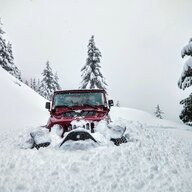
An EV TJ would be great for my daily commute, and for much of my local wheeling, But I'd be worried about range if I had to travel even a little bit. And I'd be very worried about snow wheeling. Electric range on my chevy volt drops a bit when it gets cold, and plowing through deep snow takes a LOT of energy. Low single-digit MPG is normal when breaking trail. My average mpg in the depths of winter is half of what it is in summer.

1760986076825.png


I don't see doing longer, serious trails without having some way to charge. I like what Patrick is doing with the drivetrain, but I'd want a small gas engine connected to the electric motor, too. Even 10 hp would be enough to maintain trail speeds, and it would charge the battery while idling.
 
An EV TJ would be great for my daily commute, and for much of my local wheeling, But I'd be worried about range if I had to travel even a little bit. And I'd be very worried about snow wheeling. Electric range on my chevy volt drops a bit when it gets cold, and plowing through deep snow takes a LOT of energy. Low single-digit MPG is normal when breaking trail. My average mpg in the depths of winter is half of what it is in summer.

View attachment 650409


I don't see doing longer, serious trails without having some way to charge. I like what Patrick is doing with the drivetrain, but I'd want a small gas engine connected to the electric motor, too. Even 10 hp would be enough to maintain trail speeds, and it would charge the battery while idling.

Realistically, there's a reason you are seeing near full size ICEs used in REVs like the Ramcharger. A 10 HP generator might get you something like 5kw/hr charging capacity, which would be gaining you 25 miles per hour it runs using Patrick's impressive efficiency. The Ramcharger is supposed to be using a 130 Kw/Hr generator with a 3.6L Pentastar (that put out something like 270 hp in the JK/JL).

With the used value of the JLU 4xe getting clobbered, it'd be difficult to justify investing the money to build a TJ REV when you could compromise on the all electric range side and pick up a PHEV 4xe in the mid-$20ks with relatively low miles.

EDIT: Corrected inverted hard math.
 
Last edited:
  • Like
Reactions: Woodrow
An EV TJ would be great for my daily commute, and for much of my local wheeling, But I'd be worried about range if I had to travel even a little bit. And I'd be very worried about snow wheeling. Electric range on my chevy volt drops a bit when it gets cold, and plowing through deep snow takes a LOT of energy. Low single-digit MPG is normal when breaking trail. My average mpg in the depths of winter is half of what it is in summer.

View attachment 650409


I don't see doing longer, serious trails without having some way to charge. I like what Patrick is doing with the drivetrain, but I'd want a small gas engine connected to the electric motor, too. Even 10 hp would be enough to maintain trail speeds, and it would charge the battery while idling.

Yep, I get that, how about this:
1760991477764.png


That and a gallon of gas plus 45 min and you get 20 more miles (about).

I'm calling these the E-Jerry Cans.

I'll be you already have one, or something similar.

- Patrick
 
  • Like
Reactions: Rickyd and Woodrow
Realistically, there's a reason you are seeing near full size ICEs used in REVs like the Ramcharger. A 10 HP generator might get you something like 5kw/hr charging capacity, which would be gaining you two miles per hour it runs using Patrick's impressive efficiency. The Ramcharger is supposed to be using a 130 Kw/Hr generator with a 3.6L Pentastar (that put out something like 270 hp in the JK/JL).

With the used value of the JLU 4xe getting clobbered, it'd be difficult to justify investing the money to build a TJ REV when you could compromise on the all electric range side and pick up a PHEV 4xe in the mid-$20ks with relatively low miles.

I don't disagree if the 4xe's were well designed but, they aren't, hence, 'clobbered' price. It's a horrible design, you know, typical Jeep intern-engineering kwrap.

First of all, what the hell does 'REV' stand for?!? I've been confused about this marketing messaging since it was announced. I think it 'means' - Range-Extended Vehicle even though Dodge says it means: 'Range-Extended Truck' < did I miss a letter in the acronym somewhere...? Whatever, not my marketing department.

Whatever, it's dead, Dodge killed it a couple weeks ago, and isn't really a Jeep thing anyway. Long distance drives in the Jeep are for the young, with their pre-destroyed backs.

It's all about options. Pick this, pick that. It's a hell-of a thing.

- Patrick
 
  • Like
Reactions: speeding_infraction
Yep, I get that, how about this:
View attachment 650415

That and a gallon of gas plus 45 min and you get 20 more miles (about).

I'm calling these the E-Jerry Cans.

I'll be you already have one, or something similar.

- Patrick

If I recall correctly from the story of the cybertruck on the Rubicon...it made it to the springs...and they generator they brought and the rather sizable (both kw unknown) generator at the springs were insufficient to charge the cybertruck...I suppose with sufficient time it would have done something.

IMG_20251020_142853.jpg


-Mac
 
I don't disagree if the 4xe's were well designed but, they aren't, hence, 'clobbered' price. It's a horrible design, you know, typical Jeep intern-engineering kwrap.

First of all, what the hell does 'REV' stand for?!? I've been confused about this marketing messaging since it was announced. I think it 'means' - Range-Extended Vehicle even though Dodge says it means: 'Range-Extended Truck' < did I miss a letter in the acronym somewhere...? Whatever, not my marketing department.

Whatever, it's dead, Dodge killed it a couple weeks ago, and isn't really a Jeep thing anyway. Long distance drives in the Jeep are for the young, with their pre-destroyed backs.

It's all about options. Pick this, pick that. It's a hell-of a thing.

- Patrick
Ahh, I think the clobbered 4xe secondary market price is more due to perceived reliability than a specific flaw in design, not unlike many other BEV and PHEVs that have been on the market in the last decade.

A good chunk of the market assumed that the 4xe would be the Prius of Jeeps, although I don't think it was actually marketed that way. Unfortunately, since I own one, I got to experience all the bitching on the forums about it. There are owners who used it as a BEV for all intents and purposes, so much so that they whined on the forums about having them go into Fuel and Oil Refresh Mode when the Jeep decided that they were risking the gas and oil going bad from sitting so long.

Not unlike a 392, the 4xe is a party trick. It's a 375 hp / 470 ftlb beast that's heavier than it's ICE counterpart, and it can drive about 20 miles silently without firing up the ICE.

Unlike the 392 the additional power came at no increase in cost when you factor in the now defunct $7,500 tax credit, and if leased actually made the rent cost less than a standard ICE wrangler.

Regardless, I'm in for all the options possible, because a Jeep can have a different meaning to each of us.
 
  • Like
Reactions: srimes and 4x4 EVC
Novak Conversions Jeep Wrangler TJ engine mounts