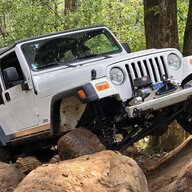
Novak Conversions Jeep Wrangler TJ radiator

It just happened!

When checking measurements for the driveshafts, I discovered that the newly installed 241 case has a 1310 yoke on the front instead of the stock 1330. Normally, I'd be mad about this, but it just so happens I've got a fairly new driveshaft that fits the needed measurement. It's setup with a 1330 joint at the axle and 1310 at the transfer case, which is exactly what's needed. It does make me wonder why the yoke was swapped, so I'm going to be keeping an eye on the case for a while.

Other than that, things are shaping up nicely. The Savvy engine skid is in, along with the front driveshaft. I was able to get the skid tucked in nicely but needed to use some old bicycle tube on each side of the new transmission pan. This was because the skid rubs on both sides of the transmission pan and I don't want to damage it with metal on metal. I'll be keeping an eye on this also.

20250615_183956.jpg


20250615_184016.jpg


20250615_184048.jpg


20250615_184136.jpg


20250615_184531.jpg


20250615_191854.jpg


20250615_184210.jpg
 
Last edited:
Rich - I don't think the bike tube will solve your contact problem. If it is touching enough to scrape the paint, it will soon cut through the rubber and be touching the pan anyway. You may have to pull it and clearance the skid.

100% agreement here. This is a temporary fix until I can address the issue. Having gone through this with the previous Savvy engine skid, I've talked to a friend of mine who works in an auto restoration shop that can bend the outside edges, so they'll clear the pan. When I tried doing this by hand, it was not a fun or productive experience. While it's aluminum, this stuff is amazingly strong. Want evidence of that? Try bending formed 6061-T6, 1/4" aluminum by hand! :(
 
Nice! That worked out better than expected. Did this mean you are driving yourself up to PA?😎

Wish that was the case. This will be the 1st time in 15 years I'll not be wheeling my Jeep with my buddies. I still need a rear driveshaft, and even if that was here, I've not had time to test everything. I don't want to be "that guy" holding everyone else up because I didn't have my sh@! together. That guy is always there, it just won't be me, even if it means not taking my vehicle. Fortunately, I'll still get to wheel and will have fun hanging out with old friends!
 
When I get fixated on a problem, understanding the subtle differences in solutions can sometimes be frustrating. While reasoning through 1310 vs 1330 U joints, I came across this chart at Crawlpedia. It provides some very illuminating data, which helps put things into perspective.

Series Max Angle Max Speed Continuous Tq. Max. Cont. Tq. Yield Tq.

1310 30 ° 6,000 RPM 130 lbs-ft. 800 lbs-ft. 1,600 lbs-ft
1330 20 ° 5,000 RPM 150 lbs-ft. 890 lbs-ft. 1,850 lbs-ft
1350 20 ° 5,000 RPM 210 lbs-ft. 1,240 lbs-ft. 2,260 lbs-ft

With these numbers I ran the math and here's what the comparison looks like between the 1310, 1330, and 1350 u joints:

Using the provided data, here is a direct percentage comparison of 1310 vs. 1330 U-joints based on three strength metrics:

Metric13101330% Increase (1330 vs. 1310)
Continuous Torque130 lbs-ft150 lbs-ft+15.4%
Max Continuous Torque800 lbs-ft890 lbs-ft+11.25%
Yield Torque1,600 lbs-ft1,850 lbs-ft+15.6%

Summary:​

Upgrading from a 1310 to a 1330 U-joint results in:
  • ~11–16% increase in torque strength
  • Slight decrease in max angle (from 30° to 20°)
The strength gain is moderate, and the trade-off is mostly in angular flexibility.
 
Last edited:
This build has been the result of years of experience, especially getting it wrong in the past. My focus this time around was about making sure the numbers (math) are in the best place I could make them. The main objectives were around the following:

- 35" tire
- 10" shock travel
- 3" springs and 1.25" BL
- 18" belly height

After lots of work and iterations, including the addition of a 1" aluminum spring spacers up front, bump stop adjustments front and rear, and numerous other tweaks, here are some reference numbers (all measurements are at the lowest point) to use for future builds:

Shock Travel
- Front 10", with 5" up and 5" down
- Rear 9.5", with 4.5" up and 5" down
Rear Differential Clearance = 10 7/8"
Front Differential Clearance = 10 7/8"
Gas Tank Skid Clearance = 17 5/8"
Front Bumper Clearance = 24 1/2"
Rear Bumper Clearance = 22"
Rocker Clearance = 24 7/8"
Steering Box Skid Clearance = 20 1/2"
Front Lower Control Arm Skid Clearance = 12 3/8"
Front Engine Skid Clearance = 17 7/8"
Transfer Case Skid Clearance = 18 1/2"

Thus far, the numbers have come in where I wanted them and the overall ride is very, very good. While it's a dream to add a mid-arm, out-boarded shocks for additional travel, and more, this is a solid start, with very good math to start from!
 
This build has been the result of years of experience, especially getting it wrong in the past. My focus this time around was about making sure the numbers (math) are in the best place I could make them. The main objectives were around the following:

- 35" tire
- 10" shock travel
- 3" springs and 1.25" BL
- 18" belly height

After lots of work and iterations, including the addition of a 1" aluminum spring spacers up front, bump stop adjustments front and rear, and numerous other tweaks, here are some reference numbers (all measurements are at the lowest point) to use for future builds:

Shock Travel
- Front 10", with 5" up and 5" down
- Rear 9.5", with 4.5" up and 5" down
Rear Differential Clearance = 10 7/8"
Front Differential Clearance = 10 7/8"
Gas Tank Skid Clearance = 17 5/8"
Front Bumper Clearance = 24 1/2"
Rear Bumper Clearance = 22"
Rocker Clearance = 24 7/8"
Steering Box Skid Clearance = 20 1/2"
Front Lower Control Arm Skid Clearance = 12 3/8"
Front Engine Skid Clearance = 17 7/8"
Transfer Case Skid Clearance = 18 1/2"

Thus far, the numbers have come in where I wanted them and the overall ride is very, very good. While it's a dream to add a mid-arm, out-boarded shocks for additional travel, and more, this is a solid start, with very good math to start from!

As always you keep meticulous records and measurements on things and I for one really appreciate it. If for no other reason that to use as a reference point on things. Glad things are working for your Rich.
 
The new Tom Woods driveshaft was delivered and for the 1st time in nearly 2 months the Jeep is drivable. During the test drive I had a bad vibration. I'm not sure how I missed it, but the transfer case was sitting on the Savvy crossmember. I had to remove the skid and crossmember to clearance it. Everything is good now and I'll be able to test it tomorrow, if it's not pouring rain like it has been.

During the down time the Jeep got the following:
  1. Power steering cooler
  2. Transmission cooler
  3. Rubicrawler
  4. 241 transfer case
  5. Rear driveshaft
  6. Beadlocks
  7. 35x11.50R17 Falken AT4W tires
I still need to set the rear pinion angle but will test it first before making any adjustments.

20250627_112929.jpg


20250627_140142.jpg


20250627_175829.jpg


20250627_175938.jpg
 
Last edited:
Took the Jeep out today and put about 80 miles on it. Here's what I noticed during the drive:

  1. Observation: Having driven it with the stock skid for nearly 4 years, the increase in Noise, vibration, and harshness (NVH) is what I'd call major with the addition of the belly skid. That said, it isn't abnormal but is worse than the TJ. The reason being, the TJ has a Yukon spin free conversion, while the LJ doesn't.
    • Option 1: Leave it alone and live with it.
    • Option 2: I do have a spare small spin free kit and although I wasn't planning to install one, I'm going to have to think this over.
    • Option 3: Use the Reid knuckles I have, which allows for running Warn 20990 locking hubs. The downside here is they run a 19-spline outer stub shaft.
  2. Observation: The transmission temperature is running about 15 to 20 degrees hotter than usual. Where previously the transmission temperature would run 125 to 130 degrees, on an 80-degree day, it was at a maximum of 150 today. Looking at the exhaust routing, the cause for this is obvious, i.e. the downstream catalytic converter is 1" away from the transmission pan and the exhaust pipe runs parallel to the transmission pan, being only 1.5" away. Although 150 degrees isn't bad, during low-speed crawling I can see that easily rising north of 180 degrees on a hot day.
    • Option 1: Leave it alone and live with it.
    • Option 2: Remove the downstream converter.
    • Option 3: Shield or wrap the converter and exhaust pipe.
  3. Observation:The Speedometer is off by 6mph.
    • Option 1: Order and install a SpeedoHealer
Other than those items, there were no funny noises or reasons not to be confident in the Jeep's reliability. :)

20250628_123521.jpg
 
Last edited:
Took the Jeep out today and put about 80 miles on it. Here's what I noticed during the drive:

  1. Observation: Having driven it with the stock skid for nearly 4 years, the increase in Noise, vibration, and harshness (NVH) is what I'd call major with the addition of the belly skid. That said, it isn't abnormal but is worse than the TJ. The reason being, the TJ has a Yukon spin free conversion, while the LJ doesn't.
    • Option 1: Leave it alone and live with it.
    • Option 2: I do have a spare small spin free kit and although I wasn't planning to install one, I'm going to have to think this over.
    • Option 3: Another option is to use the Reid knuckles I have, which allows for the running Warn 20990 locking hubs. The downside here is they run a 19-spline outer stub shaft.
I don't understand why increased NVH after new skid install would improve with a Yukon spin free conversion? Unless you talking about driveline vibes, in which case I assume you've already adjusted the front pinion up as much as possible?
 
  • Like
Reactions: lBasket
I don't understand why increased NVH after new skid install would improve with a Yukon spin free conversion? Unless you talking about driveline vibes, in which case I assume you've already adjusted the front pinion up as much as possible?

The stock transmission mount does a really good job of helping to isolate noise and vibration. With the Savvy skid there are two small bushings that take the place of the trans mount, and they don't do as good of a job, at least with the three I've installed.

My guess is that the combination of that and the 241 transfer case being pushed almost in contact with the tub, increases noise and vibration. It's not quite as bad with the 231 as it is with the 241. With the Yukon conversion the front shaft won't be spinning and that helps.

FWIW, I'm running an insulated hard top and the inside of my jeep is fairly quiet. The addition of the skid, with everything pushed up close to the tub, is making me consider floor insulation.
 
The stock transmission mount does a really good job of helping to isolate noise and vibration.
Yeah it does. Brand matters too. Mopar or Anchor best in my experience.
With the Savvy skid there are two small bushings that take the place of the trans mount, and they don't do as good of a job, at least with the three I've installed.
I used the genright universal x-member when I did my Atlas and the NVH was also noticeable. It uses a bushing on either side and a hard mount centrally. Somewhat similar situation. I can’t say that I notice it anymore but my worn in mud tires pretty much drown out everything else.
My guess is that the combination of that and the 241 transfer case being pushed almost in contact with the tub, increases noise and vibration. It's not quite as bad with the 231 as it is with the 241. With the Yukon conversion the front shaft won't be spinning and that helps.
I’d be surprised if the hub conversion changes much, but given your experience with the TJ, maybe?
FWIW, I'm running an insulated hard top and the inside of my jeep is fairly quiet. The addition of the skid, with everything pushed up close to the tub, is making me consider floor insulation.
👍
 
Yeah it does. Brand matters too. Mopar or Anchor best in my experience.

I used the genright universal x-member when I did my Atlas and the NVH was also noticeable. It uses a bushing on either side and a hard mount centrally. Somewhat similar situation. I can’t say that I notice it anymore but my worn in mud tires pretty much drown out everything else.

I’d be surprised if the hub conversion changes much, but given your experience with the TJ, maybe?

👍

I've read through your build and it's one of my favorites. You do great work and in some ways we're both doing the same thing, i.e. pushing the short arm suspension to the most we can squeeze out of it. I did see that you used a Genright crossmember and figured it must be similar. The most notable difference I noticed when going from the stock transmission mount to a crossmember is the noticeable vibration at idle. It was present in both of the TJs I've built, and the Yukon spin free kit helped minimize that at highway speed.

FWIW, the LJ isn't where I want it to be but that's part of the fun and challenge with our builds. I'll adjust the pinion angles and get them to where they need to be. Once that's done, I'll re-assess and go from there!
 
Had some time to dial in the pinion angles:

- Front is 11 degrees at the pinion and 12 degrees at the driveshaft
- Rear is 14 degrees at the pinion and 15 degrees at the driveshaft

I didn't have time to test drive it, which will have to wait until the Speedohealer arrives.

20250629_100555.jpg


20250629_112959.jpg


20250629_122339.jpg


20250629_130728.jpg


20250629_131403.jpg
 
When I went to Home Depot yesterday, I parked beside this pristine Scrambler. The owner came out as I was parking, so we chatted about the Jeep. He bought it at an estate sale in Texas. There was Zero rust and it was one of the most original I've seen. Absolutely beautiful! :love:

20250628_095625.jpg
 
Given how close the exhaust and downstream catalytic converter is to the transmission and RubiCrawler, I worked on something to help manage the exhaust heat.

https://www.amazon.com/dp/B0DKXDLSP2?tag=wranglerorg-20

https://www.amazon.com/dp/B012C5FOLK?tag=wranglerorg-20

https://www.amazon.com/dp/B0DMNZ5B7M?tag=wranglerorg-20

Checking the temperature differences, they show a 30 reduction at the exhaust pipe and 100 degree reduction at the converter. The latter sounds to good to be true, but I did wrap 2/3 of the converter with 3 layers. The only advice I've got for others is the 11.8" stainless ties are on the short side. If I were to do it again, I'd look for longer ones.

20250704_113037.jpg


20250704_113057.jpg


20250704_113110.jpg


20250704_121805.jpg


20250704_121816.jpg


20250704_121951.jpg


20250704_133353.jpg


20250704_133428.jpg
 
Last edited:
Novak Conversions Jeep Wrangler TJ radiator