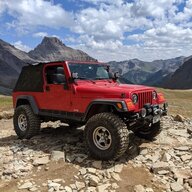
Novak Conversions Jeep Wrangler TJ engine mounts

Dyno Testing Bolt-ons On The 4.0

Sure, but a perfectly tuned carb should be equivalent to a TBI in that regard. So if it's going to outperform port FI, it has to do it against that disadvantage from the start.

For the record, I had no plans or interest in getting into a carb vs EFI discussion and don't remember how it happened, I guess just as a tangent to whether single, 4 and 12 port injectors offer any difference in the completeness of the atomization and evaporation process. I still think probably no but a dyno can tell us for sure.


I've definitely heard/read it, I just havent every been interested in putting a carburetor on anything in the past 20 years so never paid much attention.

I did some googling but what I found that seemed truly apples to apples didn't come to the same conclusions.

This is what I came across that actually compared port EFI vs carb with the same manifold.
Inconclusive as the performance was very similar. They did bring up the charge cooling thing in the text
https://www.motortrend.com/how-to/carburetor-vs-fuel-injection-we-put-both-to-the-test-on-ls-engine/

EFI makes 20+ over carb
https://www.enginelabs.com/engine-t...-efi-carb-delete-n-a-race-engine-exposes-all/

Here's one where the carb makes more, but it's a carb on performance intakes against a completely different EFI intake.


The viscosity of air is so low there's hardly any difference in the frictional losses in a temperature change of this magnitude (we're talking ballpark, 25-30°F drop) and a duct this short - It's about a 5% change in viscosity but it's 5% of a couple of thousandths of a psi. Losses in runs of HVAC duct work are expressed in usually single digit inches of water column, which is 1/27th of a psi.

As I've researched my response to this I've come across no shortage of claims that the carb cools the charge more because of the reasons discussed here, and I don't disagree...if you take a charge temperature measurement in the manifold then yes, it's going to be cooler on the carb'd engine than the EFI because you're measuring it after the fuel has cooled it, vs before. My argument is simply that the cooling affect is of equal magnitude, it just happens as it enters the cylinder instead of before it goes down the runner. It's not an easy thing to confirm though, unless you drill a hole somewhere and place a temp sensor inside the cylinder without it being smashed by the piston, and have it actually respond quick enough to get a reading at the right instant in a process that lasts milliseconds. If it's possible then it's probably only by the sort of instrumentation you find at CERN. Therefore, my approach has to break it down into simple heat transfer.

A big note here - We're getting well beyond the gnats ass at this point, I doubt any of it is significant enough to show up on a dyno test, but just as an academic exercise...

Process 1 - TBI/carburetor
air enters throttle body at ~150ish IAT
fuel injected, atomizes and vaporizes, cools charge by ~25°
125° charge moves through 200° manifold, picking up heat from what starts as a 75° temperature difference

Process 2 - port EFI
air enters throttle body at ~150ish IAT
moves through 200° manifold, picking up heat from what starts as a 50° temperature difference
fuel injected, cools charge by ~25°

Exactly how much temperature is picked up in the runner is unknown in either case, but it can be inferred that Process 1 will pick up about 50% more than Process 2 because it has 50% more temperature difference. Best case for the EFI is that the air picks up ALL the heat from the manifold and both end up hitting the port at 200, before the EFI gets the cooling and it ends up 200 vs 175 for a 5% density advantage. If the carb picks up 30 and the EFI picks up 20, then the charge ends up 155 carb vs 145 EFI - about a 3% advantage in density. Best case for the carb is that my understanding of modernish EFI is completely wrong and the intake valve closes on a mixture that hasn't fully vaporized, and that would extend to the same possibly being true in the injector argument.

Your premise makes sense, except the cooling doesn't necessarily all happen immediately at the point fuel is introduced. With port EFI more of the fuel vaporization happens after the air is in the cylinder which is too late to improve flow.
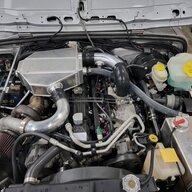
 
So, cams are a problem. I called around today and no one has cores. I guess there is a current issue at the foundry where most of the US made cams are made. The estimate they gave me was early next year for ready to grind cores. So, Comp it is I guess.
 
  • Wow
Reactions: BlueC
It's funny how that happens. I guess we should take it PM and stop muddying this thread if you want to keep talking. Maybe you can explain the mechanics of carb & TBI throttle blade icing. 🤔 I assume it has something to do with a pressure drop. Maybe that also cools the charge, but I'm wondering away from the thread again. :sneaky:

yeah, it's a combination of pressure drop in the air and cooling from the evaporating fuel. Never personally experienced it on my carb'd vehicles, but from what I've read about it in aviation it sounds like it's more about the air pressure drop because it seems to happen more frequently on extended, closed-to-part throttle periods such as during descent - which would be a time of more air pressure drop and less fuel supplied.
 
  • Like
Reactions: BlueC
Your premise makes sense, except the cooling doesn't necessarily all happen immediately at the point fuel is introduced. With port EFI more of the fuel vaporization happens after the air is in the cylinder which is too late to improve flow.

yeah, it's all based on being fully vaporized before crossing the "finish line", which I have been thinking of as when the valve closes. That's where I started with my first post in this thread about whether the different injectors make a difference in how completely it evaporates before the valve closes.
 
I'd gladly give up 5hp to be rid of carburetors every single time. Engine life,fuel economy and maintenance are far too important to me.

The only examples I want a carb on are Briggs and stratton,honda,stihl,husky,etc

I dunno, man. My lawn mower is fuel injected. Not having to worry about the choke, float levels, jets getting plugged up, etc is pretty nice.
 
I dunno, man. My lawn mower is fuel injected. Not having to worry about the choke, float levels, jets getting plugged up, etc is pretty nice.

I'd be happy to ditch carbs on everything. I've already gone Milwaukee M18 for all the stuff that used to be 2 stroke. All I've got left is the push mower and the lawn tractor.
 
  • Like
Reactions: TerryD
Re: the injector quandary

https://wranglertjforum.com/threads/single-4-port-12-port-injectors-on-a-dyno-with-a-xj.74163/

The video linked in the above thread demonstrated small gains (on the order of 4hp) for the increased hole count. One issue though...at the end he posted the chart that included the AFRs for all runs and they were not the same. Question for the tuners in this thread- when the PCM goes open loop at WOT, is there any long term fuel trim in play? I know there are different LTFTs saved in different parts of the map but I don't know if WOT even calculates any, or if they're copied or extrapolated from smaller throttle openings, and if they are, do they get used for WOT...

What I'm getting at is whether there's utility in getting a few drive cycles in for the LTFTs to adjust before putting it back on the rollers.
 
How big of a mower? I don't think efi would be worth the cost on a push mower

lol, that wasn’t part of the equation! It’s a John Deere quik trac 652. 52” deck and 26hp kohler. Zero Turn stander. It’s Tim Allen style overkill for my lawn, but it only takes me about 20 minutes a pop to mow (which happens about 2x a week this time of year)
 
  • Like
  • Wow
Reactions: BlueC and Rickyd
Go Green. 🥳
1717673211643.png
 
We may not have a choice much longer. I walked through the mower aisle at Lowe's a few weeks ago and 3/4 of them were electric.

I'm not opposed to the idea but I need a good 90-120 minutes of run time out of my push mower and need my lawn tractor to give me basically an entire day depending on what I'm doing.
 
  • Like
Reactions: Illiquid
We may not have a choice much longer. I walked through the mower aisle at Lowe's a few weeks ago and 3/4 of them were electric.

I'm not opposed to the idea but I need a good 90-120 minutes of run time out of my push mower and need my lawn tractor to give me basically an entire day depending on what I'm doing.

Can't buy them in CA anymore
 
Ok, back to bolt on mods, I would like to see lockout hubs

oh that's a good one.

The great thing about this data is not only does it tell us how much power it costs, but probably more useful is how much extra fuel it burns, and how much extra heat the cooling system has to reject to make that power.
 
Ok, back to bolt on mods, I would like to see lockout hubs

I'm going to go ahead and say that's well out of testing for Jezza. I think the best "test" for those would be real world, long term fuel/mileage logging.
 
I'm going to go ahead and say that's well out of testing for Jezza. I think the best "test" for those would be real world, long term fuel/mileage logging.

You're right. I wasn't thinking about the path of power flow for that.

You'd have to have the rig on a treadmill, or on a 4 wheel dyno where the front rollers were driven by the rear rollers.
 
  • Like
Reactions: BlueC
Novak Conversions Jeep Wrangler TJ engine mounts