Buy Once – Cry Once: Stock ’97 Into my TJ

richardh

Member
Original poster
Supporting Member
Joined
Aug 25, 2023
Messages
59
Location
Los Angeles, CA
Figured it was time to start a proper build thread instead of just hoarding parts and ideas.

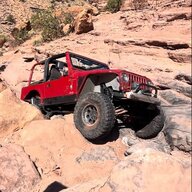
This is the starting point: a red 1997 TJ, mostly stock, honest, and unpretentious. It’s not pretty in a show-Jeep way, but it’s exactly what I wanted — a straight, rust-free frame, clean title, relatively low mileage at 109k, a 4.0L that runs strong, and a 32RH that’s rebuildable. It has a few light mods already — winch, mild lift, wheels and tires — all of which will get sold off as the build progresses. It drives, it wheels, and it’s the perfect foundation for a Jeep I’m building for me.

I’ve wheeled TJs for a while and know they are a great platform, and now I want to push the limits of what my driving, and a bolt on build can do.

The goal is a stable crawler that can still survive highway miles to and from the trail. I’m firmly in the buy once, cry once camp at this point. I’m building this one from the ground up in one shot. I’ve got built 2005 TJ that will stay on the trails while this one lives in my garage being built.

I’m not promising regular updates, but I do plan to keep this thread alive as the build moves forward — even when progress is measured in grinding sparks instead of shiny new parts. My next post will lay out the overall vision and parts direction, followed by a request for input on build sequencing before I start cutting brackets off a perfectly good frame.

More soon.

PXL_20251220_213138047.MP.jpg


PXL_20251220_213127803.MP.jpg


What a beautiful sight in my yard :)

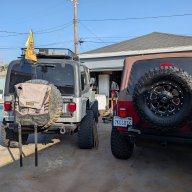
PXL_20251220_214218440.MP.jpg


PS My friends are convinced it's time for an intervention for my Jeep habit.
 

Build Goal - Longer Lowish Crawler on 37s​

Before I start tearing this thing completely apart, I want to lay out the basic direction and big decisions for the build. This isn’t a final spec sheet — it’s the foundation everything else will be built around.

I’m aiming for:
  • Stability on climbs and sidehills
  • Predictable suspension behavior
  • Low center of gravity
  • Enough road manners to get to and from the trail
This Jeep is being built to wheel hard, deliberately, and without drama.

Major Components / Big Decisions​

These are the core pieces that define where the build is headed.
  • Rubicon JK Axles, trussed, chromoly rear, RCV front, big brakes, 5.38 gears, lockers
  • Atlas 5.0:1 Transfer Case
  • Built 32RH with reverse manual valve body
  • 37” tires on Method Beadgrip Wheels
  • 3 link front with coilovers
  • 4 link rear with coilovers
  • PSC hydro assist with PSC steering box
  • VANCO HydroBoost braking
  • MetalCloak Armor
  • Lot’s of love for Barnes4WD 😀

Big Picture​

I am trying to keep everything on this jeep working together as a system built on purpose to meet the goal.
  • Axles that can live on the rocks
  • Gearing that matches the tire size
  • Suspension that prioritizes control over flex-for-photos
  • Steering and brakes that don’t feel like afterthoughts
This isn’t about cramming the baddest parts possible under a TJ. It’s about building something balanced, durable, and confidence-inspiring on real trails.

Next post will dive into build sequencing — what order to tackle teardown, suspension, drivetrain, and final assembly — and I’ll be looking for input from people who’ve already been down this road.

More soon.
 
  • Like
Reactions: Zorba

Tear Down, Build Sequencing, and Key Considerations​

Before cutting anything off the frame, I want to document the rough sequencing I’m planning to follow. This Jeep is set up so that once it’s parked, it doesn’t need to move again — plenty of room to work around it, and it can live on jack stands until it’s done.
That frees me up to focus on doing things in the right order, not rushing to keep it rolling.

Initial Setup​

  • Body lift + motor mount lift first
    • This happens before teardown so drivetrain geometry is known early
    • Gives room for the flat belly, Atlas, and pan clearance decisions later

Tear Down​

The idea here is to get to a clean, bare, workable chassis without bouncing back and forth.
  1. Body components off
    • Fenders, flares, bumpers, armor that won’t be reused
    • Anything that interferes with cycling suspension later
  2. Mechanical teardown
    • Transmission
    • Transfer case
    • Driveshafts
    • Axles
    • Wheels and tires
    • Fuel tank and skid
    • Exhaust as needed
  3. Interior strip
    • Seats
    • Carpet
    • Factory cage
    • Anything flammable or in the way of frame work

At this point the Jeep is essentially a bare tub on a frame.

Build-Up Phase​

This is where sequencing really matters.

Flat Belly / Drivetrain Mock-Up​

  • Install transmission and Atlas
  • Build and place crossmember
  • Set as-flat-as-possible tummy tuck, accounting for:
    • Deeper transmission pan
    • Atlas case size
    • Driveshaft angles
  • Nothing fully welded yet — this sets the foundation for everything else

Rear Suspension First​

Rear drives packaging and stretch affect everything downstream.
  1. Stretch tank installed
    • Final location before links exist
    • Driveshaft and upper link clearance considered early
  2. Rear link & coilover mock-up
    • Links tacked
    • Coilovers mounts tacked with shocks placed
    • Real tires installed
    • Cycle suspension fully
  3. Body interaction
    • Tub trimming
    • Rear body armor mocked in place
    • Shock clearance checked at full bump and droop
  4. Finalize rear
    • Once geometry, clearance, and packaging are confirmed
    • Burn in rear brackets and mounts

Front Suspension​

Front comes after rear so wheelbase and belly constraints are already locked.
  1. Front link, coilover, and steering mock-up
    • Axle at final location
    • Coilovers mounts tacked with shocks placed
    • Steering components mocked
    • Hydro assist packaging verified
  2. Cycle with real tires
    • Full bump
    • Full lock
    • Stuffed tire into fender area
  3. Body & fender mock-up
    • Front fenders and inner structure mocked
    • Verify clearance before welding anything permanent
  4. Finalize front
    • Burn in brackets only after everything cycles cleanly

Back on Its Own Weight​

  • Jeep back on the ground
  • Set at ride height
  • Verify:
    • Wheelbase
    • Stance
    • Belly height
    • Shock angles
    • Visual sanity check before moving on

Armor & Body Work​

  • Body armor mock-up and install:
    • Front fenders with inners
    • Rear armor
    • Sliders
    • Boat-side skids
  • Steering box skid mocked and built around finalized steering geometry

Interior & Cage​

This comes late so nothing structural gets in the way earlier.
  • Notchback cage
  • Seats
  • Console
  • Shifter(s)
  • Final interior layout

Key Philosophy​

  • Nothing gets fully welded until it cycles
  • Real tires during mock-up
  • Rear dictates front
  • Drivetrain height dictates links
  • Tire clearance dictates body mods
  • Parts in the garage before starting a phase
  • I’m not in a hurry, this will take time.

This is the plan in the first draft before the first cut. I’m sure some details will evolve once steel starts getting cut, but I’d rather catch sequencing mistakes on paper than after grinding welds off a frame. If you’ve stretched, linked, and coil overed a TJ — especially with an Atlas and flat belly — I’m very open to feedback on this order.

Next updates should be teardown photos once the Jeep officially comes apart.

Open Questions​

  • What did I miss in the plan or sequencing?
  • Do I need any temporary cross bracing or other supports while the TJ is stripped?
  • What is the biggest problems people have found in this kind of plan?
 
  • Like
Reactions: Zorba
How much stretch are you thinking?
Why Metal Cloak? Steel or aluminum armor?
LCG isn't really a build philosophy around here, where a balanced suspension is more so.
Who's suspension system were you thinking of using? Or were you just going to install brackets and build your own?
 
I’m aiming for ~99” to 101”, with as much of that as practical coming out of the rear. I'm using a Barnes4WD stretch tank to gain the clearance in the rear. I want better tire placement, better climbs, and fewer compromises up front. Final number will be driven by packaging and how everything cycles, not a hard target.

I like the look MetalCloak, and I’m going steel. This Jeep is going to get used, and I want armor I can confidently slide on rocks without worrying about damage. Weight isn’t the priority here — protection is.

Agreed on the LCG discussion. I’m not chasing “low” for the sake of it. The goal is a balanced suspension with good geometry, proper uptravel, and predictable behavior. Ride height will land where the suspension and drivetrain need it to be.

I’m starting with Barnes 4WD bracket kits and designing my own where needed. I want the freedom to place links where they make sense for geometry, tuning, and packaging.
 
  • Like
Reactions: Wildman
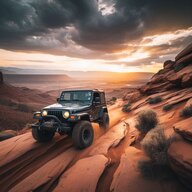
I'm sitting @ 100" with 5" in the rear & 2.75" in the front. I pushed the axle as far back as I could and still get the tires under the MC flares. I've got a 23 gallon GR fuel tank but I've got a thirsty Hemi too.

20241011_140939.jpg


You might find the Barnes brackets better but most would tell you for a TJ the Savvy midarm is about as good as it'll get.

20241130_160032.jpg
 
  • Like
Reactions: Rancho LJ
How much "problem solving" did you encounter pushing the front forward 2.75"? Did you have to move your steering box? Did you have to get something like the twisted pitman?
 
How much "problem solving" did you encounter pushing the front forward 2.75"? Did you have to move your steering box? Did you have to get something like the twisted pitman?

I have the TNT steering correction kit which is similar to the kit offered now by Barnes. With the steering box rotation I couldn't use the twisted pitman arm.
I have a flat pitman arm from Parts Mike.

My setup is a little different in that I have a Off-Road Only AiRock system so my ride height is adjustable. And that makes how far I could push the front forward harder since I was making sure my steering cleared when it's sitting on the bump stops.

This is it raised up as far as it'd go. I have 12" travel Fox shocks front & rear.

20241003_130829.jpg
 
  • Like
Reactions: richardh
I want better tire placement, better climbs, and fewer compromises up front.

I like the look MetalCloak, and I’m going steel. This Jeep is going to get used, and I want armor I can confidently slide on rocks without worrying about damage. Weight isn’t the priority here — protection is.

If you want performance, then you'll want to be very conscientious of weight and rethink using aluminum
 
This is what my TJ weights... I've got the steel MC corners and fenders w/8" wide flares. And a UUCF 2" drop steel transmission skid & Skid Row steel engine skid.. Plus a For HP44 front and TeraLow CRD60 rear. Hemi V-8 & 545RFE transmission & STaK's 3 speed t-case so it's not a light rig period but it'd be about 200-300lbs lighter if I'd gone aluminum for some stuff. Just to add to what Tworley said above.
This was with me 185lbs in the drivers seat.

20250710_120435.jpg
 
  • Like
Reactions: richardh
I’m curious how you’re going to set ride height, then install your armor? Armor is going to affect sprung weight, therefore affecting ride height…:unsure:

Also…JK axles will require lots of maintenance running 37’s.
 
  • Like
Reactions: richardh
The honest answer is that I'm working with AccuTune, and their weight tables. We went back and forth on the parts so they could advise me on springs, and coilover adjustment. In the end, it's a very informed guess that will be adjusted when the TJ is back on the ground.

I'm hoping to avoid some of the maintenance with ball joint delete kit, Reid knuckles, and quality axle choices. I believe the biggest maintenance headache will be the unit bearings, and possibly the lockers. What else were you thinking for maintenance?
 
The honest answer is that I'm working with AccuTune, and their weight tables. We went back and forth on the parts so they could advise me on springs, and coilover adjustment. In the end, it's a very informed guess that will be adjusted when the TJ is back on the ground.

I'm hoping to avoid some of the maintenance with ball joint delete kit, Reid knuckles, and quality axle choices. I believe the biggest maintenance headache will be the unit bearings, and possibly the lockers. What else were you thinking for maintenance?

A lot of people in my 4x4 club run 37s on rubicon Dana 44’s and they’ve almost all bent the housings, roached the lockers and broken axles. Plus, the ball joints and unit bearings almost become “wear” items.

Not saying it can’t be done, but about the only nice thing about JK axles in my opinion is the 65” wms measurement.
 
  • Like
Reactions: MattTJRubicon82
A lot of people in my 4x4 club run 37s on rubicon Dana 44’s and they’ve almost all bent the housings, roached the lockers and broken axles. Plus, the ball joints and unit bearings almost become “wear” items.

Not saying it can’t be done, but about the only nice thing about JK axles in my opinion is the 65” wms measurement.

I've read & seen a lot of those issues also but what's a JKU weigh compared to a even a steel armored TJ? While I'm not a huge fan of the JK axles like you I do agree with the idea that they might work for a TJ if built properly.
 
  • Like
Reactions: bbaldwin237
Google shows a JKU Rubicon weighs 4500+ in stock form.

I would of guessed 5k for a base weight. But even 4500 is 1k more than a stock TJ.
I know sleeving doesn't help as much as wrapped tubes but in this case would it be helpful?