Dave Kishpaugh's (Jeep West) geometry correction brackets are now available

Status
Not open for further replies.
from the perspective of a mild wheeler with shortarms whose skill level hasn't revealed the kind of problems that call for either a midarm or geometry correction, the last several pages of this thread effectively read like:

A: hey there's these ($165) geometry correction brackets
B: that's dumb, just get a ($3k) midarm it's better

I could have missed it, but I never saw Dave invite that comparison, he only seems to have defended his product against attacks that were never really reasonable considering the price point and target market for each product.

$165 is inexpensive enough that any skeptic on here with welding skills ought to be able to try it out. Hell, I'd do it if I thought I had the expertise to give useful feedback and also was dumb enough to climb into a rig with suspension link brackets that I had welded with my $90 FCAW from Harbor Freight.

The original product from Nth Degree that Dave has brought back was called the HIK AKA the Handling Improvement Kit key word handling. Its purpose was to alter the control arm angles and raise the roll center within the confines of the stock suspension. The net effect was a improved roll center height, reduction in roll steer, flatter arms that allowed a lower travel arc and an instant center location that makes the Jeep "feel" like it only has two inches of lift on it. This leads to a better handling Jeep that is much nicer to drive.

That is not to say there are not benefits to that off road as well. There is less chassis upset on climbs and increased stability in off camber situations.

You are also going to notice at no point that I used the word eliminate. Within the confines of stock length control arms there is no way that you can eliminate any bad traits you can only lessen them to a degree.

Dave did open that door and he would benefit from better explaining what the brackets can and cannot do and leave it up to the consumer if they are the right fit for them. This is the internet so there will always be fanboys and shit talkers fighting over everything given half a chance.
 
Your ignorance to the value of geometry correction brackets is baffling to me, especially when you claim to understand suspension geometry.

All you want to do is discredit them and yap about your jeep. This thread isn't about your "built" jeep, frankly watching a video of your jeep hop almost as much as one with short arms and cheap shocks just solidifys the advantage of geometry correction brackets as a viable option for anyone looking to improve their rig without an invasive build.
Dave you are not helping yourself having a tit for tat with JJ. He is never going to actually provide any explanation why he believes the brackets do not work. Just give an accurate explanation of the benefits and limitations of the brackets and leave it at that.
 
Your ignorance to the value of geometry correction brackets is baffling to me, especially when you claim to understand suspension geometry.

All you want to do is discredit them and yap about your jeep. This thread isn't about your "built" jeep, frankly watching a video of your jeep hop almost as much as one with short arms and cheap shocks just solidifys the advantage of geometry correction brackets as a viable option for anyone looking to improve their rig without an invasive build.
Whatever Dave.
 
Please send your dick pics to @Wildman so we can get this dick measuring contest finally resolved!!!
1620650156310.jpeg
 
I think the only way to settle this is with a classic shoot out at TJ Fest 2022. Bring some cash 😎. I'll run my short arms with no fancy brackets.
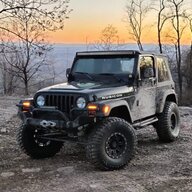
Then you can all get together, makeup and shake hands, and then demonstrate how shitty your driving skills are and negate any mods that you've done for your rigs.

Now excuse me while I go install some Rancho 5000x shocks on my TJ.
 
Read a few pages back where Dave said you can redrill the mounts (a third hole) for better off-road performance since the focus of these brackets is on-road.
Well I guess if you wanted to change it all the time you could. Or just pick a setting knowing that improvement one way may sacrifice the other.
 
  • Like
Reactions: Brianj5600
It is not. Look at all the products out there trying to correct it with varying degrees of success or failure. If it worked so well noone would be trying to build a better mouse trap to fix it.
Most address it trying for a bolt in solution. Most of those create other issues while trying to fix the current ones.
 
As Blackjack stated, in lieu of comparing products or jeeps. It should just be stated what the geometry correction does and then leave it up to the reader to determine if it is beneficial to them or corrects what they need corrected within their constraints (budget, ability, availability, etc....).

Just look at the physics,
Lifting a Jeep 4" and utilizing the same frame and axle mount locations, definitely changes the anti-squat, and may have an affect on the rear steer. This is because it raises the point of intersection of the two control arms up and aft. This is a fact.

Having a higher AS can force the wheels/axle to walk under when on steep steps and this is what is commonly referred to as bouncing (walk, loose traction, walk). Rear steer is during articulation when one set of links is pulled forward and another is pushed aft due to being in different parts of the radius. (I don't think I ever felt rear steer in my jeep, but I am guessing it is felt during hard acceleration on the road when the body rolls and the body roll is effectively articulation and causes steer AND in rock crawling when you pick a line and due to articulation of the axle it drives slightly off that line?)

There are other issues with 4" lift with stock control arm locations; lifting wheels due to moment induced into frame by control arms and the location of the force applied above the CG, etc... but I am just going to focus on the above to simplify for this post.

Now does this higher AS and rear steer, or whatever issues you may be experiencing affect you enough to want to make a change? If the answer is yes, then analyze what changes can be made.

The geo correction referred to in this thread, relocates the control arms to make them flatter and reduces the anti-squat, this is a fact, if the line of intersection is further forward and down due flatter links, then the AS is reduced, it may also reduce the rear steer by pushing the point forward and reducing the fwd/aft movement during articulation. It also reduces body roll by raising the mounting point of the panhard on the axle. This will reduce body roll and may also reduce rear steer. This is a fact. Is there any negatives to this modification, yes there may be limitations to up travel due to the height of the upper control arm mounts, your current frame side lower mounts may be beat to hell and you can't redrill this side, etc..... Then there is the cost and effort.

Compare the benefits to the negatives, does it address your issue, is it in your price range and ability. Will it completely address your issue or just "make it slightly better or less noticeable" and if so is this acceptable to you. Then make a decision. AND YES definitely compare to other methods/products which may not only do the same thing but provide additional benefits at a different cost and ability level. Key thing is to choose the method/product which addresses your issue within your price/ability range
 
As Blackjack stated, in lieu of comparing products or jeeps. It should just be stated what the geometry correction does and then leave it up to the reader to determine if it is beneficial to them or corrects what they need corrected within their constraints (budget, ability, availability, etc....).

Just look at the physics,
Lifting a Jeep 4" and utilizing the same frame and axle mount locations, definitely changes the anti-squat, and may have an affect on the rear steer. This is because it raises the point of intersection of the two control arms up and aft. This is a fact.

Having a higher AS can force the wheels/axle to walk under when on steep steps and this is what is commonly referred to as bouncing (walk, loose traction, walk). Rear steer is during articulation when one set of links is pulled forward and another is pushed aft due to being in different parts of the radius. (I don't think I ever felt rear steer in my jeep, but I am guessing it is felt during hard acceleration on the road when the body rolls and the body roll is effectively articulation and causes steer AND in rock crawling when you pick a line and due to articulation of the axle it drives slightly off that line?)

There are other issues with 4" lift with stock control arm locations; lifting wheels due to moment induced into frame by control arms and the location of the force applied above the CG, etc... but I am just going to focus on the above to simplify for this post.

Now does this higher AS and rear steer, or whatever issues you may be experiencing affect you enough to want to make a change? If the answer is yes, then analyze what changes can be made.

The geo correction referred to in this thread, relocates the control arms to make them flatter and reduces the anti-squat, this is a fact, if the line of intersection is further forward and down due flatter links, then the AS is reduced, it may also reduce the rear steer by pushing the point forward and reducing the fwd/aft movement during articulation. It also reduces body roll by raising the mounting point of the panhard on the axle. This will reduce body roll and may also reduce rear steer. This is a fact. Is there any negatives to this modification, yes there may be limitations to up travel due to the height of the upper control arm mounts, your current frame side lower mounts may be beat to hell and you can't redrill this side, etc..... Then there is the cost and effort.

Compare the benefits to the negatives, does it address your issue, is it in your price range and ability. Will it completely address your issue or just "make it slightly better or less noticeable" and if so is this acceptable to you. Then make a decision. AND YES definitely compare to other methods/products which may not only do the same thing but provide additional benefits at a different cost and ability level. Key thing is to choose the method/product which addresses your issue within your price/ability range

great post. I would have thought we were collectively smart enough to understand this without it having to be spelled out, but I guess I was wrong.
 
Status
Not open for further replies.