Tire pressure

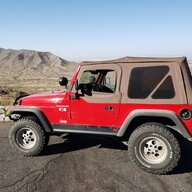
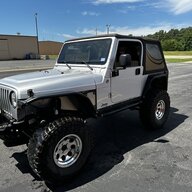
If you start with the factory recommendation of 29 psi for 30X9.50R15 tires, then the adjustment for 31X10.50R15 is 25 psi. That is where I would put them.

The stock size 30" tire has less volume and material to carry the weight of the vehicle, so it needs more pressure. The larger tire needs less pressure to carry the same load. How much less? See below for the calculation.

Even at 25 psi, the 31" tires are capable of carrying a total load of 5,600 lbs, way more than a Wrangler needs. So, anything more than 25 psi for a 31" tire is overloaded and too much. Instead of throwing out arbitrary numbers, it's best to base a recommendation on something that at least has a meaning behind it.

Screenshot 2025-06-03 153917.jpg
 
Last edited:
I'll run 32 psi sometimes as my commute is all highway. 30 psi definitely rides much smoother. Will need some new tires here shortly as the KO2's are holding up pretty well but 2018 date codes. Probably about 50k miles on them.
 
  • Like
Reactions: MBDIAGMAN
For best tire wear on pavement, refer to the sticker in the door jamb and set the cold pressure no less than that regardless of tire size WITHIN REASON. Changing from 205 70-15 to 31’s is not within the range that I call “within reason.” Adding 2 pounds to it will give insurance and best tire wear. Below that sticker pressure and it is very likeLy to wear excessively in the middle of the tread.

BTW, when I say “within reason,” I mean tire sizes not too different from each other. I’m not saying putting on big tires is not within reason.😊
 
Last edited:
For best tire wear on pavement, refer to the sticker in the door jamb and set the cold pressure no less than that regardless of tire size within reason. Adding 2 pounds to it will give insurance and best tire wear. Below that sticker pressure and it is very likeLy to wear excessively in the middle of the tread.

:unsure:

1750117583565.png

jeep 40s stock axles.jpg
 
Last edited:
For best tire wear on pavement, refer to the sticker in the door jamb and set the cold pressure no less than that regardless of tire size within reason. Adding 2 pounds to it will give insurance and best tire wear. Below that sticker pressure and it is very likeLy to wear excessively in the middle of the tread.
I thought high pressure resulted in center wear, and low pressure resulted in outer edge wear.
 
For best tire wear on pavement, refer to the sticker in the door jamb and set the cold pressure no less than that regardless of tire size within reason. Adding 2 pounds to it will give insurance and best tire wear. Below that sticker pressure and it is very likeLy to wear excessively in the middle of the tread.

That is not correct. If you want to be accurate, the better move would be to use a calculator and adjust to a new tire based on the load calc of the stock tire at stock pressure and correlate that to where the new tire supports that load.

Sticker pressure only works for actual stock size and load tires.
 
I thought high pressure resulted in center wear, and low pressure resulted in outer edge wear.

That was with bias ply tires. With radials, low pressure makes the tire have a raised area in the center of the bottom as it rolls. Sort of like a soccer ball with extremely low pressure will roll with a dimple toward the ground. As it rolls that dimple causes it to scrub in the center.

It amazes me that after over fifty years of radial tires, there are still even charts in some tire stores that show the pictures and results of incorrect pressures as they were with bias ply tires.
 
That is not correct. If you want to be accurate, the better move would be to use a calculator and adjust to a new tire based on the load calc of the stock tire at stock pressure and correlate that to where the new tire supports that load.

Sticker pressure only works for actual stock size and load tires.

Since the introduction of radial tires I have driven well over a million miles, closer to two million, watching pressures and situations closely. The pressures as I have described have resulted in incredible tire mileage for me. For those who follow a different approach and it works, I’m very happy for them.

Back in the eighties, I put a set of 33’s on my F150 4x4. They were touching the ground only about 2/3 of the width of the tire, so I aired down to make them appear to touch the pavement all the way across. I then took about a 500 mile trip. When I got home, the center of the tires were very noticeably worn. After that I ran about 37 psi cold and they lasted quite a long time.

That’s what has worked for me. Your results may vary.
 
That was with bias ply tires. With radials, low pressure makes the tire have a raised area in the center of the bottom as it rolls.

Well that is contrary to what I have seen with the “chalk test”, or more accurately a dust test after a haboob, and also looking at tread marks after driving across wet pavement onto dry pavement. Higher pressure had tread contact in the center and not the outer edges.
 
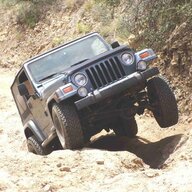
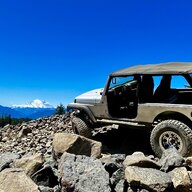
I have 265-75R16 KOs on my 05. The sidewall states 80psi for max load of 3500lbs. Waaay more capacity than I need. I keep them at 28psi for the road and air down to 15-18psi on the trail. Even at the low pressures My tires have very little sidewall flex.
Age and heat buildup are the cause of most failures not caused by external objects and then it’s most likely because that object caused a slow air leak . The lower the pressure and higher the weight load the more sidewall flex there is causes heat buildup. Each tire has its own sidewall build. Over the years I’ve developed the habit of checking tire and bearing temps especially on trailers.
Ultimately the correct tire pressure depends on the tire makeup, the load, the speed and heat buildup.
I’ve never experienced uneven tire ware due to tire improper pressure just from failure to keep proper alignment.
 
  • Like
Reactions: Dr. Internet
I am running 33 12.50 15 kenda klever M/T's. Mine are all set at 24.5 psi. They are all wearing evenly across the tread.
 
Well that is contrary to what I have seen with the “chalk test”, or more accurately a dust test after a haboob, and also looking at tread marks after driving across wet pavement onto dry pavement. Higher pressure had tread contact in the center and not the outer edges.

“Higher pressure had tread contact in the center and not the outer edges.”

Correct! At the right pressure, tread contact is a good thing. When the pressure is TOO low, the center develops a bubble, if you will, underneath where it is not touching the ground in the center of that bubble. While rolling at this too low pressure, the tread is scrubbing the pavement at the leading and trailing edge of that bubble resulting in tire wear in that area.

The concept I attempt to describe above is real. Where the mystery, guesswork, theories, arguments come from is what pressure eliminates that wear process. That is the key and I’ve never found a magic formula to arrive at that answer. Different tires give different results when changing pressure.

That sweet spot tire pressure that achieves optimum tire wear is not a very wide range. Sometimes it only takes an increase of one or two pounds to eliminate the wear.

Max tire pressure is a whole different issue, and has changed drastically in recent years. With a heavily loaded trailer, pay attention to max tire pressure to prevent catastrophic damage.
 
Last edited:
I am running 33 12.50 15 kenda klever M/T's. Mine are all set at 24.5 psi. They are all wearing evenly across the tread.

I can see how a tire that size on a vehicle that light could have a pressure that low and not have the rolling bubble. You apparently have found the sweet spot. I contend that you could add a good bit of tire pressure and not get into a fast wear down the middle situation. If you did, however, the added pressure would, of course, negatively effect ride and tire performance.
 
Back in the eighties, I put a set of 33’s on my F150 4x4. They were touching the ground only about 2/3 of the width of the tire, so I aired down to make them appear to touch the pavement all the way across. I then took about a 500 mile trip. When I got home, the center of the tires were very noticeably worn. After that I ran about 37 psi cold and they lasted quite a long time.

37 PSI worked because the F150 (even in the 80s) is a heavier vehicle and you were riding around on probably LT metric tires if I had to guess. Even if they were flotation (inch sizes), 37 isn't too crazy because of the weight of that truck. You wouldn't want to do that on a Jeep just because the door sticker says 35.

There are 4 classes of tire size and they all have different load capacities at different pressures. If your approach with the Jeep is to run 37 psi simply because the door sticker says 35, that may work on some tires and that may go over quite poorly on others. You will probably not like that pressure on most of the LT flotation tires.

I run 37 psi in my tires, but that is because they are an LT215/75R15 and that is what maintains the correct load based on the stock 30" tire pressure recommendation from Jeep. If I had 35x12.5, I'd be down around 20-22, if I had 33's, 22-24, 31's, 25, 30's, 29.

It really just comes down to the size/load of the tire and what vehicle they're carrying. Some Jeeps will say 35 on the sticker, some 29, because they came with different tires. If you had a Jeep with the 30" stock tire package, then you'd be riding around at 31 psi on every tire because the door sticker said 29....when really different sizes should be adjusted accordingly based on what they can carry.

Also, I think this was addressed later but under inflation would wear the the outside edges of the tire, not the centers. Over inflation would wear the centers, but it takes a lot of over inflation to get to that point. Handling, braking, and ride quality all go out the window long before over inflation kills the tire.

 
I can see how a tire that size on a vehicle that light could have a pressure that low and not have the rolling bubble. You apparently have found the sweet spot. I contend that you could add a good bit of tire pressure and not get into a fast wear down the middle situation. If you did, however, the added pressure would, of course, negatively effect ride and tire performance.

This is where the calcs come in handy, at least as a general baseline that keeps you from going too far in either direction. It's not a sweet spot, it is simply the load rating of the tire being more than ample for the situation.

Take the 30" tire package, which has a recommendation of 29 psi on a 30x9.50R15 LT tire.

It supports 1376 lbs at 29 psi.

33x12.5R15 supports 1765 lbs at 25 psi. So even at 24 or 25 psi, a 33x12.5 is way more than capable of carrying a Jeep, and technically it is over inflated. It still works fine, but it is not close to being a rolling bubble. It is simply a strong tire on a lightweight vehicle that needs very little pressure to carry the weight.
 
  • Like
Reactions: bucky