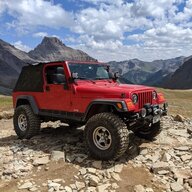
Novak Conversions Jeep Wrangler TJ engine mounts

Tire PSI for sand driving

Just to be clear, the sidewall failure I am referring to is not anything immediate, it is the cumulative effect that can result in a failure much later, even a year or more later. Most people wouldn't even connect the two. For example, once a highway tire has been run low for a while it is advised by tire experts to replace it as it has suffered irreversible sidewall weakening which can lead to separation and failure down the road.

After having a sudden and catastrophic failure years ago on the front an F250 at highway speed I tend to error on the extreme side of caution, that's something you never forget.

There is a blog by a forensic tire engineer named Roger Marble and although a lot of it has to do with RVs there is a lot of information that pertains to every tire and use scenario. During his career he did forensic studies on failed tires and almost every early/sudden failure could be traced to a period of running low at some point during the tire's life.

the friction generated will grow with the square of speed, so cutting speed in half will cut the tire heat by 75%. If I was worried, I could hit mine with an IR gun after a 70mph run on the highway at 25 psi and then compare it at a later time after doing 40-50mph at 10psi, but my entirely gut-based feeling based on no data whatsoever is that a few minutes at 45mph and 10psi does not result in a hotter tire than 70mph at 25psi (or said another way, the reduction in speed has a bigger impact than the lower pressure).

Now, I've thought about how bad it would be to have a 35" tire blow out on something with a 103" wheelbase and 'm not ballsy enough to run aired down at 70 for any period of time. But some people are and the vast majority seem to have lived to tell about it.

I see the bigger risk as when people just don't pay attention to their tire pressure and they daily-drive for months on end with a visibly low tire. Think about how much more seldom we hear about blowouts since the advent of TPMS.
 
the friction generated will grow with the square of speed, so cutting speed in half will cut the tire heat by 75%. If I was worried, I could hit mine with an IR gun after a 70mph run on the highway at 25 psi and then compare it at a later time after doing 40-50mph at 10psi, but my entirely gut-based feeling based on no data whatsoever is that a few minutes at 45mph and 10psi does not result in a hotter tire than 70mph at 25psi (or said another way, the reduction in speed has a bigger impact than the lower pressure).

Now, I've thought about how bad it would be to have a 35" tire blow out on something with a 103" wheelbase and 'm not ballsy enough to run aired down at 70 for any period of time. But some people are and the vast majority seem to have lived to tell about it.

I see the bigger risk as when people just don't pay attention to their tire pressure and they daily-drive for months on end with a visibly low tire. Think about how much more seldom we hear about blowouts since the advent of TPMS.


Definitely the TPMS has changed the game, as has improved tire construction.
Off roaders that air down are a very tiny niche in the overall tire consuming public and the length of time running under inflated while off road is a much smaller percentage of the tire's life than with an unaware prolonged underiflation by a daily driver.

But since my trips to the beach involve 500 miles round trip of highway I am still going to error on the side of caution. I guess it's a risk vs rewards thing with me. Since I have been fine at 18 PSI where I go so far I don't see the need to go lower. If I ever do though, it will be with much caution and likely very temporary.

Here's another air pressure question, how low would you guys go for washboard roads when you'll be cruising at higher speeds for extended periods? Say with a tire size of 31" in a load range C?
 
Last edited:
Definitely the TPMS has changed the game, as has improved tire construction.
Off roaders that air down are a very tiny niche in the overall tire consuming public and the length of time running under inflated while off road is a much smaller percentage of the tire's life than with an unaware prolonged underiflation by a daily driver.

But since my trips to the beach involve 500 miles round trip of highway I am still going to error on the side of caution. I guess it's a risk vs rewards thing with me.

Here's another air pressure question, how low would you guys go for washboard roads when you'll be cruising at higher speeds for extended periods? Say with an average tire size of 31" in a load range C?

500 miles for sure I would not do aired down. I air down when I hit the dirt and I air up when I hit the pavement to go home, but I'll cover pavement at a bit higher speeds in between to avoid having to air up and then air down a few minutes later. I'm talking 20 miles max at 45mph, with an occasional short burst to 55 if necessary to get to the next trail. I might feel differently if I was in the heat but these occasions are usually in 70 degree weather or less.


With washboards, I don't really get enough benefit from airing down to be worth the trouble unless I'm down around 12 or less. So that's how low I would go. But the washboards I typically drive on are also curvy and on the side of a mountain so I'm usually not doing more than 25 or 30 and tire heat is not a concern.
 
500 miles for sure I would not do aired down. I air down when I hit the dirt and I air up when I hit the pavement to go home,

Yes that is what I meant, I do the same. I just meant that my caution for not overspeeding for long stretches when aired down off road is due to me not wanting to prematurely shorten the life of my tires for highway use. I get that others have no issues and I can respect that, I just choose to be more cautious. I probably don't see a lot of the really challenging stuff a lot of guys go looking for. If there's two ways to navigate a section of trail, I'll always pick the easier one.
 
Last edited:
  • Like
Reactions: freedom_in_4low
When we do the week in Moab I normally drop to 8 psi and generally leave it for the week. Unless I know I have a lot of highway miles maybe 40+ before the next trail.

I stay a few miles south of Moab and will drive the highway into town for the trails, food or a combination of them. Speeds are up to 65 mph on 35’s.
 
  • Like
Reactions: PurpleTJAZ
When we do the week in Moab I normally drop to 8 psi and generally leave it for the week. Unless I know I have a lot of highway miles maybe 40+ before the next trail.

I stay a few miles south of Moab and will drive the highway into town for the trails, food or a combination of them. Speeds are up to 65 mph on 35’s.

Without doing any research I'm going to guess that your 35 inch tires will have a lot more sidewall strength and able to support a lot more weight at 8 PSI than my puny 30" tires would at the same 8 PSI.
 
Without doing any research I'm going to guess that your 35 inch tires will have a lot more sidewall strength and able to support a lot more weight at 8 PSI than my puny 30" tires would at the same 8 PSI.

I have no idea. Mine are Baja Boss MT’s on 15’s incase anyone cares to figure it out.
 
With all the variations in tire size, tire type, weight, speed and trail conditions it seems like the only answer to the OPs question as to how much to air down is "as much as necessary and no more than necessary ". Kind of like when Mark Smith said about off road speed, "as slow as possible and as fast as necessary " or something like that.
 
  • Like
Reactions: Apparition
Novak Conversions Jeep Wrangler TJ engine mounts