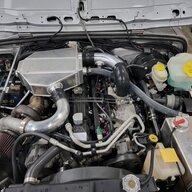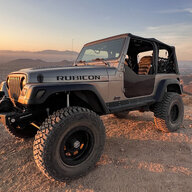
Jezza's Turbo LJ

Is the .25 AL your using for your front bumper 6061? If so, your correct, it will crack if bent with too small of a radius.

 
The die radius is less important then, 5052 is much softer then 6061. I would not suggest mounting a winch with a single layer of .25 5052. I would consider a winch deck/tray that spans the top frame mounting locations from a different material. This also makes the rear flange in question a non issue. I would put the flange on your winch tray sandwiching the bumper. Just a couple thoughts.
 
  • Like
Reactions: JMT
Yep, I still have the 3582 on the LJ currently. The kits come with a 5431 Precision turbo. It's a 54mm with a T3 flange. The packaging is a little tight with the factory airbox on the kits. If you went much bigger on the turbo the airbox may need to find a new place to live. That 5431 is good for around 500 crank hp that should easily support a mild stroker with low boost. There is also an upgrade for that turbo that adds an additional 85hp.

I know it's tuning dependant but what boost are you seeing on the lj and with your kit on a 4.0l? Estimated(or dyno) stroker hp?

Sorry for all the questions. I've had turbos on the brain since deciding the next motor to go in my 70 chevy will have a turbo.
 
I know it's tuning dependent but what boost are you seeing on the lj and with your kit on a 4.0l? Estimated(or dyno) stroker hp?

Boost PSI will be up to the set limit, then vented mechanically or electronically, assuming the turbo(s) can flow enough air to reach that limit. Are you asking him how much PSI he is running, or maybe how much that specific turbo is capable with a 4.0?

If you're asking about additional power potential, maybe this can help you out. You can get a really good ball park forced induction power estimate using this equation; (boost psi / local atmospheric psi) X Known engine N/A power = additional power, then add that to the original power amount.

So if you know engine X makes 200 hp at sea level, and you want to push 7 PSI boost and atmospheric pressure is 14.7 PSI, then your power with forced induction will be around 295 hp. (7/14.7) X 200 = 95.24 + 200 = 295.24
 
  • Like
Reactions: jrfuda
Boost PSI will be up to the set limit, then vented mechanically or electronically, assuming the turbo(s) can flow enough air to reach that limit. Are you asking him how much PSI he is running, or maybe how much that specific turbo is capable with a 4.0?

If you're asking about additional power potential, maybe this can help you out. You can get a really good ball park forced induction power estimate using this equation; (boost psi / local atmospheric psi) X Known engine N/A power = additional power, then add that to the original power amount.

So if you know engine X makes 200 hp at sea level, and you want to push 7 PSI boost and atmospheric pressure is 14.7 PSI, then your power with forced induction will be around 295 hp. (7/14.7) X 200 = 95.24 + 200 = 295.24

I wonder how accurate that equation would be given other variables come into play. The 4.0l turbo will support over 500hp. But that is just a number without everything else being built to support it.

I'm curious what boost he is seeing on his setups and their safe power levels. His stroker is almost identical to mine except for a boost friendly compression ratio.(forged rods and pistons,arp bolts,edelbrock head,cam) So in my mind I could swap pistons and follow his recipe.

not that I need to,my motor makes great power.honestly it is probably just right for a tj chassis and too much right foot.but where is the fun in not building until the right foot scares you after 5 seconds?

I was thinking about my build direction recently and realized I value a daily driver hot rod convertible.offroad capability is something I'm working on,but I don't want it to impact the former.
 
I wonder how accurate that equation would be given other variables come into play.

It works, but that is assuming the base number is accurate and not changed, i.e. the forced induction is the only change.

I'm curious what boost he is seeing on his setups and their safe power levels.

Obviously "safe" power and boost levels vary depending on hardware, but generally N/A engines are considered "safe" up to about 15 PSI, or double the standard power. The 4.0 may be stronger or weaker, but somewhere around 15 PSI I'd start expecting issues in the cylinders. He'll have to answer to give you solid answers since I'm talking in generalities. You piston material and ring gap might be an issue, so that's something to look into.
 
  • Like
Reactions: Wildman
It works, but that is assuming the base number is accurate and not changed, i.e. the forced induction is the only change.


Obviously "safe" power and boost levels vary depending on hardware, but generally N/A engines are considered "safe" up to about 15 PSI, or double the standard power. The 4.0 may be stronger or weaker, but somewhere around 15 PSI I'd start expecting issues in the cylinders. He'll have to answer to give you solid answers since I'm talking in generalities. You piston material and ring gap might be an issue, so that's something to look into.
Fuel type and availability starts to play a role there as well. In death valley and plenty of other rural places all you can get is 87 octane or severely degraded,old "91".

 
  • Like
Reactions: Wildman
In death valley and plenty of other rural places all you can get is 87 octane or severely degraded,old "91".

That sucks. We have 87, 89 and 93 at every station I've ever been to here, and lots of them also have 89 or 93 non-ethanol too. A few stations even have 100 and 105 on a pump, but I live in racing country.
 
  • Like
Reactions: Wildman
That sucks. We have 87, 89 and 93 at every station I've ever been to here, and lots of them also have 89 or 93 non-ethanol too. A few stations even have 100 and 105 on a pump, but I live in racing country.

You got E85 out there?

Its economics. No one is going to sell a perishable product that winds up costing them money when the demand isn't there. 99.9% of cars run on 87. I can find high octane fuel,but I'm unwilling to drive into urban areas and have a 50-200 mile round trip just for gas several times a week
 
I have been working on making some custom AC hoses for the LJ. The stock hoses get in the way of the turbo, so I bend them out of the way, but they also block the valve cover and intake manifold from coming off easily. I really dislike recovering the ac every time I mess with it. So I made some lines out of hardline aluminum and welded the ends back on them. I have a ton of leaks now as my welds were tough to do. I couldn't go too hot or the tubes would melt, but being too cold left porosity and spots where the weld didn't penetrate. I decided to go a different route and use rubber hoses. There is one issue and that is no fittings exist to adapt the stock compressor and condenser to rubber. So, I'm making my own. I want the compressor outlet to go down under the radiator and the compressor inlet hose to go up by the firewall. I have been working with a company that makes custom hoses to get the hoses and ends made. I just need to make the adapters. Here is what I have so far. 3d printed at a draft speed.
 

Attachments

  • jeep_wrangler_tj_ac_fitting_adapter_custom_2.jpg
    jeep_wrangler_tj_ac_fitting_adapter_custom_2.jpg
    409.9 KB · Views: 64
  • jeep_wrangler_tj_ac_fitting_adapter_custom_1.jpg
    jeep_wrangler_tj_ac_fitting_adapter_custom_1.jpg
    401.3 KB · Views: 65
I got a cam and crank correlation code the other day. I had to use a scan tool to set the cam and crank difference as close to zero as possible. I also hooked up my scope to see how the sensors align at zero difference. This was the scope data. Looks to me like the last crank tooth before the gap falls right in the center of the first cam tooth. Set like that mine was reading 0 difference, and the code went away. I thought it was interesting.

20250906_151731.jpg