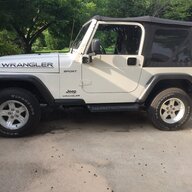
Normal engine temp?

agreed, when I did the 02's on the jeep, I want Bosch at the orileys counter (not knowing, and Bosch has a great reputation as OEM equivalent in the VW world) boy was that a mistake, had to pull them out and throw in NTK's. that was the first real useful piece of info I got from the forum.
My first car was a beetle. Rolled her 2 weeks after I got my license. Dad said “your not getting another one”, so I set out to find a body to replace the dents in the one I rolled.
Found one, pulled the dented body off, put the acquired body on, then proceeded to totally rebuild/require my ride.
Bosch was a commonly used term around our house for years. My beetle, Dad had a Karmon Ghia, and we acquired a very transporter that Dad converted to a camper.
On weekends I did valve jobs on VW’s. I got to where from start to finish of pulling an engine was less than 10 minutes. Install was maybe 20.

But following advice here from Chris,MrBlaine and others, I found NTK to be the only way to go.
 
  • Like
Reactions: KingCarGuyZ
My first car was a beetle. Rolled her 2 weeks after I got my license. Dad said “your not getting another one”, so I set out to find a body to replace the dents in the one I rolled.
Found one, pulled the dented body off, put the acquired body on, then proceeded to totally rebuild/require my ride.
Bosch was a commonly used term around our house for years. My beetle, Dad had a Karmon Ghia, and we acquired a very transporter that Dad converted to a camper.
On weekends I did valve jobs on VW’s. I got to where from start to finish of pulling an engine was less than 10 minutes. Install was maybe 20.

But following advice here from Chris,MrBlaine and others, I found NTK to be the only way to go.

Part of why I love VW's. everyone has a story. Good, Bad, Or indifferent that revolves around a VW type 1. for me it's my dad's old Duneuggy that I restore. not fast. but a blast to drive on the streets. tales a Jeep with the top and doors of to shame. (i'd attach a photo, but its pain from my computer)
 
On weekends I did valve jobs on VW’s. I got to where from start to finish of pulling an engine was less than 10 minutes. Install was maybe 20.
It always amazed me how little time it took to pull VW engines in beetles, I had a 1966, the last of the 6 volt models. I had to run a 6 to 12 volt inverter so I could install an AM/FM radio into it. You had to keep the engine revved up just a tad to keep the lights from dimming and keep the turn signals flashing with those old 6 volt systems lol.
 
  • Like
Reactions: TJ4Jim
It always amazed me how little time it took to pull VW engines in beetles, I had a 1966, the last of the 6 volt models. I had to run a 6 to 12 volt inverter so I could install an AM/FM radio into it. You had to keep the engine revved up just a tad to keep the lights from dimming and keep the turn signals flashing with those old 6 volt systems lol.
😂 I have a really loud exhaust and you can hear when my idle drop 40-50 RPM when I turn on the headlights 😂
 
It always amazed me how little time it took to pull VW engines in beetles, I had a 1966, the last of the 6 volt models. I had to run a 6 to 12 volt inverter so I could install an AM/FM radio into it. You had to keep the engine revved up just a tad to keep the lights from dimming and keep the turn signals flashing with those old 6 volt systems lol.
Mine started out as a ‘63 w/36 hp. After the roll, it had a ‘61 body, 2 front fenders, 1 rear fender, engine and front hood lid from the ‘63, and full complete wiring harness that I pulled from a wrecked ‘65.
For my next b’day, neighbor down the street had a 40 hp engine that Dad secretly rebuilt for me (but 1 cylinder was 2mm shorter than the other 3). 9 months after the install, spun the insert on the rod - didn’t hear it hammering when it ran as VW engines sounded like hammers anyway.
Pulled engine, saw the issue - pulled the rod, polished the journal with some Emory cloth, put the rod back in with insert bearing and new piston and cylinder. Put the engine back in, filled crankcase with STP, and traded her in on a Dodge Coronet.
A friend saw her about 6 months later - knocking and smoking like a drunken lady (or man, to be PC) of the evening.

Now, should I tell you about the time a valve seat broke and implanted itself in the top of one of the pistons? Just so happens it was the same cylinder that spun the insert above. 😀
 
It always amazed me how little time it took to pull VW engines in beetles, I had a 1966, the last of the 6 volt models. I had to run a 6 to 12 volt inverter so I could install an AM/FM radio into it. You had to keep the engine revved up just a tad to keep the lights from dimming and keep the turn signals flashing with those old 6 volt systems lol.
@Jerry Bransford - Back in those days, 6-12 volt inverters were for the most part a pipe dream. Dad worked at TI (Texas Instruments for you youngins out there 😀), he could get anything needed electronically - but I think shy’ed away from it knowing the limited hp and allowable trunk space to store such a device.
 
Mine started out as a ‘63 w/36 hp. After the roll, it had a ‘61 body, 2 front fenders, 1 rear fender, engine and front hood lid from the ‘63, and full complete wiring harness that I pulled from a wrecked ‘65.
For my next b’day, neighbor down the street had a 40 hp engine that Dad secretly rebuilt for me (but 1 cylinder was 2mm shorter than the other 3). 9 months after the install, spun the insert on the rod - didn’t hear it hammering when it ran as VW engines sounded like hammers anyway.
Pulled engine, saw the issue - pulled the rod, polished the journal with some Emory cloth, put the rod back in with insert bearing and new piston and cylinder. Put the engine back in, filled crankcase with STP, and traded her in on a Dodge Coronet.
A friend saw her about 6 months later - knocking and smoking like a drunken lady (or man, to be PC) of the evening.

Now, should I tell you about the time a valve seat broke and implanted itself in the top of one of the pistons? Just so happens it was the same cylinder that spun the insert above. 😀
Those vw engines are tough, I’m waiting on my 20year old 1400 to blow so I can build it into a 1932 or similar😬
 
Whoa! - sounds like your lighted up like Clarke Griswold at Christmas! 😀 And assuming your using LED’s, a 40-50 rpm lug-down equates to a lot of candlepower. 😂😂😂😂😂😂😂😂
Nah, sealed halogens aimed like junk (need new buckets) you would be better off driving by a headlamp
 
@Jerry Bransford - Back in those days, 6-12 volt inverters were for the most part a pipe dream. Dad worked at TI (Texas Instruments for you youngins out there 😀), he could get anything needed electronically - but I think shy’ed away from it knowing the limited hp and allowable trunk space to store such a device.
This was 1967 when I was in the USAF and they had small 6-12v inverters that were much smaller than the AM/FM radio it powered. I was perhaps 1.5" deep, 2" wide, and around 8" long. Just an astable multi-vibrator to turn the 6v to square-wave which could be stepped up by a small transformer and then smoothed out by a couple diodes and capacitors. It was $15-20. :)
 
This was 1967 when I was in the USAF and they had small 6-12v inverters that were much smaller than the AM/FM radio it powered. I was perhaps 1.5" deep, 2" wide, and around 8" long. Just an astable multi-vibrator to turn the 6v to square-wave which could be stepped up by a small transformer and then smoothed out by a couple diodes and capacitors. It was $15-20. :)
👍😀
 

Remembered while driving around Dallas this AM while FIL at dermatologist

I remembered the reliability of the old radio “swinging magnet” vibrators that was previous to the inverter you describe. They would generate the AC needed for the old original 6 volt tube radios (no xfmr, rectifiers, capacitors needed as tubes just needed AC).
My brother went thru several I. The 2 years he had his ‘49 Dodge, followed by a ‘53 Chevy. 😄
 
Remembered while driving around Dallas this AM while FIL at dermatologist

I remembered the reliability of the old radio “swinging magnet” vibrators that was previous to the inverter you describe. They would generate the AC needed for the old original 6 volt tube radios (no xfmr, rectifiers, capacitors needed as tubes just needed AC).
My brother went thru several I. The 2 years he had his ‘49 Dodge, followed by a ‘53 Chevy. 😄
what is this "radio" you speak of? my VW doesn't have one of those newfangled contraptions 😂
 
  • Like
Reactions: Blondie70
Remembered while driving around Dallas this AM while FIL at dermatologist

I remembered the reliability of the old radio “swinging magnet” vibrators that was previous to the inverter you describe. They would generate the AC needed for the old original 6 volt tube radios (no xfmr, rectifiers, capacitors needed as tubes just needed AC).
While the filaments in vacuum tubes could run on AC, the other parts (plates and grids) of vacuum tubes absolutely need DC. Converting to AC (actually pulsating DC) was done so the voltage could stepped up via a transformer (then rectified/filtered back to DC) to the high DC voltages required by vacuum tubes. I spent years building and working on, and teaching vacuum tube receivers and transmitters. Typical filament voltages were 6 or 12 volts but typical B+ plate voltages were 150-180 VDC.
 
  • Like
Reactions: MrMark52