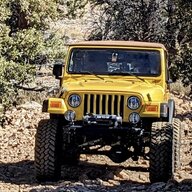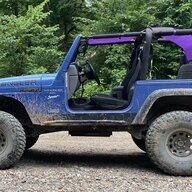
Introducing Big Juicy

When it rains, it pours. Although it's mostly stuff I probably should have already done, but circumstances forced my hand this weekend.

Haven't done much since the SYE, other than hitting the trails at Crossbar in Davis, OK. Came home from vacation to find a big puddle of ATF. "Thankfully" it was mostly caught by the skid pate, and I was able to clean that up before I dropped the skid, so I momentarily avoided a bigger mess. The only spot I found any drips was on the forward transmission pan bolts. I hadn't opened that up since I acquired it, and it was on my list but it got moved to the top of the list. New filter, lube locker, & 6 quarts of ATF later, we're back in business. It feels like it's shifting harder into drive, so I may need to re-check that level. I didn't expect to add 6 quarts, that's for sure, but I have no idea how much I lost. It was a lot.

Also a while back I replaced the u-joints in the front axles. I had a helper who wanted to use my press to do the u-joints. I told him to be careful because you can bend the ears, and guess what happened. Chromoly's had been on my list, but the front axles also got bumped to the top of the list. I had a bugger of a time with the u-joints, but I was also working by myself which made it even more challenging. On two occasions I dropped a cap and had to re-collect needle bearings. I had a stash of needle bearings from other projects, which is a good thing because I couldn't find one to save my life. It ended up being in my shoe. In the end, I CAREFULLY used my press to get enough clearance for the c-clip, and everything went in great.

When putting the new axle in I noticed that the old axle came out with dirt in the splines & on the shaft. I put the new one in/out and it also came back with dirt on the splines & shaft. I also haven't opened the differentials since I got it (I did stick my pinky in the fill hole early on and it came back with clean oil so I left that alone), but this seems kinda serious, so lube lockers also moved to the top of the list.

The oil actually looked ok, so the dirt must be caked up at the inner seal. I don't see anything looking down the tube (it's the passenger side, so it's the long side), and shoving the axle all the way in, I don't see dirt on the end poking into the carrier. Really, inside the diff there is no sign that anything is wrong. I guess replacing those seals & cleaning out the tubes needs to be on the list but I'm not sure I have time for that right now.

I'll add pics in a bit.
 
  • Like
Reactions: Nickgsjeep
Aftermath of having changed u joints in several vehicles, trying to see if I can salvage a couple as trail backups. Found one needle bearing in my shoe when I was done for the night. Another Christmas Miracle!! (not pictured). What is pictured is the fact that this isn't chronological, because you can see the oil dry on the floor but you haven't seen why I needed it just yet.

FFAAFADF-7BEF-4532-B3F8-B722DCB9E15A.jpeg


This exhaust hanger was in my way. A good 45 seconds with the torch and a light kiss with the sledgehammer and it is no longer in my way.
78770025-3A0E-492E-916E-CA8C9A190638.jpeg


pro tip: if you have all the bolts out of the trans pan while your banging on that exhaust hanger, expect a mess.
A3409A4F-123D-4C42-A5D3-E5703052FC11.jpeg


here’s the dirt that my axle shafts acquire upon insertion/removal.

EDIT: turns out the dirt was just at the bottom of the axle tube. I used the screwdriver trick to keep the shaft off the bottom of the tube...tested in & out a few times, no dirt, so I sent it.
191194BB-235D-4A63-A6D6-D991751F8E59.jpeg
 
Last edited:

How to not freak out because you just stripped out the holes for your caliper bolts: a visual essay.


Time required: < 30 mintues
Tools needed:

  • heli-coil kit
    • 570-8 tap (comes with the kit)
    • insertion tool (comes with the kit)
    • heli-coil (comes with the kit, duh)
  • 21/64" drill bit
  • drill (or drill press if you like an adventure)
  • some sort of tap holder
  • a good attitude

Rest assured you're not alone, these threads were not long for this world when they left the factory it seems. The most common way you'll find on the internet is to use a heli-coil to repair it, which is what I did because I needed it fixed tonight. There are other ways, some better, some worse, this is how I did it.

The kit comes with a tap, a strange threaded rod, and a mess of springy thread thingies. It doesn't come with the 21/64" drill bit you need to use first. OF COURSE the 21/64 bit in my piece of junk harbor freight drill bit set was broken, so I had to break down and buy the one from the parts store too. As far as drilling the hole out, the best thing to do is to remove the axle from the vehicle, stand it upright, and allow your drill press to do the work nice and straight like. But if you're on a time crunch, you'll have to use your hand drill and do your best to keep it straight. The straighter the better, but I freehanded it and it worked out ok, so clearly there is some tolerance here.

image8.jpeg


Once you're drilled out, grab your tap holder (you have a tap holder, don't you??), mount up the included tap, and cut you some threads. Slow and not necessarily steady wins the race. You shouldn't need to use any lubricant here, the tap will cut threads through that cast iron very easily. Again, make sure you go in straight. My tap holder has a ratcheting handle which makes it a lot easier to not wiggle the tap too much once it was in place. Tap it all the way through.

image9.jpeg


Next, take the black threaded rod and thread a helicoil onto the end. You'll notice that it has a weird end that sort of grabs the tang on the bottom of the coil. This is what helps get the helicoil threaded in. What they don't tell you is that they don't include the tool to back the helicoil out, so this is like Cortez burning his ships when they reached the new world-- no turning back. It also doesn't make any difference which direction you insert the helicoil from. The helicoil itself is just about the perfect length; you thread it in until it just clears the surface and it should be just about flush with the back side.

Protip: do it from the outboard side. The inboard side is just plain harder to do. Ask me how I know. But my pain is your gain, because I now know it works from either direction.

Protip the second: your tap holder will work with the insertion tool as well, but more easily if you do it from the outboard side. That said, it can be done by hand w/o the tap holder.

Protip the third: Epstein didn't kill himself.

image3.jpeg


Once the coil is in there nice and good, take some needle nose pliers and break off the tang as shown with a little bit of wiggling. This leaves you with clean threads on both sides that you can now once again use! Congrats, you did it! (new caliper bolts might not kill you, either).

image2.jpeg

image1.jpeg

image0.jpeg


Seems like everybody has this problem eventually, hopefully this helps you fix it. They claim this fix is stronger than how it came from the factory. I don't know about all that, but it certainly was an improvement over how things were about 30 minutes earlier.
 
I like that you’re bringing this thing back to life. Nice work 👍🏼
 
  • Like
Reactions: Irun

How to not freak out because you just stripped out the holes for your caliper bolts: a visual essay.


Time required: < 30 mintues
Tools needed:

  • heli-coil kit
    • 570-8 tap (comes with the kit)
    • insertion tool (comes with the kit)
    • heli-coil (comes with the kit, duh)
  • 21/64" drill bit
  • drill (or drill press if you like an adventure)
  • some sort of tap holder
  • a good attitude

Rest assured you're not alone, these threads were not long for this world when they left the factory it seems. The most common way you'll find on the internet is to use a heli-coil to repair it, which is what I did because I needed it fixed tonight. There are other ways, some better, some worse, this is how I did it.

The kit comes with a tap, a strange threaded rod, and a mess of springy thread thingies. It doesn't come with the 21/64" drill bit you need to use first. OF COURSE the 21/64 bit in my piece of junk harbor freight drill bit set was broken, so I had to break down and buy the one from the parts store too. As far as drilling the hole out, the best thing to do is to remove the axle from the vehicle, stand it upright, and allow your drill press to do the work nice and straight like. But if you're on a time crunch, you'll have to use your hand drill and do your best to keep it straight. The straighter the better, but I freehanded it and it worked out ok, so clearly there is some tolerance here.

View attachment 264992

Once you're drilled out, grab your tap holder (you have a tap holder, don't you??), mount up the included tap, and cut you some threads. Slow and not necessarily steady wins the race. You shouldn't need to use any lubricant here, the tap will cut threads through that cast iron very easily. Again, make sure you go in straight. My tap holder has a ratcheting handle which makes it a lot easier to not wiggle the tap too much once it was in place. Tap it all the way through.

View attachment 264991

Next, take the black threaded rod and thread a helicoil onto the end. You'll notice that it has a weird end that sort of grabs the tang on the bottom of the coil. This is what helps get the helicoil threaded in. What they don't tell you is that they don't include the tool to back the helicoil out, so this is like Cortez burning his ships when they reached the new world-- no turning back. It also doesn't make any difference which direction you insert the helicoil from. The helicoil itself is just about the perfect length; you thread it in until it just clears the surface and it should be just about flush with the back side.

Protip: do it from the outboard side. The inboard side is just plain harder to do. Ask me how I know. But my pain is your gain, because I now know it works from either direction.

Protip the second: your tap holder will work with the insertion tool as well, but more easily if you do it from the outboard side. That said, it can be done by hand w/o the tap holder.

Protip the third: Epstein didn't kill himself.

View attachment 264995

Once the coil is in there nice and good, take some needle nose pliers and break off the tang as shown with a little bit of wiggling. This leaves you with clean threads on both sides that you can now once again use! Congrats, you did it! (new caliper bolts might not kill you, either).

View attachment 264996
View attachment 264997
View attachment 264998

Seems like everybody has this problem eventually, hopefully this helps you fix it. They claim this fix is stronger than how it came from the factory. I don't know about all that, but it certainly was an improvement over how things were about 30 minutes earlier.
One of the few advantages of getting older. Little things like this don't freak you out like they would when you're younger. Nicely done! (y)
 
Turns out even after that lube locker I still had a leak. It was right on the back angled corner & rear most bolts, so obviously the gasket didn’t seal right. I could see the red “lip” of the lube locker extending past the edge of the pan, so I figured I had an alignment problem or something. Dropped the pan, and it looked like the gasket was maybe not cut square? The impressions are square everywhere except for this one section.
AFBB9C70-46F6-43E5-91A6-1A2C5CDFFEBA.jpeg


Rather than try the LL again, I read a thousand forum posts and elected to go with the grey-colored The Right Stuff. I followed the directions to a T, and it leaked comically. I should’ve just poured it onto my friend, would’ve had the same effect and I wouldn’t have had to clean the pan.

So we tried once more, only with the rubber gasket that came with my Wix filter, and no RTV. Which begs the question, what does the Lube Locker give me that the free rubber gasket doesn’t give me if the value add of LL is no RTV & reusability?

Anyhoo, it appeared to hold....until the next morning when the original drip returned. The advantage this time was that it was once again daylight and I had cleaned it VERY decently well so I was able to trace it.

You’ll find that a lot of people here had what they thought was a leaky gasket but found out they actually had a leaky selector shaft seal, because it’s usually too dirty up there to tell and the fluid runs to the lip of the pan/gasket and really makes you think the gasket is the problem.

67B4F463-1739-4DA6-8704-B7B5397A5197.jpeg


That leak does not look like much, but if you let it sit long enough, it will make a horrible mess.

Replaced the seal, and after 24 hours it appears to still be completely dry.
 
On the Topic of Replacing the Selector Shaft Seal

seems like this is a pretty common problem, although the first time I had ever read about it was this weekend. There are some decent videos that use a special tool to remove the seal from above, and I found at least one write up of somebody who dropped the valve body and pushed the seal out from below, I did neither. Well, I wanted to use the tool, and I thought I found it at Napa for $8.99, but it ended up being the GM version which absolutely will not work.

Time to complete: less than an hour (not including time seal spent in the freezer prior to getting started)

tools needed:
* 12mm socket
* 7/16" socket
* various picks & flathead screwdrivers
* tiny bit of grease
* Transmission selector seal

Autozone had this as part #8609 but Napa had it as # 8017. I went with the Napa part, but the AZ one looked identical.


Step 0: put your new seal in the freezer.

Step 1: DONT drain the pan, don’t remove the front driveshaft, don’t disconnect the cooler lines.

Step 2: I already had my skid plate dropped for other repairs, but it’s absolutely possible to do this repair with the skid pate on. But it’s probably easier without it.

Step 3: remove the 2 bolts holding the cable brackets. The top bracket was 7/16” and the bottom bracket is 12mm. Because of course. It was really hard to get a good pic of this, but the pink arrow is the 7/16” and the blue is 12mm. They’re on opposite sides, but each bolt has a square but on the other end that holds it in place for you.

5E600F53-70D9-4AB6-BBE7-0271C8AF3CB1.jpeg


Step 4: slide both brackets off the selector switch. I had to do some gentle prying with a flathead screwdriver to get them to slide off. There was a lot of gunk up there, even after liberal use of brake kleen.

The picture isn’t great, but both brackets are on the shaft, and they only go back on one way. The top one can be flipped toward the rear & out of your way. Step 5 deals with the other one.

895218E1-79AD-445E-83A8-F73D9E309755.jpeg


Step 5: also not completely necessary, but probably helpful was moving the shifter cable out of the way. On the rear of the bracket is a metal ring with expanding fingers on it to keep it in the bracket. Squeeze with pliers and it will pull through.
22E596FA-B6A0-41DE-9468-03338D71DEBB.jpeg


Step 6: remove the seal. This is where the tool would come in handy. But instead I started in with a pick and got some of the inner metal lip to pry up. I was as careful as I could be to not mar up the shaft. You should be even more careful.

Once I had it sufficiently f’d, I used a small flathead screwdriver and was able to get the entire seal out of the seat. It didn’t take long, but early in it seemed futile. Maybe this took 10 minutes? Probably not even.

Once you take the seal out, you start to get more ATF bleeding into the seal seat. I had a paper towel in there to absorb as much as possible before taking it out at the last second to put the new seal in. Maybe it doesn’t matter, IDK.

513E3A54-8EDF-4895-81BE-E58E26FDB233.jpeg


Step 7: put the new seal in. If you left it in the freezer long enough, it will help it go in easier. You’ll also need an appropriately sized socket as your driver. That fancy tool comes with one, but if you own a TJ and can’t improvise a seal driver....

Seal driver requirements:
* same outer diameter as the metal portion of the seal
* inner diameter big enough to slip over the shaft
* long enough that the upper tip of the shaft does not extend through the driver
* not so tall that you can’t bang on it from above.

for me, it was a 21mm 1/2” drive socket from Autozone. Had it been maybe 2mm shorter I would’ve had to use a deep drive and that would’ve been harder.

sorry, no pics of this part of the process, but it’s the easiest to figure out once you get to this point.

anyway, get your seal out of the freezer, grease the inner lip (I used some red grease, ATF will probably work too), slide the seal over the shaft (it will be snug), and slide your driver over the shaft & onto the seal. CAREFULLY and with great patience tap the driver as uniformly as possible to drive the seal into the seat nice and straight like. You’ll want it to be flush with the surrounding area, keep tapping until it is.

I used a 4 lb sledge and just lightly tapped it. Don’t worry, mine went in a little crooked, too. You can see it fully seated in the mirror

DE1AF512-4B01-4424-BC94-DEE1E6DD6E4E.jpeg


Step 8a: put it all back together. Pull the forward cable back through the retaining bracket till it seats. Then slide the selector cable bracket over the shaft. There is a flat spot on the back of the shaft that only allows it to go on one way.
Then feed the 12mm bolt back through and put the square bolt into the notch and tighten back up.

Step 8b: put the upper bracket back on. There are 2 pieces the tip of the shaft will feed through. The bottom part will fit through in any orientation. Then rotate the bracket so that the flat part of the upper shaft will fit through the upper part of the bracket. This took a little bit of patience, but once I finally had it in place it slid right on.
Put the 7/16” both through, square nut into the notch, and tighten down.

step 9: crack a celebratory Coors light, dry everything up, and wrap a paper towel around the area. Pray it doesn’t turn red.

There are other ways to do it, that was how I did it. This job ended up being much easier than I expected. The moral of the story is that if you have a leak that appears to be at the transmission pan, take your time and be 9000% certain it's not actually from this seal, especially if the problem arose after the car had sat for some time.
 
Last edited:
  • Like
Reactions: TJ Starting
Went wheeling in Hot Springs last week, and am a little worse for the wear. #1 issue is that I think/hope I screwed up the t-case shifter linkage, because it really doesn't want to stay in 4-low. I fought with it for a while on the trails, but eventually parked it and just rode with a friend. Later that day I drove in 4-hi with no issue. Then for one last test I got it into 4-low relatively easily but then couldn't get it back into 2-hi without some rolling and coercion.

The exhaust is also somewhat bent and won't got onto the hangers, so I've got to solve that somehow. I may break down and give that to a muffler shop to solve unless I can figure it out while the tranny is pulled out.

Then in late August we're going up to Disney OK which involves a lot of water. Like, a LOT. I took the JK last time, and it did fine, but I know the water will be too deep for the 32RH vent location, so I have to do that or explain to my wife why my beater jeep can't be driven here and why I have to take the nice jeep into deep water.

So projects to complete in the next 3 weeks:

  1. transmission breather relocation
  2. new transmission mount
  3. savvy transfer case cable shifter
  4. RMS
  5. oil pump, since my oil pressure seems to be weird and I'll already have the pan off
For the trans breather as much as I would love to simply re-use the existing hole, I don't think there is enough clearance to make me feel good about it, so I'm planning to follow this guide, which is similar to the one on pirate 4x4, only I intend to tap & plug the old vent rather than weld it shut.

https://www.jeepforum.com/forum/f9/relocating-vent-32rh-3-speed-auto-462033/
I've never dropped a transmission before which is pretty daunting. I"ve never pulled the pump out of a transmission before which is pretty daunting...and the FSM says to tighten the band #1 adjuster which nobody else seems to mention and also scares me. And then of course drilling on the case is scary. Plus the fact that a handful of people have reported that they started puking up ATF after they did this "upgrade." We'll be starting this later this week, and I expect a multi-day effort. Gonna try and film this one for posterity.
 
  • Like
Reactions: TJ Starting
No pics yet, but we made significant headway on the transmission breather tube. Got just about everything disconnected on the trans, just have the actual bolts, plus the cooler lines & dipstick tube to remove. I was thinking I would remove the cooler lines from the transmission body, but I think it may be easier to just remove them from the radiator. They'll kinda be in the way, but the FSM says there are potentially 3 different styles of fittings at the trans and some require a special tool, so I think I'll try to avoid that mess.

Speaking of messes, I'm currently intending to drop the trans w/o draining the pan. This may be stupid, I guess we'll find out. I had to fight with the gasket seal at the pan last month, so I'm looking to avoid that plus another $35 in ATF. I may live to regret this decision but some things you need to learn the hard way.

And I've pivoted on the vent location as well. Most of the write-ups have it set back an inch or two from the bell housing with the original vent hole being plugged. A couple brave souls have attempted to re-use the existing vent hole, which makes the most sense to me. I found someone who said they used some clay to measure the clearance from the torque converter and found it to be 17mm. The 90deg fitting I have is about 16mm assuming I can get it 100% of the way threaded in. I think I'm going to grind it down, because there's probably 2-3mm of excess meat on the fitting, and that might make all the difference.

Rest of the trans is coming out this afternoon. Wish me luck.
 
  • Like
Reactions: Nickgsjeep
This is a study in how to do things the wrong way. Part of doing things the right way is understanding WHY it's the right way, and sometimes you need to do it the wrong way to learn why.

Note to self: drain the transmission before removing transmission from vehicle. The dipstick tube will getcha. It's only held in by being "pressed" in with an o-ring. One question I can't shake is how the dipstick tube doesn't seem to be the source of a lot of fluid leaks but the shift selector shaft requires an actual seal and is the source of lots of leaks. I find this very odd.

Note to self: drain it even more, because you're still going to need to disconnect the cooler lines at the transmission because there are brackets and junk in the way. I'm sure it's possible to take the trans out w/o disconnecting them at the trans, but it wasn't worth it. But know that ATF will come out those holes. Plenty of it. Even after you drain the thing.

Regarding the vent, here's what I did (spoiler alert, it ain't gonna work):
  • tapped the vent hole with the 1/8" NPT tap. Didn't have to drill, the hole was already a smidge bigger than the bit. Praying this doesn't cause problems with the threads later.
  • Started to thread in the fitting, quickly realized the 3 "layers" of the barb would not allow the thing to turn; will hit the bellhousing after a couple turns
    • trimmed the barbs down with a hacksaw
  • Tried to fit it again, this time realized that pump bolt will get in the way while turning, but should be fine depending on the orientation
    • removed pump bolt
  • Tried to fit it again...its as in as it is going to be. There is a little shoulder(?) where the threads end, I think I'm up against that. I measured several times with my calipers, I don't think the fitting is bottomed out against the interior of the pump. Regardless, it's in as far as it it going to go.
The result is that when you finally get the torque converter in all the way, you'll find that the fitting brushes up against the back of the torque converter. I could probably shave down the fitting, and trim the hose, but this feels like the wrong approach if I have to backwoods it that hard. I think I'm going to pull the pump and put the new fitting in the top of the case.
 
I'll post a full writeup on the vent relocation once I'm done, still sort of gathering facts and working in parallel. I did get the pump out last night using the slide hammer technique. It came out with maybe 3 decent pulls on each bolt. Much easier than I expected. Now the FSM says to tighten the band adjuster (the one right by the shift selector on the outside of the case), but I don't have anything that will fit over it to allow me to torque it down......so I skipped that step. I may end up getting an 8mm crows foot to put on my torque wrench to allow me to torque it down, but I don't know how precise that 72 in-lbs needs to be, and I don't know how much additional torque the Crowfoot will add. Or maybe it won't matter since I didn't loosen it anyway.

Anyway, pump came out and the first drum sort of hung down a little. Hopefully that's not the end of the world. In all the write-ups I've seen on this project, nobody mentions the gasket. Well, there is one, and it's kinda brittle and it's stuck to the back of the pump. And I wouldn't say it's in OEM condition. The trick is finding a new gasket.

Here's where I core dump on what I have found on the 32RH transmission

  • it goes by many other names, including A-999 and TF-999.
  • It is very similar in some respects to the 42RH
  • It is very similar in some respects to the 30RH (found in the 4cyl TJ), which is also known as an A-904
  • I can't tell if the pumps are the same or not
  • The parts manual (https://wranglertjforum.com/attachments/1997-1999-tj-parts-list-pdf.14032/) lists the following for transmission pump gaskets:
    • 30RH: 5211 8266
    • 32RH: 5211 8266

In one video where a guy is doing this, I can see his pump and his gasket on the workbench, and it looks like it has 3 rectangles, then 5 holes, then another rectangle, and the pump has a similar configuration.

I found a place selling the pump gasket covering these models*: A904 (aka 30RH), 42RH, and A999 (among others). It shows 3 rectangles, then 5 holes, then a gap, then another hole. So slightly different from what I saw this other guy have. Of course I pump my pump back in last night without taking any pictures like a huge idiot. Regardless, I ordered that gasket and I'll cut it to match what I already have I guess. I feel pretty good that the FSM has both trannies using the same gasket part #.

Speaking of putting the pump back in, it's not the easiest thing in the world. First, I used 2 studs (same size as on a Dana 30 differential, FYI) to guide the pump into position, and slid it as far as it would go. From there, we stood it up on it's end (had been working horizontally up till now) and then used the old tail housing off my transfer case which even with the bearing still installed fit over the input shaft and sat perfectly on the lip surrounding the input shaft seal. I then put a 2/10 board over that, and hit it with big orange. At first it felt like I was making no progress, then bam, it dropped in.

image0.jpeg


I'm writing all this for future me to reference since I'm going to re-pull the pump once the new gasket arrives. I wish I had spent as much time researching that gasket prior to pulling the pump, so my parts could've all been on-hand.

I'm still cautiously optimistic that I haven't completely ruined my transmission.


* Gasket is for these models: A904 Front Pump Seal Up Gasket Kit 42RE 44RE A500 40RH 42RH A998 A999 TF6
 
Last edited:
  • Like
Reactions: Nickgsjeep
Gasket arrived by mail a day ahead of schedule, via usps. I had the day off, but didn't check the mail (normally runs at like 10AM), so I could've gotten started early as it was the only thing I was waiting on . Instead I discovered it was in the mailbox all crushed up at 7pm, couldn't get started till about 1030 pm. Luckily my buddies like to work late.

Thanks USPS! I put the gasket under my copy of Gradshteyn & Rhzhik (Table of Integrals, Series, and Products) which was enough to flatten it out before I needed it.

image3.jpeg


32RH Band Adjustment & Pump Install
Re-pulled the trans pump to replace the gasket. This time I had an 8mm crowfoot on hand in order to tighten the first band & do the adjustment at the end of the process. Had to do a lot of thread cleanup because the 3/4" locknut wanted to turn the adjuster screw.

General process is as follows, and can be found in the FSM or elsewhere:
  1. loosen 3/4" locknuet
  2. tighten band adjuster screw
  3. Remove pump
    1. if you tighten the band, that first drum will stay put. This is handy. If you do it upright, you MAY not need to mess with the band adjuster.
    2. If you do it horizontally it will sort of drop and hang, and could cause alignment issues. I did it horizontally the first time and I'm pretty sure I was still able to get everything back in place, but it could've gone worse and I haven't started the car yet so who knows?
  4. do your stuff
  5. put studs in some/all of the bolt holes
  6. line up your gasket (assuming you were able to find one)
    1. removing the old gasket was a pain because it seems to be almost burned on. I had to work very hard with a razor blade to get the gasket off the pump. Mercifully there was very little gasket left on the case where the pump sits, and what was there came off easily. Scraping on that aluminum surface sounds like a bad idea.
image1.jpeg


Then line up the pump and slide it over the studs and drive it home as described in my last post. The first time we did this, the pump fell right in, but we hadn't tightened that band. The next time we did it we had tightened the band and it would not drop in, so we loosened the band and it went right in....only we had removed the studs because we were afraid they were binding, and the pump lost alignment with the gasket, so we tightened the band and lifted the pump out slightly. Lined everything up, put the studs back in, and it literally fell right into place. So maybe it's less of a band tightening thing and more of an alignment thing. I have no idea. I probably broke it, lol.

image2.jpeg


I also didn't replace the seal, nor did I replace the huge rubber o-ring. They looked like they were in great shape, and I didn't want to fix what wasn't broke, although dropping/re-installing the trans is a bear.
 
Also fixed the NSS pigtail. It has a plug on both ends so I was able to remove it and solder splice. For some of the other connectors which need help, I may have to crimp/buttsplice them from under the vehicle.

The new NSS has a slightly longer plunger and I think sits a little deeper in the trans...hopefully that doesn't cause a problem. There were 2 models on Amazon, the 240 & 240T. I bought the 240T, maybe I should've bought both and compared.

image3.jpeg
 
I spent a good portion of yesterday putting all the transmission bits back on, including a new deep pan which has a drain plug. I also welded in a bung for a transmission temp sender. I put in 4 quarts overnight, no leaks. Also yesterday I attempted to prime the pump with a drill through the distributor hole as I've seen in several videos, but I was unable to get any pressure.

So I decided to fire up the engine despite having not been able to prime the pump with a drill. The plan was to fire it up in the hopes that for some inexplicable reason running the motor would just make it all work. And it did. Oil pressure came up within 3 seconds, although it's holding around 60 psi at idle now. I don't know if that's because of the new pump, or because I replaced the rear main seal, or because I'm running 10W-30 instead of 5W-20. That's like twice as many W's or something. Running through the gears has it moving between 35 & 60ish.

Speaking of running through the gears, I've been adding ATF trying to find the right level, but this thing is just drinking fluid. I didn't spill any out of the torque converter, and the pan has a bigger capacity, and I don't appear to be leaking anywhere. I had been running with the t-case in neutral because I'm scared to death that I screwed up the transmission from (a) removing the pump w/o tightening that band first and (b) touching the band adjustment at all.

I finally had the courage to put the t-case in gear and run through the transmission gears....no noise, can definitely feel it shift, and despite having the e-brake on & being chocked, I can feel it want to pull. We may be out of the woods. Next step is to put the skid back on and actually test drive it.


= = = = = = = =

While we're here, let's talk about that dipstick tube. When we went to put it back in, there was some debate about how far it needed to go in. Had the pan off, so we basically put it in as far as it would go, which was where the bottom of the tube was flush with the bottom of the hole inside the transmission. Put everything back together, and then realized/remembered there was a bracket for that dipstick, and I must have the tube too deep because it doesn't line up with the bracket. But it also doesn't leak at the o-ring, which is also a big concern. But then again it has more wobble than is healthy, so I need to get it tied in somehow.

Options:
  1. make a little bracket to go between the tube and the bell housing hole.
    1. this would leave things as-is, which means no change in leak status
    2. the stick would read artificially high because the stick has about 1/2" too much penetration
  2. CAREFULLY wiggle the tube back up to allow it to align with the existing hole
    1. I could accidentally pull the whole thing out and I already know that means ATF everywhere, because that's what happened the first time I pulled it out.
    2. It could change the leak status
  3. Use that fancy drain plug I just installed and drain everything into a clean bucket, do what I need to do with the dipstick tube, and then re-fill
    1. it's a pain to clean the bucket
    2. it could change the leak status
    3. It could give me the opportunity to put a new o-ring on the tube, IF it's the same size as one of the o-rings in the pack I got from harbor freight today. We reused the old o-ring, but it could probably be refreshed.
The obvious answer is #3, but I'm not excited about draining it. I'm even less excited about making another mess though.
 
  • Like
Reactions: TJ Starting
Just completed the maiden test drive. Everything seems to be FANTASTIC aside from this new noise I picked up, seemingly unrelated to the work we did. Or at least not directly related. Ran the wires from the trans temp sender into the engine bay until I'm ready to tackle that side of that project. I need to get some wire loom, but I want to mention that using non-insulated crimps is SO MUCH BETTER than those crappy plastic insulated ones. They hold way better, they look way better...they do take a little more time to make sure it's in the crimper die correctly, but so worth it. I feel like I should post a picture. Except I don't have one.

so far no ATF leaks either. I'm super anxious to see if the RMS stopped my oil drip. I figure I'll know by morning.

Here's that pesky noise:


Another interesting thing is that the oil pressure spends a lot more time near 60 than it ever did before. It does seem to hold pressure better; used to be coming into a hard stop would drop it to 0, replacing the sender made that be closer to 10psi at a stop. Now I'm holding 30psi. Not sure how reliable that gauge is though.
 
The noise was not having my rear driveshaft tightened. If that's the only bonehead thing I did during this massive project, I'll be stunned. Drove it for about 10 mins after tightening the bolts, everything is great.

Then took it out just now and (a) wouldn't start up immediately, (b) finally did fire up after a LLLOOONNNGGG crank, (c) needed me to feather the gas to stay alive, died the moment I stopped doing that. Tried again, fired right back up. That was weird and I don't know what it might have been. But I'll check the CPS bolt and the dizzy hold down bolt later tonight. Those seem like likely suspects for a crank but no start scenario.
 
  • Like
Reactions: SoCalGlide
Oil pressure still living around 60psi a significant portion of the time. I need to get a real gauge on that soon.

I also installed a trans temp gauge. I had a killer coupon so I went with the cheap Glowshift. I like the 270deg sweep, and I'm banking on the fact that many problems & bad reviews can be traced back to bad installs. I'm confident I can do a better job on the wiring than most, although I've just rough plumbed everything as a test fit so no pictures yet. :). Or maybe they really do suck and I'll regret this purchase, although I'm only in for about $15.
While doing the gauge wiring I discovered this rats nest behind the stereo. The wiring was correct, although he missed the radio ground wire, not sure how it even worked. And then he had an additional half of a connector wired in-between the gray and black harness plugs. No idea why he did that, it was absolutely unnecessary even based on how he did the wiring. Also determined that the fact that it doesn't have power in the ACC position is not due to crappy radio wiring, it's somewhere before that in the electrical flow, because the wiring is correct now and it still happens, and the cigarette lighter has the same behavior (didn't notice that before).

image0-6.jpeg

drained the atf and extracted the dipstick tube enough to let it bolt into the bracket at the bell housing. I feel like it's a little bit too far out; I liked it a lot more where it was, but the wobble would've bit me on the trails, guaranteed. I think the o-ring is probably starting to fail. I have one in my harbor freight o-ring sampler that I think is just a little bit too small, so I kept the original. It's weeping a very tiny bit at the hole now, which is almost certainly because of the o-ring. Of course I found one on eBay AFTER I drained the fluid, it won't be here for a couple of days. Good chance I'll drain the tranny after the upcoming trip, so I'll have a chance to address that. Also need to replace the pigtail on the TC lockup, that wiring is in bad shape.

All this work was in preparation for our annual trip to Disney, OK, which involves a ton of reasonably deep water crossings. The JK did great there last year, but I've spent the last 10 months building the TJ up for this purpose. My #1 concern is obviously the water, but my #2 concern is the fact that I've had this thing pretty well apart, and while it drives a-ok, it's a 5 hour drive (yes, we drive not tow) is a stress test that I won't know if I've passed until I'm there.
 
  • Like
Reactions: SoCalGlide
Oil pressure still living around 60psi a significant portion of the time. I need to get a real gauge on that soon.

I also installed a trans temp gauge. I had a killer coupon so I went with the cheap Glowshift. I like the 270deg sweep, and I'm banking on the fact that many problems & bad reviews can be traced back to bad installs. I'm confident I can do a better job on the wiring than most, although I've just rough plumbed everything as a test fit so no pictures yet. :). Or maybe they really do suck and I'll regret this purchase, although I'm only in for about $15.

While doing the gauge wiring I discovered this rats nest behind the stereo. The wiring was correct, although he missed the radio ground wire, not sure how it even worked. And then he had an additional half of a connector wired in-between the gray and black harness plugs. No idea why he did that, it was absolutely unnecessary even based on how he did the wiring. Also determined that the fact that it doesn't have power in the ACC position is not due to crappy radio wiring, it's somewhere before that in the electrical flow, because the wiring is correct now and it still happens, and the cigarette lighter has the same behavior (didn't notice that before).

View attachment 272886

drained the atf and extracted the dipstick tube enough to let it bolt into the bracket at the bell housing. I feel like it's a little bit too far out; I liked it a lot more where it was, but the wobble would've bit me on the trails, guaranteed. I think the o-ring is probably starting to fail. I have one in my harbor freight o-ring sampler that I think is just a little bit too small, so I kept the original. It's weeping a very tiny bit at the hole now, which is almost certainly because of the o-ring. Of course I found one on eBay AFTER I drained the fluid, it won't be here for a couple of days. Good chance I'll drain the tranny after the upcoming trip, so I'll have a chance to address that. Also need to replace the pigtail on the TC lockup, that wiring is in bad shape.

All this work was in preparation for our annual trip to Disney, OK, which involves a ton of reasonably deep water crossings. The JK did great there last year, but I've spent the last 10 months building the TJ up for this purpose. My #1 concern is obviously the water, but my #2 concern is the fact that I've had this thing pretty well apart, and while it drives a-ok, it's a 5 hour drive (yes, we drive not tow) is a stress test that I won't know if I've passed until I'm there.
How deep do you expect the water crossings to be?
 
How deep do you expect the water crossings to be?

Not above the hood, but definitely over the winch. I've got my other breathers up higher, not much to be done with other stuff. A snorkel wasn't necessary last time, but it's probably not a terrible idea to have a temporary one for this trip.
 
I'll post in the wheeling trips channel, but as a quick report, the water was WAY down from last year. Still a few deep places you could hit if you weren't careful, and we flirted with the edge a few times, but no real water-related trouble. Although the 2 times I got in real trouble it was in the water, but never near the intake.

Trans temp gauge worked great, glad I have that now. And the savvy cable t-case shifter solved the 4-low problems I had on our last trip. Once or twice got up near 220, but both times were while stopped. I think that Derale cooler is in my future.

Things I need to investigate after this trip:
  • On hot days, temp gets up to 230 when doing > 65mph for an extended time (as reported by my reader showing live data), but cools down to 210 or lower if I slow down or stop at a red light. It did this on the way to/from my last trip so not the result of recent damage. :)
  • fan seems to be hitting the shroud when I turn, possibly a result of some damage
  • low rumble from up front, present > 50 mph. Possible driveshaft balance issue?
  • puking up ATF, possibly because I over filled it
  • other ATF leaks?
  • Check control arms & mounts, hit them hard multiple times

This was a cool pic, but was about 100 yds past the sign saying "no motor vehicles past this point." I only saw the sign after scouting how to get around that drop, immediately pulled back. Pensacola Dam is the longest multiple arch dam in the world. Pictured here is about 1/3 of it.
IMG_2520.jpg
 
  • Like
Reactions: TJ Starting