How to install a Ecoboost oil cooler / heater in a 4.0 and why

It might actually be useful in a boosted application.

My first concern would be that whatever extra load you're putting on the oil pump might be more detrimental to your engine's longevity than slightly hotter oil temps.

It should actually be significantly lower load on the oil pump. As oil temperature rises, viscosity decreases, meaning it is easier to pump and also flows through all of the channels more easily. Worst case, your pump would go into relief about 60 PSI, which it probably already does fairly frequently, especially at high engine RPM.

In terms of restriction, your oil filter is going to be way more flow restricting than a stacked plate cooler. A bigger oil filter like the M1-301A will more than offset any increase in restriction caused by adding the exchanger.

 
It should actually be significantly lower load on the oil pump. As oil temperature rises, viscosity decreases, meaning it is easier to pump and also flows through all of the channels more easily. Worst case, your pump would go into relief about 60 PSI, which it probably already does fairly frequently, especially at high engine RPM.

In terms of restriction, your oil filter is going to be way more flow restricting than a stacked plate cooler. A bigger oil filter like the M1-301A will more than offset any increase in restriction caused by adding the exchanger.

Sounds like a pretty optimistic theoretical analysis to me.

You would be adding restrictions to your oil plumbing. Interesting conclusion that more restriction = "easier to pump".
 
Sounds like a pretty optimistic theoretical analysis to me.

You would be adding restrictions to your oil plumbing. Interesting conclusion that more restriction = "easier to pump".

Even a 5W-30 oil has a massive change in viscosity as temperature rises. At 32F, it has a kinematic viscosity of 600 cSt, but by 212F, it is only 11 cSt. While the power required to pump that oil isn’t exactly linear with respect to kinematic viscosity, it still makes a massive difference.

This is where the net fuel savings come in on the oil heater. Without the heater, the higher viscosity results in a far higher pump power requirement during a warm-up cycle. After the unit is fully up to temperature, there is no significant difference.

The tiny amount of additional power required to flow oil through the heater is negligible compared to the energy saved during warm up.

That said, it is more likely that our pumps go into relief mode very quickly during warm-up or really any condition that isn’t idle or near-idle. In this case, the pump enters relief far sooner when the oil is cold, meaning less oil volume is flowing into the engine. The power consumption of the oil pump in this case is less affected by viscosity, and really is just a function of engine RPM. As the oil warms up, less oil is recirculated via the relief, and instead, more oil is pushed through the engine.

Even in the relief case, however, overall engine power drops as the oil heats up. Even though the power consumption of the oil pump isn’t significantly changed, the changing viscosity greatly affects the power lost in the hydrodynamic bearings. As the oil warms up, viscosity drops, and less viscous shear force is developed in the hydrodynamic bearings. Thus they spin more freely, and more power can be generated for the same amount of fuel burned.
 
So tell me how you know (facts, not theory) that the coolant warms more quickly than the oil.

That's surprising to me.

Seems like most of the theoretical benefits claimed occur during warmup. For me, warmup is < 0.5% of my running time so wouldn't be significantly helpful anyway but if oil really does warm slower than coolant, that is a fact I appreciate knowing.
 
Unfortunately most of the papers are paywalled, but some abstracts still reveal some good data:

Startup fuel consumption reduction of 8% by use of oil/coolant heat exchanger:
https://scholar.google.com/scholar?...t#d=gs_qabs&t=1726519325852&u=#p=4w1NBjoSDUIJ
Here's one comparing EGR oil heating to a stacked plate oil/coolant heat exchanger:
https://books.google.com/books?hl=e...ALZWq01JRStEJB3NmvEeZ0pHI#v=onepage&q&f=false
Here's another one showing a positive heating effect on the oil from the coolant:
https://scholar.google.com/scholar?...t#d=gs_qabs&t=1726519871876&u=#p=d3ypStAXXH8J

Here's one comparing a system with a heat exchanger to one that also has an exhaust gas to oil heating loop:
https://www.e3s-conferences.org/art...conf_ati2021_07023/e3sconf_ati2021_07023.html
Although this one isn't about a coolant to oil heat exchanger, it has a lot of good theoretical discussion about why heating the oil works:
https://scholar.google.com/scholar?...=#d=gs_qabs&t=1726520642459&u=#p=59n2ihMnYc8J
 
Well, 1st tank with the these mods and I get 15.4 MPG city and mountains. I'm used to closer to 12-13 mpg. I think if I can clean up the tune and do a couple small additional improvements, I can get 1-2 mpg better.

15.4 mpg would indicate a roughly 20% reduction in fuel consumption since I first flashed a tune and started retrofitting parts, which is huge. At 10,000 miles a year, that's $600 in fuel per year. But it also means every tank gets me an extra 50-60 miles, which is an additional hour of driving time before having to fill up. (If I manage to get it up to 17 mpg, that would be a 26% reduction in fuel consumption, and could save $850 a year, and increase the range by 90 miles...)

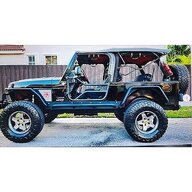
Note I have the run-of-the-mill 35x12.5 on 5.5" of combined lift. It is also a Rubicon model with heavy steel bumpers and tire carrier. So not surprisingly, my fuel economy is abysmal to begin with.

As for how much fuel economy gain is due to this heat exchanger in particular, it is very hard to say. It certainly has a big impact on city driving since it heats the oil up faster, but it seems to also have a small benefit on highways at reducing detonation, allowing me to keep more aggressive timing while staying stochiometric in closed loop.

I would guess it will pay itself off in the course of 1-2 years, even before accounting for savings associated with increased oil/engine life.

Maybe I need to chase 20 mpg on 35s for the heck of it...

I have no idea why, but I was thinking of this thread today and wanted to give you another idea.

A couple years ago I had a truck that sucked the gas faster than a fat kid eats Twinkies. Could not figure it out, nor could a couple of shops. All the usual suspects were checked and replaced ( I won't bore you with all of them) but here are a few that I believe made a difference.

Spark plugs were changed to platinum. Injectors changed to Bosch 4 holes. These two got the truck back to a reasonable number but not where it should be. Then one day it would not start easily and found a crappy battery cable. Changed it and made a big difference. Decided to change all of them, a total of 5 or 6 and mileage went back to where it was when new. Changing the cables with corrosion blocking the flow of electricity was the single biggest improvement and this was on a truck with 200k+.

For $30 and an hour of time you might get closer to your goal of 20 on 35's.
 
  • Like
Reactions: Steel City 06
I have no idea why, but I was thinking of this thread today and wanted to give you another idea.

A couple years ago I had a truck that sucked the gas faster than a fat kid eats Twinkies. Could not figure it out, nor could a couple of shops. All the usual suspects were checked and replaced ( I won't bore you with all of them) but here are a few that I believe made a difference.

Spark plugs were changed to platinum. Injectors changed to Bosch 4 holes. These two got the truck back to a reasonable number but not where it should be. Then one day it would not start easily and found a crappy battery cable. Changed it and made a big difference. Decided to change all of them, a total of 5 or 6 and mileage went back to where it was when new. Changing the cables with corrosion blocking the flow of electricity was the single biggest improvement and this was on a truck with 200k+.

For $30 and an hour of time you might get closer to your goal of 20 on 35's.

Actually I do have the 12-hole injectors. I suspect they are helping a lot, especially in combination with the colder air resulting from a few other mods, since the larger droplets from the one-hole injectors would otherwise take longer to vaporize.

Spark plugs are Autolite Platinum as well. I also have the Viper coil mod, but I'm not sure how much I can attribute to those.

Wiring is all fairly new and oversized, since my alternator is larger than stock and I run a 850 watt brushless fan and also have a winch.

Currently up to around 17.5 MPG.
 
  • Like
Reactions: DuckNut
Actually I do have the 12-hole injectors. I suspect they are helping a lot, especially in combination with the colder air resulting from a few other mods, since the larger droplets from the one-hole injectors would otherwise take longer to vaporize.

Spark plugs are Autolite Platinum as well. I also have the Viper coil mod, but I'm not sure how much I can attribute to those.

Wiring is all fairly new and oversized, since my alternator is larger than stock and I run a 850 watt brushless fan and also have a winch.

Currently up to around 17.5 MPG.

An XJ thread discussed how the 12 holes don’t do anything on our setups, but installing new injectors helps when old injectors needed to be replaced.

Something about the port design limiting how much improvement could be made…and they discussed FRP’s shared experience with many dyno runs showing no discernible difference.

Regarding wiring, would anything beyond resistance and voltage drop tests help us determine if the wiring needs replaced?
 
  • Like
Reactions: Steel City 06
Regarding wiring, would anything beyond resistance and voltage drop tests help us determine if the wiring needs replaced?

the problem with battery cables is they can be 90% broken through but as long as there's a few strands, it won't show any resistance at the current that a volt meter puts through it for measurement, and it won't show voltage drop with just a few milliamps that pass through without a heavy electrical load. You'd probably want to check voltage drop with the stereo blasting, the fuel pump and all your lighting on.

I'll be transparent here that I don't understand the mechanism through which a battery cable could impact your fuel efficiency without being so bad that you felt something wrong. You either need to be passing fuel through without making power (like a misfire) or passing more fuel through than you can burn (like consistently running rich). I think a misfire would be felt and trip a DTC, maybe a reduced reference voltage could cause the O2 signal voltage to shift down and cause the PCM to add fuel thinking it was running leaner than it was? But I would think it would affect all sensors (IAC, ECT, MAP, TPS) and surely one of them would have tripped a DTC...

EDIT: Another thought that just occurred to me is if the alternator cable was bad it might lead the PCM to regulate the voltage up to get correct voltage to the PCM, putting extra drag on the accessory belt. But that doesn't seem like something that would make enough of a difference that someone would notice and clearly know something was wrong.
 
Ran into the battery cable issue the other day with my trailer winch. Cables were dressed down the side and someone had wrapped a soft shackle around that steel. Cable barely looked touched but the winch wouldn't work worth shit.

-Mac
 
the problem with battery cables is they can be 90% broken through but as long as there's a few strands, it won't show any resistance at the current that a volt meter puts through it for measurement, and it won't show voltage drop with just a few milliamps that pass through without a heavy electrical load. You'd probably want to check voltage drop with the stereo blasting, the fuel pump and all your lighting on.

I'll be transparent here that I don't understand the mechanism through which a battery cable could impact your fuel efficiency without being so bad that you felt something wrong. You either need to be passing fuel through without making power (like a misfire) or passing more fuel through than you can burn (like consistently running rich). I think a misfire would be felt and trip a DTC, maybe a reduced reference voltage could cause the O2 signal voltage to shift down and cause the PCM to add fuel thinking it was running leaner than it was? But I would think it would affect all sensors (IAC, ECT, MAP, TPS) and surely one of them would have tripped a DTC...

EDIT: Another thought that just occurred to me is if the alternator cable was bad it might lead the PCM to regulate the voltage up to get correct voltage to the PCM, putting extra drag on the accessory belt. But that doesn't seem like something that would make enough of a difference that someone would notice and clearly know something was wrong.

The tiniest little hole in the cover and it will start corroding. After years the wires may be completely covered in corrosion and cause an insulating incident. 20 years bouncing around in the elements is probably past their prime.
 
the problem with battery cables is they can be 90% broken through but as long as there's a few strands, it won't show any resistance at the current that a volt meter puts through it for measurement, and it won't show voltage drop with just a few milliamps that pass through without a heavy electrical load. You'd probably want to check voltage drop with the stereo blasting, the fuel pump and all your lighting on.

That’s true about the limitations of a standard multimeter for resistance checks on a bigger line.

A load tester that checks the alternator (in addition to the battery and starter) should do that.

EDIT: Another thought that just occurred to me is if the alternator cable was bad it might lead the PCM to regulate the voltage up to get correct voltage to the PCM, putting extra drag on the accessory belt. But that doesn't seem like something that would make enough of a difference that someone would notice and clearly know something was wrong.

Yea, I doubt a half volt or so increase would decrease the MPGs enough to notice. And our gauge and computer would likely inform us if we were running in the 15v+ range.

I’ve seen alternators push around the 14.1V range at the alternator even when there was a bad/failing connection at the battery (due to corrosion or a loose cable fastener). The voltage revulstor should prevent it from overcharging.

In a previous truck, the voltage read normal when the cable was barely connected (had a loose cable fastener). Yet, there wasn’t enough current flow to start the engine after it sat…even though the lights and stereo worked just fine. It started right up when I properly screwed in the battery cable terminal because it allowed for more current flow.
 
Buy 3 feet of 3/4 coolant hose

Is there a reason to use the molded heater hoses at all instead of just buying regular hose by the foot? 20 years ago I used marine grade hose off a reel on my 1993 Ford Explorer instead of buying the molded hoses but if it's better I'll do it for the lower. (Since I'm replacing all my coolant hoses anyway I'm thinking I'll do hose by the foot for the entire top hose instead of buying a molded one then cutting it and putting in a fitting.)
 
Is there a reason to use the molded heater hoses at all instead of just buying regular hose by the foot?

You can use bulk hose but you'll appreciate the two molded 90s...which yes you could approximate with fittings but have more places for failures and leaks.

I used bulk hose but it was on the 3/4" side and only to add an oil cooler into the mix. I didn't add fittings...just did a big sweep.

-Mac
 
  • Like
Reactions: Steel City 06
Read through this whole thread. When I saw LN Engineering in a link I certainly knew the name as they provide alot of solutions for my other car, a 997.2 C4S ('09-'12 911).

And since there was some discussion about oil temp sensor location, thought I'd share how Porsche do it, at least in the 9A1 found in '09-'15 911s. In these the dual temp and fill sensor runs down through the block from next to the oil filter (which is on top) to the pan. Temp and fill level is picked up from the pan which holds 9 Qt and is an "integrated dry sump" heavily baffled to prevent oil pickup losses under high cornering loads. The oil temp gauge is generally considered very accurate. Most including myself run 8 Qts of 0W40 as there can be some overfill issues with the boxer layout on hard cornering.

And on to what the oil temps look like. Well, they move around much more than coolant temps and are both air temp and load sensitive. The highest I've ever seen was 300F on the long sustained climb out of Death Valley in summer with a typical 120F-ish temp at Furnace Creek. Typically they'll run between 190-250 and I'd say at cruising it'll usually be at 225. In winter under low load it can run under 200 sometimes but rarely. Climbing a steep grade at interstate speeds in 50-90F air temps it often climbs to 250.

I would expect the 4.0L oil temps to vary in a similar way. I would see the heater function being quite useful where I live.
 
I used bulk hose but it was on the 3/4" side and only to add an oil cooler into the mix. I didn't add fittings...just did a big sweep.

That's what I was asking about. The OP cut his fitted hose and added a 90° fitting to connect the hose from the heat sink to the cut fitted hose. I was just going to get 5' of hose and not have a fitting like he did. (I'll use the fitted hose for the lower one, a gates heater hose isn't very expensive.)

20230919_185548.jpg
 
  • Like
Reactions: macleanflood
Is this something that happens with a stock PCM (no tune)? If so, might the Windstar cowl intake help with that even without a tune?

In regards to just the oil cooler, the effect will probably be minimal and below what can be easily measured outside of a laboratory. A tune might be able to take more advantage of this though. Cooling the oil during extended periods of high load might help reduce hotspots in the cylinders, which would allow a tuner to be more aggressive in those scenarios. Without a tune, the only effect that may be helpful is the slower temperature response of coolant to rapid changes in engine load. Particularly, since the coolant wouldn’t see as fast of a temperature rise as it would without the oil/coolant heat exchanger, default engine timing might be sustained for a longer period.

As for the Windstar intake, the answer to that is yes, and there is now hard data to back that up thanks to @Jezza in this thread (a few pages in):
https://wranglertjforum.com/threads/dyno-testing-bolt-ons-on-the-4-0.79004/

I had previously assumed the effect would be small without tuning, but as it turns out it is fairly substantial even without tuning. As to how that breaks down between gains from more ideal ignition timing and from the higher density of air, I don’t think that has been explicitly proven yet. (Both probably have some positive effect.)
 
  • Like
Reactions: Rickyd
Would simply insulating the air hose off the stock air box make any difference then?

Little to no effect most likely. The mouth of the intake is probably at a cooler location than the majority of the tube, but the difference will be fairly small. So there would be fairly little heat transfer here. I would say it is probably not worth the time or effort.

As for insulating the Windstar intake, I suspect that an insulated Windstar intake will show a small bit more gain than just the Windstar intake alone. Since the incoming air is ambient and then passes over a fairly hot area of the engine compartment, it would have a significantly higher rate of heat transfer compared to the stock setup.

So I recommend Windstar intake first, then insulate that if you have time.

As for how much gain can be had without a tune, you will actually see more gain from insulating anything upstream of the intake air temperature sensor than downstream. Upstream of it, it will have effects on both engine timing and on air density, but downstream, it will only affect air density. The PCM (at least in the late model TJs) estimates manifold air temperature based on IAT, coolant temp, and other factors.

That said, insulating downstream of the IAT sensor is probably still beneficial due to the higher air density as well as the reduced tendency of the cooler air to detonate. (Also, a tuner could take advantage of this heightened detonation threshold for more timing gain.)