Novak Conversions Jeep Wrangler TJ engine mounts

Crazy idea for custom cargo rack

TJMexico

TJ Enthusiast
Original poster
Supporting Member
Joined
May 26, 2025
Messages
281
Location
NW Mexico
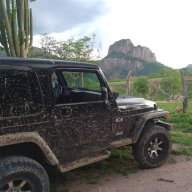
I just made a trip into the mountains that generated some questions that I'll post later. It was less than 50 miles one way and took over four hours. On the first 1/4 of the trip I was able to make about 30mph, so that'll give you an idea of road conditions on the last 3/4. Some places were just bare spots on the mountainside where a vehicle could fit. But I ended up in a little village that was one of the most beautiful places I have ever seen with some amazingly sweet people.

I plan to go back, but I need MORE CARGO CAPACITY. I have actually considered swapping the TJ for a Cherokee XJ, but I really don't want to. I love the way the little Negrita handles back there. So, I have this wild idea that I need somebody to talk me out of with a rational explanation.

Now, I know that some will say that this would be ugly, but aesthetics are way down the list of my concerns. I need to be able to carry cargo. I need it to work over the hard top as we get funky weather here and I have to have cover for these long treks into the mountains.

Here in Mexico I have seen pickups that have full-body length cargo rack that are attached on the front and rear bumper. There is no connection to the body of the vehicle. Some 45 degree angles can add rigidity at the top joints, but there is nothing else holding it up. My idea is to design something like this for the Jeep. It'd entail new custom made bumpers on front and back where the rack would attach. I'd have to rig something so that I could open the hood enough to get to the engine. Probably have the front basket detachable and just load it with light stuff. Maybe have middle supports attached to the door hinge or the window bolts like some of the aftermarket cargo racks.

The photo below is something like what I'm talking about.

My main concern is the rigidity of such a contraption for off-road use. First, I am not sure how much the chassis twists on a TJ. This would likely be a concern as it would mean that the rack would twist and likely come apart if there is sufficient twist in the chassis.

I know a really good metal smith here. He does big cargo beds for carrying cattle on two-ton and three-ton trucks. Dude know his stuff. If it can be done, he can definitely do it.

So, what do you all think? Am I crazy? Or can this work?
CargoRackFullLength.webp
 
Should probably be weight. A 500 lb rack up high mounted to an 8,000+ lbs 1-ton truck isn't much. A 500 lb rack mounted to the top of a Jeep will be a lot to deal with. Start adding heavy bumpers and you'll quickly max out the Jeep without loading any cargo.

That had crossed my mind, as well. The total weight of the rack would be a lot.

Thanks. That's my first rational reply against.
 
  • Like
Reactions: Woodrow
I've followed Blake and Chelsea's adventures in their '98 TJ for several years now on IG (@cb_overland) and YouTube.

The dude is a DIY master. He built a simple and effective roof rack; their TJ's essentially open-air 365 (certainly not my choice) — that said, you might gain some inspiration and insight.

The Fox Adventure Rig Overview I Walkaround 1998 Jeep TJ Overland Build |

CB Overland.png


CB Overland_IG.png
 
Last edited:
I've followed Blake and Chelsea's adventures in their '98 TJ for several years now on IG (@cb_overland) and YouTube.

The dude is a DIY master. He built a simple and effective roof rack; their TJ's essentially open-air 365 (certainly not my choice) — that said, you might gain some inspiration and insight.
Nice rig. I wish I could go open air, but the weather here prohibits it. Summer rainy season and snow in the winter up in the big mountains. But thanks for pointing me there.
 
I'd use a short trailer for additional capacity. Easier to load too!

View attachment 636880View attachment 636881

-Mac

Booyah! I had thought of this, as well.

Best trailer I ever owned was the bed of an old wrecked Datsun pickup (shows you how long ago that was) with a yoke welded on front. I have been thinking about hunting down a front-end wrecked small pickup and doing that, but even a trailer like you have pictured here would work, and would probably weight much less. Something about 2 to 2.5 meters long would be perfect.

I am not sure why I abandoned that idea and started looking at racks, but I need to go back to considering this option. I think it might be my best bet.

Is that your rig? If so, how much weight can you handle in addition to the trailer, and how does it handle on rough trails? I travel some really bad trails.
 
Last edited:
Definitely would recommend the trailer over a huge rack. I run a Garvin expedition rack, but max load never exceeds 300 lbs. 2-3 Grumman G1750C and G1740C canoes plus paddles, life jackets, etc. totals just under 270 lbs. Anything beyond that, I wouldn't even bother.

If you build a trailer, use a standard 3,500 lbs axle. This has the exact same bolt pattern as the TJ. Given that and that you can use 3,500 axle brakes (with the trailer derated to 2,000), you can run the exact same wheels and tires as you have on your jeep. The additional leverage from the larger tires on the brakes is counteracted by the fact that you have 3,500 lbs brakes on a 2,000-lbs rated trailer.

If you have cash, Timbren makes a specific axle-less suspension rated at 1 Tonne (2,200 lbs) that is actually just the 3,500 lbs model with the same spring and a longer arm. This is ideal as it allows you to use the 3,500 lbs hubs and incorporate the softer ride of the same spring on a longer lever. It also gives your trailer quite a bit of suspension travel.

Electric or electric-over-hydraulic brakes make things a lot nicer versus surge brakes. There are companies that make disc brakes for trailers as well.
 
Last edited:
... Electric or electric-over-hydraulic brakes make things a lot nicer versus surge brakes. There are companies that make disc brakes for trailers as well.
Brakes is something I had never thought of. I'm down in Mexico, so getting brakes installed on a trailer might be pretty difficult where I am.

I'd only be using it off-road, really. The longest run on pavement would be just a few miles before I jump onto dirt, then it's all rocks and arroyos (creeks) after that, along with some trails that don't even count for roads.

I've never used a trailer on that kind of terrain before. How critical is it to have trailer brakes when traveling like that?
 
I don't have trailer brakes.

I can tow a 18' RV...it just takes three trips.

We were cleaning up a dumped RV about a 1/4 mile off the main road...the trail back to the RV degraded into a Jeep trail as the RV rotted away.

Rather than cut out and improve the trail to get my truck and dump trailer in...I used the Jeep and that little trailer.

Bought that trailer from a guy in town. Looks like it might have had some equipment bolted to it...but it's tilt deck and I can drive my craftsman mower right on it. We volunteer mow the local park.

I've also used the trailer to deliver generators, fuel, water and food to folks farther up the road when it snows too much or we get a big storm and all the trees come down on the power lines.

-Mac
 
I had considered building a trailer at some point as well, and so I had done a bunch of research into trailer design and stability. Here are some notes that might be helpful:

  • A common rule of thumb is to have about 10-20% of the trailer weight on the tongue. This is a rough rule. A good implementation of this is to place the axle at a 60:40 location on the cargo body of the trailer, ignoring the tongue or bumper.
  • For stability on the highway, you need to maximize the resistance to yaw on the jeep and minimize the resistance to yaw on the trailer. There are a few ways to do this. The main way: Keep the trailer coupling as close as you possibly can to the center of gravity of the jeep, and as far as possible from the center of gravity of the trailer. This means a short hitch on the jeep, and a long tongue on the trailer. In addition, keeping the rotational inertia of the trailer to a minimum helps immensely. This means place heavy objects close to the center, especially things like fuel or water tanks, batteries, etc.
  • For maneuverability off-road, the ideal setup actually is the complete opposite of the previous hitch placement rule. A long lever on the hitch on the jeep and a short tongue allows the trailer to track closely to where the jeep tracked, and keeps it maneuverable. The problem is this vastly increases the risk of yaw instability on the highway.
  • An ideal solution to both of the above concerns is to use an adjustable length tongue. The easiest implementation of this is to use hitch receiver tubing (approx. 2.5x2.5x.1875" wall; it's actually a specific category of tube) on the trailer tongue, and then attach the coupling to a long piece of 2x2 tube with bolt holes drilled every few inches. This allows the tongue to be telescoped in or out as much as needed. For highway driving, simply telescope the tongue out to a long length, and then telescope it shorter if you need more maneuverability. If the telescoping tube is long enough, it is possible to allow a greater than 90° angle between the trailer and Jeep before jacknifing. A longer tongue also reduces weight transfer from the trailer to the jeep during heavy braking, meaning less porpoising of the jeep.
  • Also, using the above method, consider having the receiver hitch tubing be full length to the entire trailer and stick out the back of the bumper. This gives you a 2" receiver hitch on the rear for accessories, but more importantly, it gives you an extremely strong recovery point that can be used to pull the trailer and jeep out backwards simultaneously.
  • For trailer yaw stability, hitch design is only mildly important, as is use of a trailer sway damper. A damper only adds about 5 mph to critical speed (the minimum speed at which the system becomes unstable); meanwhile, the method of minimizing yaw leverage on the jeep and maximizing it on the trailer noted previously can increase the critical speed as much as 20-40 mph.
Note: "Trailer yaw stability" in here refers to two different types of instability. The first one is oscillating yaw movement, known as trailer sway. The second one is non-oscillating rapid yaw movement, which I don't think has a particular name, but it almost always results in the car/trailer departing the land and jacknifing.

For trailer sway, the system is typically underdamped at speeds under the critical speed, meaning that if a motion starts, it will be absorbed within a few cycles. At the critical speed, damping is zero. Meaning a yaw input would theoretically oscillate at the same intensity for all eternity. Above the critical speed, damping is actually negative, and this results in the oscillation (trailer sway) to rapidly increase in intensity until the vehicle and trailer wreck. The design goal is to get the critical speed well above any speed a sane person would drive with a trailer so that the system is always at least underdamped.

For the non-oscillating mode, this usually occurs as a jacknife during heavy braking while going around a corner. The number one mitigation for this failure mode is properly tuned trailer brakes, followed secondly by minimizing the lever length on the car and maximizing it on the trailer. Basically during a turn with hard braking (assuming no trailer brakes), the impulse of the decelerating trailer is being forced into the car at the angle of the trailer. Meanwhile, since the trailer and car are at an angle to one another, this creates a moment (rotational force) in the car. The longer the distance between the center of gravity of the car and the hitch point, the larger this moment is. At a certain point, the combined rotational forces on top of braking forces cause the rear tires of the car to break free (pretty much exactly like a PIT maneuver), and the car spins out and jacknifes with the trailer. Hence, the design goals here are to minimize the force from the trailer on the car (by use of trailer brakes) and also to minimize the lever length on the car. (Lever length on the trailer is less important in this failure mode, but is still important for other reasons as noted previously.)
 
  • Like
  • Wow
Reactions: NDSpeed and lBasket
Brakes is something I had never thought of. I'm down in Mexico, so getting brakes installed on a trailer might be pretty difficult where I am.

I'd only be using it off-road, really. The longest run on pavement would be just a few miles before I jump onto dirt, then it's all rocks and arroyos (creeks) after that, along with some trails that don't even count for roads.

I've never used a trailer on that kind of terrain before. How critical is it to have trailer brakes when traveling like that?

Personally I wouldn't run without brakes but if it is a super small and light trailer, it can be okay.

Most 3,500 lbs trailer axles are designed so they can be installed with or without brakes. Meaning there is usually a flange you can bolt them on to. Smaller axles vary, larger ones tend to be equipped with brakes regardless.

The simplest kind of brakes are surge brakes, which is what a typical U-haul trailer uses. There's no controller. Instead it just uses the force between the hitch and tongue to depress a hydraulic cylinder which engages the brakes. Effectively, it acts as a multiplier, meaning it never brakes quite as hard as the tow vehicle, but can reduce the force the trailer puts on the car as much as 75%.

The mechanically simplest brakes are electric drum brakes, which are probably the most common on trailers you'd buy off a lot. It's just an electric solenoid that engages a drum. For these, you would need a trailer brake controller in the jeep.

(There is a redneck method to trailer brake wiring where people literally just wire it to the brake lights on a relay. It kind of works, but also doesn't give any proportional braking control. It's just on or off. Also illegal in most places. Plus some people accidentally wire it so it comes on with the turn signal...)

Here's an example:
https://thetrailerpartsoutlet.com/products/3-5k-tk-trailer-axle-3500-lb-electric-brake-5-lug
3500-lb axle with electric drum brakes already installed on it. 61" width, so 1/2" wider than a TJ axle, and you can use the same rims and tires. (Supposedly this place will ship to Mexico.) You'd just need to add leaf springs and some wiring, plus a trailer brake controller in the jeep.
 
While looking that up I noticed Dexter now sells 4" portal axles for trailers:

https://thetrailerpartsoutlet.com/products/3-5k-tk-trailer-axle-3500-lb-electric-brake-5-lug-4-drop

I'll bet this is due to people building off-road trailers for jeeps. Especially that they offer it in both 5x4.5 and 5x5 wheel pattern. 5x5 is very rare for trailers but it is the JK/JL pattern.

Edit: looks like this is intended to be a drop axle rather than a portal axle. Still interesting that 5x5 is now becoming more widely available.
 
And you have think of a tow rack like this ? Or is too small ? I think is the simpler

There you can carry two big hard transport plastic boxes , or a good biiig one

View attachment 636944

If you buy the Walmart fold-up one and don't use the fold-up section it keeps it really close to your bumper for less leverage
 
  • Like
Reactions: Tob
Novak Conversions Jeep Wrangler TJ engine mounts