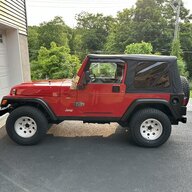
TJ Frame Swap: Putting a 2006 Frame Under A 1998 Sahara

thats what i was told didnt want the hassle so i got the frame parts from pokonometal fab and fixed it but was thinking if i had to title it with new frame would use a newer one that way if i sell it i would sell it as the year of the frame not a 99 thus making it worth more on selling it
 
Clutch Replacement Saga:

For anyone who has replaced a TJ clutch, it's generally not too difficult. What can make it difficult is the engine/trans/transfer case angle, and I think the best way to approach it: once the old clutch has been removed and the new clutch is in place and you have the transmission ready to go in, put the rear of the TJ on jack stands that generally correspond to a level engine/trans/transfer case in relation to your work surface. Some people put the rear in the air before starting. I have done it both ways, and it worked equally as well.

Keep in mind that if your flywheel is cracked, checked, or warped, it is not recommended to have any surface area removed-you are recommended to install a new flywheel. Mine was badly checked, and I ordered a new flywheel from Amazon.

I had planned to perform the clutch replacement while the body was off the old frame and prior to moving anything to the new frame. With all of that access, this should be a piece of cake, right?

What I didn't know was that the pilot bearing had been utterly destroyed at some point. There was nothing left but the bearing casing, and that was proud of the opening by about 1/8". I could not get this casing out and I didn't know what to do. I spent more than 4 hours scouring the internet for ideas. Finally, on the Mazda racing forum, I read a post where someone had taken a dremel grinding bit, cone shaped, chucked it in their drill, ground down the casing to very thin in a line along the center bottom, then took a hacksaw blade and carefully, carefully cut the casing along this line so that it could then be removed. This was the method I used.

After the casing was removed, the new flywheel and clutch installation went very quickly and was mostly trouble free. Be sure you have some way to block the flywheel from spinning when you are torquing the bolts. It took about 15 minutes of monkey-fumbling to get the transmission mated again to the engine. I was working on this alone, and taking my time.

Why did it take me 9 hours to complete? I spent 45 minutes on disassembly; 15 minutes determining that I was not able to remove the pilot bearing case without some advice; 4 hours researching; 1.5 hours of travel to get the dremel-cone grinder-mabob, 30 minutes grinding, cutting, and removing the old bearing pilot casing; 30 minutes inspecting and removing the flywheel after I determined it needed to be replaced; 30 minutes researching and ordering a new flywheel; 60 minutes on final installation and reassembly of the engine and transmission.

Without all of the extracurricular activity, I think 2-2.5 hours, working alone and taking my time, is the more likely scenario. I can only imagine the nightmare of facing these issues with the body on the frame while working underneath on my back.
 
  • Like
Reactions: reddvltj
My Final Step(s):

I have attached the final data report in excel format with all updated cost items below, in this post.


More than a week ago, I put my Jeep in at a local shop to have the parking brake cables installed and the state safety inspection completed. I got the Jeep back with the parking brake cables installed and another inspection failure. The manifold was still leaking, even though I replaced the gasket-among the first things I completed after I had the body and chassis separated.

Back in 2001, I had a local shop install a Borla header-with a million mile warranty! The original manifold had cracked and the stealership wanted more than $600 for a replacement part-the exact same part that was destined to crack again. This did not include installation. No, thank you very much. I passed and went with Borla instead for $299 plus $119 installation at said local shop. In 2003, the Borla was discovered to have a crack, and was replaced under warranty. Fast forward to today-that shop is no longer in business, and I do not have, or have yet to locate, the receipt for this work or for the original installation. Why is this important? If you have need of the Borla warranty, no probs-take a photo of the crack, a photo of the receipt, send these in an email Borla, and they will send you a replacement. Since I couldn't find the receipt and the shop is out of business, Borla was very sorry and could not send a replacement.

I ordered a Dorman header kit (a donut gasket, manifold gasket, and down-pipe flange bolts/nuts are included) and a Walker down-pipe from Summit Racing. I also ordered a Miehle donut gasket from Amazon, as some of the reviews on Summit's website indicated that the included donut gasket was too small and was not workable. This was indeed the case for me as well, and I ended up using the Miehle. Thank you, Random Summit Racing Reviewer!

I removed the Borla on Saturday afternoon and installed the Dorman on Sunday afternoon. As you can imagine, this would have been much easier prior to putting the body back on the frame. Still, it wasn't difficult, just time consuming. The hardest part, frankly, was getting the bolts torqued to spec. It's tricky to do using a smaller torque wrench, but it is doable. I admit I had a moment of panic after installing the down-pipe. I was certain the O2 sensor was not going to fit into the space provided. It did fit, and with about 1/4" to spare. Of course, I slathered it up with anti-seize. Not sure if it will help or even matter, but what the hey.

The Borla was hairline cracked at the first and sixth cylinders, and possibly others, and the Dorman has done wonders for the performance of the engine. It definitely runs smoother, and I think that my dance with the CEL may be over. It went off after about an hour of driving yesterday, and has not come back on.

For the past three years or so the CEL would come on, go off, stay off, come back on, stay on, go off, etc.. All seemingly random. I could not find any cause. Perhaps these cracks were the culprit, and different seasons or temps was a factor. For the longest time I was seeing P0300. Within the last 18 months it was showing P0301 and P0306, though never at the same time, and sometimes with and sometimes without the P0300.

EDITED (19 Feb) TO ADD: I was still dancing with the CEL. I went through the entire system, and when I was checking the distributor, I noticed two things: a lot of slop in the rotor, and the plate to which the pulse ring is mounted was no longer flat. I replaced the distributor and after 5 days the CEL has not come back, the engine runs smoother, and my fuel mileage is much, much better.

I put the Jeep in today for the inspection, and the result is pass. Finally. Back on the road legally and fully safety certified. A dream fulfilled.

 

Attachments

Last edited:
Well, I was mistaken.

The previous post on 4 Feb was not, in fact, the final step. On 9 Feb, I passed 1,000 miles of driving after the frame swap. I went back under the Jeep and performed a 4th round of torque checks on all frame components and checked all of the systems. No leaks, nothing was really out of spec, and some of the bolts/nuts tightened a bit more-say 1/16th of a turn. Likely that is the inaccuracy of my cheap Tekton torque wrenches.

Driving Impressions: First, it drives and feels like it did back in Jan of '98. Everything is tight, responsive, and mostly noise-free. The noise exception here is the whine from the AX-15. Hopefully it lasts to 300k, and right now I am at 267k and some change.

No hint of DW, though I used to have episodes occasionally over the past few years, even after replacing the entirely decrepit original steering stabilizer back in October of 2018. I would still have minor episodes, and now they are gone. I suspect the replacement frame is responsible for this improvement.

The Rancho shocks have settled in a bit and no longer feel as if they may rupture one of my kidneys. Admittedly I was regretting my choice of the Ranchos over the stock items. Now it seems like they will be fine.

The ZF steering box is quite nice, and is a just touch faster than the Saginaw. I may convert back to the Saginaw, but right now I have a huge case of garage fatigue.

I don't like this clutch, and I see now that I have the lighter-duty model. The pedal feel and pressure is too light for my liking if I'm being honest, and I will revisit this at a later point. Right now I feel that I should have spent the extra $60 for the heavier duty item.

I am quite pleased with how this has turned out, and happy to have her back on the road. Hopefully another 20 years and a much easier time for the next fool who must undertake such a project.
 
Last edited:
  • Like
Reactions: Chris and reddvltj
Tips, tricks, and what I would have done differently:

1. When you remove the gear shift knob, heat up the gear pattern cap section with a hair dryer for about 5 minutes. Take a slim flat screw driver and pop the gear pattern cap out. You will not damage your gear shift knob with this method. You will need a 15 mm socket to remove the nut, and then you will also need to unscrew the knob itself.

2. I cut my parking brake cables. This was a mistake. Do this only if you absolutely must. I should have used liquid wrench on the bracket where these mount from the rear drums. Then I should have used a twisting force to free them from the bracket-they were severely rusted. Finally, I should have used a worm drive pipe clamp to pull in the clips from the mounts so that I could remove the cables from the bracket with no damage.

3. Take plenty of photos prior to disassembly. You will not be able to recall how everything goes back together. Where does that differential vent tube mount? How does that fuel line route? Where do those vacuum tubes connect? How about that throttle body spring? Etc.

4. Use the FSMs to get the torque specs, torque order, and other crucial information. On reassembly, where red or blue thread-locker is not required, use anti-seize lube. I went through more than 5 tubes of anti-seize.

5. Use Evapo Rust to clean bolts, nuts, small parts, and even some larger parts. I used small plastic solo cups with the description of the bolts/parts written on the cup to keep track of parts. Sometimes it took 48 hours to get the rust off with Evapo Rust-still it worked very well.

6. I should have ordered the control arm mounting bolts at the very beginning. I tried to reuse as many parts and bolts as possible. If your Jeep is as rusted as mine was, then you will break some bolts and damage some parts.

7. I should have sourced a trans-to-skid-plate mount from an '06, mounted it to my '98 trans, and then attempted to utilize the stock mounts on the '06 trans skid plate.

8. During engine remounting on the new frame, it is much easier if you have the oil filter and starter removed from the engine block.

9. I did not disassemble my axle/suspensions when moving from the '98 frame to the '06. During reassembly to the new frame, it is much easier and faster if you loosely attach your traction bars to the frame prior to attaching your control arms to the mounts.

10. Use dielectric grease for all electrical connections and ground connections.

11. Remove the inner gear shift boot prior to removal of the body from the frame.

12. Bag and tag all mounting hardware, write on both sides of the bag with a permanent marker, and keep these bags in a separate box in a good location. I used ziplock snack bags and a permanent blue sharpie marker.
Do you know if the stock transmission mount from a 2003/2006 manual trans will bolt to the 2001 nv 3550 trans to mount to the 2003/2006 belly pan or is there a company that makes a aftermarket that has them
 
Do you know if the stock transmission mount from a 2003/2006 manual trans will bolt to the 2001 nv 3550 trans to mount to the 2003/2006 belly pan or is there a company that makes a aftermarket that has them
I haven’t tried it, and I suspect that a 2003-06 transmission mount will mount to and work with an 01 NV3550. I would try this first, but I don’t know your time pressures.
 
Hello,

I am doing a 2005 frame swap onto my 1998 TJ and I had one question about what you mean by this step…

7. I should have sourced a trans-to-skid-plate mount from an '06, mounted it to my '98 trans, and then attempted to utilize the stock mounts on the '06 trans skid plate.

I have a 2005 skid plate already on the 2005 frame that I am looking to use. What do I need to do to make my 1998 transmission and engine mount to it?

Thanks!
 
Hello,

I am doing a 2005 frame swap onto my 1998 TJ and I had one question about what you mean by this step…

7. I should have sourced a trans-to-skid-plate mount from an '06, mounted it to my '98 trans, and then attempted to utilize the stock mounts on the '06 trans skid plate.

I have a 2005 skid plate already on the 2005 frame that I am looking to use. What do I need to do to make my 1998 transmission and engine mount to it?

Thanks!

I don't think you need to do anything special here. It's the same part number for all years.
 
I don't think you need to do anything special here. It's the same part number for all years.

Okay got it. So just replacing my transmission rubber mount since mines old and then putting it in the 2005 skid plate it should line up? I just noticed that I have a “wedge” on my old plate that I didn’t know if I needed to move it to the 2005 plate. The one in the frame is the new 2005 plate.

IMG_3799.jpeg


IMG_3800.jpeg
 
I think that will work. I am still using my '98 mount, and I had to drill the offset holes that your '05 skid has from the factory. My '06 skid didn't have those pre-drilled.
 
  • Like
Reactions: macleanflood
I think that will work. I am still using my '98 mount, and I had to drill the offset holes that your '05 skid has from the factory. My '06 skid didn't have those pre-drilled.

I finally got my engine onto the new frame. I was starting to look to replace the transmission rubber mount and noticed that the holes didn’t line up. Did you just drill them where mines lining up? Or was yours not this far off?

IMG_3849.jpeg


IMG_3850.jpeg


IMG_3851.jpeg
 
Too me it looks like your missing the bracket that brings the mount forward.

Let me see if I can dig up a picture of my 97. ( This was me adding temporary spacers while waiting for a UCF skid plate.)

IMG20250116173742.jpg


-Mac
 
Too me it looks like your missing the bracket that brings the mount forward.

Let me see if I can dig up a picture of my 97. ( This was me adding temporary spacers while waiting for a UCF skid plate.)

View attachment 600298

-Mac

Yeah I think the 2005 trans mounting bracket is different and shifts it back the 4 inches to those holes in the skid plate. But then the exhaust (cat) bracket is much higher than needed for my 1998 cat. I like your spacer idea for sure but is that strong enough to hold it? I’m thinking of making a plate to hook my transmission rubber mount to and the bolt that to the skid plate since the rubber mount bolts are lined up with the “gullies” on the skid plate.
 
The spacers were temporary after a motor mount and body lift

I'd definitely weld in a plate if needed. You might be able to drill or grind out the factory welds and slide the entire piece.

-Mac
 
The spacers were temporary after a motor mount and body lift

I'd definitely weld in a plate if needed. You might be able to drill or grind out the factory welds and slide the entire piece.

-Mac

I was also thinking if I buy the 2005 transmission mount bracket like this one it will put the holes in the right spot
 
  • Like
Reactions: macleanflood
Apologies-I was out of the country. I agree-go for the 2005 and see if it works. Here's a photo of how mine lined up and the holes I drilled:

1741903118364.png