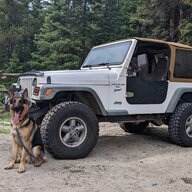
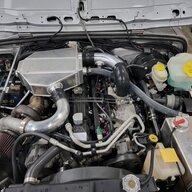
Novak Conversions Jeep Wrangler TJ radiator

Dyno Testing Bolt-ons On The 4.0

If sticking with the i6 I'm not sure if stroking it is a great idea. Better rod geometry with the stock crank and it will need to spin a bit higher to hit your target.

Yeah I thought about that("cheaper too")These AMC i6s get bad cam harmonics at around 5800 ! Unless you Rev past that, then your good but I'll keep it at/below 5600 or so,Piston speed shouldnt be bad either at that rpm.
I've been to 6k Rpm before and kept it there,I wonder if that's why my cam bearings are chewed? but even with my stock head it did "fine" and after cam swapping it I saw 0 damage it wasnt until i did the head with the Ls valvetrain with the unbelievably stiff ass valve springs....But I digress
 
  • Like
Reactions: ColoJeep and srimes
On the budget side of v8s the old la 5.2/5.9 would do well with a turbo.

If sticking with the i6 I'm not sure if stroking it is a great idea. Better rod geometry with the stock crank and it will need to spin a bit higher to hit your target.

Yep they actually respond really well to forced induction. If you do a search on the Magnum engines there is a guy who has one that he just hammers on.


I do have a question about the 4.0 since I haven't ever built one before as far as a performance build goes... But I've read more than one person wiping out cam bearings which then destroyed their engine. It's what lead to a few Magnum swaps that I know of too. So what is it about them that seems to cause issues when hopped up?
 
  • Like
Reactions: srimes
So what is it about them that seems to cause issues when hopped up?

Are you asking why people are likely having cam bearing failures, or cam related failures in general?

If you're talking about cam related failures in general, I'd say it's multifaceted. (don't choke on that big word guys :sneaky:) For the camshaft it's self, one big disadvantage of an I-6 or I-8 is the length. For the bearings, sometimes that comes to material selection, which can become a real issue when increasing spring pressure. Increased spring pressure is also a major issue for all flat tappet cams, not just inline engines. So back to that multifaceted issue, if someone puts together an engine with standard rebuilder grade or worse cam bearings, then wiggles in a higher lift cam and supporting 2x rated springs, well, something has to take the hits and soft bearings are first in line, probably followed by the cam/lifter interface.

Then there's surface finish and hardening issues, but that's well out of my ball field.

But don't take that as garage gospel, I'm just a special needs kid with internet access. :LOL:
 
Yep they actually respond really well to forced induction. If you do a search on the Magnum engines there is a guy who has one that he just hammers on.


I do have a question about the 4.0 since I haven't ever built one before as far as a performance build goes... But I've read more than one person wiping out cam bearings which then destroyed their engine. It's what lead to a few Magnum swaps that I know of too. So what is it about them that seems to cause issues when hopped up?

Yeah, but it's basically a problem with all flat tappet lifters and cams available these days. The lifters are not made as well as they used to be since they're not made in volume which results in them wiping the lobe. They aren't actually supposed to be totally flat, but that "flat" face does need to be perfectly square to the bore. A box of 12 lifters will probably have 4-8 that aren't perfect. There also seems to be issues with the cam castings too.

For most V-8s there were roller cam options long ago. The AMC 4.0 head makes it a bit tricky to install the roller lifters and the previous attempt by 505 to make them had issues with the cam material. And with alot of 4.0 performance stuff - it's just alot more expensive than more common V-8s.

And the longer cam. Surface hardening shouldn't be an issue as we actually have better tech for that these days. But it is.
 
They aren't actually supposed to be totally flat

Not everyone understands/knows that. Obviously it's exaggerated in this image, but a slight conical/cam shape to the "flat tappet" lifter face, combined with an angle to the cam face, is what causes the lifter to rotate and slip on the cam surface, thus not wearing, at least not excessively. When these features are missing, or smashed out via excessive spring pressure, that's when trouble pops up and things quickly start wearing excessively and go sideways. (assuming proper materials used and hardening isn't an issue)

1757255810313.png


Speaking of that, I've had this ashtray floating around my bench for a while. That's probably getting close to 1/4" deep. I think she's good to return to service, but I'm no engine builder, so I'll defer to yalls wisdom. :sneaky:

DSC05732.JPG
 
Last edited:
  • Like
Reactions: Rickyd and lBasket
In trying to understand why the return fuel system is increasing power as the ECM is going to recalibrate AFR constantly in closed loop - is the idea that it'll cool the air charge more? In open loop did the fuel end up richer?

Is there a longevity tradeoff on the fuel pump in the amount of time the pump is cycling? I'd never really thought about a fuel pump before, but it's something I have to think about with my future plans.

@Jezza thanks again for doing this series. Sorry to see you missed the goal by such a small margin and perhaps even more sorry to see the dyno go.
 
In trying to understand why the return fuel system is increasing power as the ECM is going to recalibrate AFR constantly in closed loop - is the idea that it'll cool the air charge more? In open loop did the fuel end up richer?

Your no longer using hot fuel that's forced in sitting in the fuel rail,it's now being circulated therefore your feeding the engine cooler fuel !
 
I'll probably do a series wrap up video yet

I would appreciate that. Even though I've watched all the videos, I can't seem to remember 1/2 of what got covered. :LOL:

Curiosity, did you ever mention what type of fuel you're running, mainly non-ethanol or E10?
 
  • Like
Reactions: ColoJeep
In trying to understand why the return fuel system is increasing power as the ECM is going to recalibrate AFR constantly in closed loop - is the idea that it'll cool the air charge more?
Your no longer using hot fuel that's forced in sitting in the fuel rail,it's now being circulated therefore your feeding the engine cooler fuel !

So, from all of the magazine and dyno guys over the years (Engine Masters, Engine Builder, Hot Rod etc) they've more or less established a rule-of-thumb that dropping the fuel temp 10 degrees Freedom nets around a 1% increase in power, and visa-versa. Obviously there are limits, so taking fuel from boiling to freezing will not mimic supercharging. The general theory is that the colder atomized fuel cools the air charge.

Hey look, I found the Engine Masters episode covering fuel temp.

 
The last of the dyno videos is up. I'll probably do a series wrap up video yet, but this is the last of the pulls.


Fun one! I think the HP in the higher rpm diminished on the fuel return because at WOT you are pulling enough fuel rate already to get cool fuel that the return is not needed . I hypothesized that this is also where the multi hole injector comes into play, with higher atomization & the cooler fuel it could incrementally have a cooling affect to the air charge, 🤷🏽‍♂️
 
A fuel pressure and temperature gauge... probably at the rail and maybe a thermal camera on the tank...and a long dyno power run would be interesting but the results probably predictable.

-Mac
 
  • Like
Reactions: BlueC
Yeah, but it's basically a problem with all flat tappet lifters and cams available these days. The lifters are not made as well as they used to be since they're not made in volume which results in them wiping the lobe. They aren't actually supposed to be totally flat, but that "flat" face does need to be perfectly square to the bore. A box of 12 lifters will probably have 4-8 that aren't perfect. There also seems to be issues with the cam castings too.

For most V-8s there were roller cam options long ago. The AMC 4.0 head makes it a bit tricky to install the roller lifters and the previous attempt by 505 to make them had issues with the cam material. And with alot of 4.0 performance stuff - it's just alot more expensive than more common V-8s.

And the longer cam. Surface hardening shouldn't be an issue as we actually have better tech for that these days. But it is.

Since it's been years since I've delt with flat tappet lifters I can't comment much on them. I'd have to say it was in the mid 70's the last time I had a car with a flat tappet cam. And yes I can remember all the issues 505 Performance had but since I had a 4 banger I was only interested in that stuff.

Thanks for the reply's guys.
 
...The cam is baby, just a small bit more than stock.

Engine Masters did a video on cams being too small. They dynoed 3 cams with 250, 260 and 270 advertised duration. The 250 and 260 had nearly the same tq down low, but the 260 started to pull away as the rpm went up. Their assessment was that the smallest cam did not make more tq because the valve did not stay open long enough. The 270 gave up bottom end and predictably made more HP. I don't have a subscription any more to watch it so if someone has HULU feel free to correct me.
 
  • Like
Reactions: Rickyd and srimes
Novak Conversions Jeep Wrangler TJ radiator