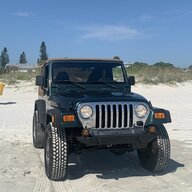
2000 Wrangler 4.0 no crank no start

BReisen

New Member
Original poster
Joined
Aug 25, 2025
Messages
5
Location
gulf breeze
Hey everyone, I'm in a real jam. Recently bought a this TJ and it is giving some issues. No crank no start. I have tested and replaced the battery and bench tested the starter. I have replaced the ignition components with no success. I have swapped the relays with no luck and than began digging deeper. I have checked all the grounds that I can find as well. The odd thing is... the terminal in the PDC that supplies the relay with constant 12v power drops from 12.6v to 3-4v. I also tested the constant 12v power terminals on the ASD and the AC clutch relays and they do the same thing.

What am I missing?
 
When does the system voltage drop to 3-4 volts, when you turn the key to crank? If you turn the headlights on do they work? Do they go very dim or out when you try to crank?

If you answered yes to all 3 you likely have a bad battery cable.
 
Last edited:
  • Like
Reactions: macleanflood
he voltage drops on pin 30 from 12v to 3-4v when I turn the key to the crank position. Headlights don't turn on but I should mention the previous owner put some aftermarket light in that have what looks to be separate wiring.
 
If you answered yes to all 3 you likely have a bad battery cable.

Or ground.

Or a bad new battery. New just means it's never worked before.

Try hooking up up to a jump pack or another running vehicle.

Transmission in neutral. Might want a fuse in position 20 to bypass neutral safety/clutch interlock. Switch the ignition to run. Climb under the Jeep and touch the big stud to the little terminal with a jumper and see if it starts.

-Mac
 
Place meter leads on the battery studs and attempt to crank the engine; does the battery voltage drop or stay at 12V?
IF the battery voltage does not drop dramatically then as others have responded check the battery cables.
I would remove, inspect and thoroughly clean positive and negative cable electrical connections and battery clamp connections to ensure good power to the starter and engine grounding even though you have replaced the battery.

Do either of the battery cables have insulation that is moving away from the ends of their cable clamps or electrical connector ends ?
Are there signs of a whitish green power interwoven in the cable strands ?
If you can answer YES to either of these questions; then there is a good possibility that your cables are old, compromised and in need of replacement.

Hope these schematics assist you in further troubleshooting your starting problems.

Screenshot 2025-08-26 at 4.14.24 AM.png
Screenshot 2025-08-26 at 4.13.00 AM.png
 
Last edited:
When does the system voltage drop to 3-4 volts, when you turn the key to crank? If you turn the headlights on do they work? Do they go very dim or out when you try to crank?

If you answered yes to all 3 you likely have a bad battery cable.

It was the battery cable, I found heavy corrosion inside of the cable insulation.
 
  • Like
Reactions: macleanflood
Place meter leads on the battery studs and attempt to crank the engine; does the battery voltage drop or stay at 12V?
IF the battery voltage does not drop dramatically then as others have responded check the battery cables.
I would remove, inspect and thoroughly clean positive and negative cable electrical connections and battery clamp connections to ensure good power to the starter and engine grounding even though you have replaced the battery.

Do either of the battery cables have insulation that is moving away from the ends of their cable clamps or electrical connector ends ?
Are there signs of a whitish green power interwoven in the cable strands ?
If you can answer YES to either of these questions; then there is a good possibility that your cables are old, compromised and in need of replacement.

Hope these schematics assist you in further troubleshooting your starting problems.

View attachment 638961View attachment 638960
It was the battery cable, I found heavy corrosion inside of the cable insulation.
 
  • Like
Reactions: CharlesHS
When does the system voltage drop to 3-4 volts, when you turn the key to crank? If you turn the headlights on do they work? Do they go very dim or out when you try to crank?

If you answered yes to all 3 you likely have a bad battery cable.

It was the battery cable, I found heavy corrosion inside of the cable insulation.

Thanks for the help!
 
Transmission in neutral. Might want a fuse in position 20 to bypass neutral safety/clutch interlock.

Based on my research this weekend, Fuse 20 looks to bypass the clutch interlock, but the NSS is further on in the circuit and completes the ground on the other side of the starter relay to allow it to close.

That said, I'm not (yet) clear on how Fuse 20 works on an automatic. This diagram is from an '02. On my '97 Fuse 20 is labeled as "Spare" so that tells me that on the A/T path, the "not used" Clutch Pedal Position Switch must be just a direct wire....the use of "not used" is confusing. Is it not there? Is it wired? Is it an open connection? Or is the '97 just different? I'm further confused by Fuse 20 not being labeled as M/T or A/T only like how the clutch switch is....maybe it's wired in for both cases on the '02 (and others?), but if it happens to blow current still flows down the clutch pedal path? That doesn't sound right either.


1756233286866.png
 
  • Like
Reactions: macleanflood
Based on my research this weekend, Fuse 20 looks to bypass the clutch interlock, but the NSS is further on in the circuit and completes the ground on the other side of the starter relay to allow it to close.

That said, I'm not (yet) clear on how Fuse 20 works on an automatic. This diagram is from an '02. On my '97 Fuse 20 is labeled as "Spare" so that tells me that on the A/T path, the "not used" Clutch Pedal Position Switch must be just a direct wire....the use of "not used" is confusing. Is it not there? Is it wired? Is it an open connection? Or is the '97 just different? I'm further confused by Fuse 20 not being labeled as M/T or A/T only like how the clutch switch is....maybe it's wired in for both cases on the '02 (and others?), but if it happens to blow current still flows down the clutch pedal path? That doesn't sound right either.


View attachment 639037

That's how I see it, and there is a connector point shown at the location of the clutch switch where it must just plug together. I'd guess they didn't change anything with fuse #20 since it wouldn't matter if it had a fuse inserted or not. Unless they omitted the wire from the load side of the fuse to save a few pennies.
 
That's how I see it, and there is a connector point shown at the location of the clutch switch where it must just plug together. I'd guess they didn't change anything with fuse #20 since it wouldn't matter if it had a fuse inserted or not. Unless they omitted the wire from the load side of the fuse to save a few pennies.

Yeah, I guess that's ultimately what I want to know. Pulling the fuse would answer the question I guess. I need to compare the diagram on my 97 since it's explictly labeled as Spare on the fuse box.