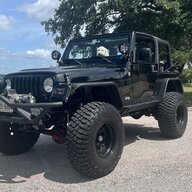
Novak Conversions Jeep Wrangler TJ engine mounts

Suspension for highway driving

A decrease in ride height over time is how I've always used that term 🤷‍♂️

Indicating a spring that has less resistance to load than it used to

Correct for common discussion agree.

And….if you walked up to a TJ and had not been there to measure it over time?
 
A decrease in ride height over time is how I've always used that term 🤷‍♂️

Indicating a spring that has less resistance to load than it used to

This is correct. It has nothing to do with advertised lift height.

 
eating-popcorn-michael-jackson.gif
 
Correct for common discussion agree.

And….if you walked up to a TJ and had not been there to measure it over time?

Then you are missing that piece of information to know if the springs have sagged compared to some point in the past.
 
I think i would say "settle" to describe the current ride height.

We do not know if there was any settling. Nor do we really care. All we can know at that moment of introduction is what the current ride height is. The decision at the moment is to change the ride height or to leave it alone.
 
Again, repeating unhelpful information.

Walk up to a TJ you haven’t ever seen, how does one deduce if the springs are sagging?
We cannot, nor do we care if the springs are sagging. That is not the question to be asking.
 
You have more time on your hand than sense.

Your posts here are BS. You babble “ride height” blah.
Thanks genius.

If the springs are advertised 3.25”, they were designed to be 3.25” on a TJ.
He wasn’t there unless you’ve got a DeLorean or phone booth he can use doctor who.

How the F is he supposed to know what they were when they were put on.l and if they happen to be 3.5” or whatever.

If they were Advertised as 3.25”, they were designed as 3.25”, and they measure now 3.25”, that’s as good of information under this circumstance provided you can get.

You have More time to babble the same BS than sense.

All suspension springs are built around a rate that is done via a number of pounds per inch of compression and that is the spring rate. The company doesn't call up the spring maker and tell them they want a 4" spring, they give them a rate expressed in pounds per inch, coil bind height, and free height.

If you have a rig that is within the reasonably narrow weight range that compresses them to the desired or advertised ride height, then you are the target buyer. If you have a heavy rig that overcompresses the springs, they aren't sagging, you are just outside the range. The way you tell that is by measuring but that does NOT automatically mean the spring is sagging. Your ass may just be too big.

FYI- I tend to concur with the genius, so there is that.
 
Last edited:
All suspension springs are built around a rate that is done via a number of pounds per inch of compression and that is the spring rate. The company doesn't call up the spring maker and tell them they want a 4" spring, they give them a rate expressed in pounds per inch, coil bind height, and free height.

If you have a rig that is within the reasonably narrow weight range that compresses them to the desired or advertised ride height, then you are the target buyer. If you have a heavy rig that overcompresses the springs, they aren't sagging, you are just outside the range. The way you tell that is by measuring but that does NOT automatically mean the spring is sagging. Your ass may just be too big.

FYI- I tend to concur with the genius, so there is that.

Good information and you've got the experience.

Now that we're down the rabbit hole, and in my first post I said I DIDN"T want to go down before mr genius gets rude and still doesn't answer what he said he did...

Just a question, when they provide that rate expressed in pounds per inch, coil bind height, and free height....do they not use any "target buyer" data to provide one set of requests vs the other? Do they not have a "stock TJ under X (would be somewhat normal weight conditions) that they take into consideration, and if it does come to that then it would, under most circumstances, fall on the lift height a Product Manager lists it?

Does the Product Manager not have any input to say "Let's, under these somewhat common standards, create ones that hit 2" lift, 3.5" lift, 4" lift?" So that we can market them, and not get 90% come back with a "You said 4", it came in at 6.5" or 2.5" or 2.75"? Cost to take the call, cost for return, impact in quality reputation in the market? All provide negative impacts.

There has to be some quality control, so that it hits the "mark" on the target customer, and the Product Management and Company overall produces a product that consistently hits that mark within reason.

So, It would seem to me, a reasonable person can look at a TJ with what were marketed as 3.25" springs....where the designer sent technical specs (ppi, coil bh, free height) that hit that target customer, one would reason a stock TJ would fit that.

So If I'm looking at a TJ that doesn't have my big ass sitting in it (ass isn't the problem more the middle, ha) but no one in it, not 1,000 LB monstrosity of a bumper with a massive toolbox full of tools and sets of extra axles in the back. Just the stock seat and a soft top and a normal spare on the stock mount....

IF a reasonable guy measured the day they bought the used Jeep, and the Springs were within close reason to what was marketed (and manufactured to tech specs NOT height) but the TJ looks normal stock type config interior and bumper etc, and it measured to close to that listed height.....that, AND that TJ has what looks to be a normal rake, nothing jumping out like the Jeeps ass sagging or the front way up like a low rider....then it's ok to say "I see no evidence that the springs are "sagging"?
 
  • Haha
Reactions: jjvw
Good information and you've got the experience.

Now that we're down the rabbit hole, and in my first post I said I DIDN"T want to go down before mr genius gets rude and still doesn't answer what he said he did...

Just a question, when they provide that rate expressed in pounds per inch, coil bind height, and free height....do they not use any "target buyer" data to provide one set of requests vs the other? Do they not have a "stock TJ under X (would be somewhat normal weight conditions) that they take into consideration, and if it does come to that then it would, under most circumstances, fall on the lift height a Product Manager lists it?

Does the Product Manager not have any input to say "Let's, under these somewhat common standards, create ones that hit 2" lift, 3.5" lift, 4" lift?" So that we can market them, and not get 90% come back with a "You said 4", it came in at 6.5" or 2.5" or 2.75"? Cost to take the call, cost for return, impact in quality reputation in the market? All provide negative impacts.

There has to be some quality control, so that it hits the "mark" on the target customer, and the Product Management and Company overall produces a product that consistently hits that mark within reason.

So, It would seem to me, a reasonable person can look at a TJ with what were marketed as 3.25" springs....where the designer sent technical specs (ppi, coil bh, free height) that hit that target customer, one would reason a stock TJ would fit that.

So If I'm looking at a TJ that doesn't have my big ass sitting in it (ass isn't the problem more the middle, ha) but no one in it, not 1,000 LB monstrosity of a bumper with a massive toolbox full of tools and sets of extra axles in the back. Just the stock seat and a soft top and a normal spare on the stock mount....

IF a reasonable guy measured the day they bought the used Jeep, and the Springs were within close reason to what was marketed (and manufactured to tech specs NOT height) but the TJ looks normal stock type config interior and bumper etc, and it measured to close to that listed height.....that, AND that TJ has what looks to be a normal rake, nothing jumping out like the Jeeps ass sagging or the front way up like a low rider....then it's ok to say "I see no evidence that the springs are "sagging"?
I'm trying to get you to understand how springs are made and spec'd out. Just so you know and can maybe try to understand, I've put all of Currie's/Rock Jock rear springs under a rig before trying to dial in ride height for shock bias.

All were 4" of some iteration, all but 1 delivered other than 4" because my rig's weight didn't match the design weight. Ass wasn't literal, it was pointed at the rig. I know you can fully understand that a TJ will have a different ride height on the rear springs based on a few things.
33 or 35" spare.
Lightweight tub mounted carrier, or heavy swing-out with a 33 or a 35 on it.
Spare in the tub.
Tuffy box crammed with every spare part and tool that will fit.
Tuffy box, swing out, 35, hard top, etc.

As the product developer, are you going to have 50 different springs so you can tell Joe in the back to run and grab the box of springs with the picture of the swing out, 35, and hard top on it, or are you going to make an average 4" spring for the average weight and call it a fucking day?

This isn't about quality control, it is about averages, how much it costs to build a run of springs and what you care about as a suspension seller. John Currie has or had at least 5 different 4" springs for the TJ platform, what does that tell you about how everyone else does it?
 
We do not know if there was any settling. Nor do we really care. All we can know at that moment of introduction is what the current ride height is. The decision at the moment is to change the ride height or to leave it alone.

When I use settle it describes to me the act of the vehicle having its full weight compress the springs and stopping at a given height.

I can't say I'm following this thread, I'll have to trust you on what decisions are being made or not
 
When I use settle it describes to me the act of the vehicle having its full weight compress the springs and stopping at a given height.

I can't say I'm following this thread, I'll have to trust you on what decisions are being made or not

Refer back to the very beginning where the op wanted to replace the springs because he heard somewhere that they sag, settle, collapse, whatever. None of that matters when the only question is whether or not the springs are creating the desired ride height, followed by a decision resulting from answering that question.

He does not care about an advertised lift height or what the springs might have done in an unknown past. He cares about what the springs are doing right now.
 
Refer back to the very beginning where the op wanted to replace the springs because he heard somewhere that they sag, settle, collapse, whatever. None of that matters when the only question is whether or not the springs are creating the desired ride height, followed by a decision resulting from answering that question.

He does not care about an advertised lift height or what the springs might have done in an unknown past. He cares about what the springs are doing right now.

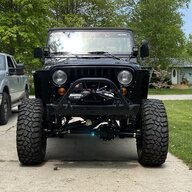
Sometimes I wonder what my springs are doing right now,but then I get my meds dialed in and it fades into background noise 😵
 
Also the Jeep came in 4 cylinder motors with a soft top at one end, a fully loaded rubicon with hard top and doors on the other.

So even in factory spec there is decent change of weight. Factor in mods and there can be a pretty big variation or weight.

I mean my rear 4” curries springs will vary about .5” if I have a full tank of gas or running close to empty…
 
I'm trying to get you to understand how springs are made and spec'd out. Just so you know and can maybe try to understand, I've put all of Currie's/Rock Jock rear springs under a rig before trying to dial in ride height for shock bias.

All were 4" of some iteration, all but 1 delivered other than 4" because my rig's weight didn't match the design weight. Ass wasn't literal, it was pointed at the rig. I know you can fully understand that a TJ will have a different ride height on the rear springs based on a few things.
33 or 35" spare.
Lightweight tub mounted carrier, or heavy swing-out with a 33 or a 35 on it.
Spare in the tub.
Tuffy box crammed with every spare part and tool that will fit.
Tuffy box, swing out, 35, hard top, etc.

As the product developer, are you going to have 50 different springs so you can tell Joe in the back to run and grab the box of springs with the picture of the swing out, 35, and hard top on it, or are you going to make an average 4" spring for the average weight and call it a fucking day?

This isn't about quality control, it is about averages, how much it costs to build a run of springs and what you care about as a suspension seller. John Currie has or had at least 5 different 4" springs for the TJ platform, what does that tell you about how everyone else does it?

So contrary to others opinion, I hear you, and understand completely.
I’ve obviously mis communicated.
I was actually talking about averages as well, and agree nothing is going to hit an exact number, this a reasonable person would look at what they have and make a reasonable observation.

So the genius is correct, if I’m reading correctly, and there should be absolutely zero threads or comments on sagging springs, ever, unless they have measurements on day one and regularly over time.

Other than that, there is zero way to comment on if springs sag, certainly the manufactured spring height shouldn’t be brought up, sounds like ever, because who knows, it all just depends.
I'm trying to get you to understand how springs are made and spec'd out. Just so you know and can maybe try to understand, I've put all of Currie's/Rock Jock rear springs under a rig before trying to dial in ride height for shock bias.

All were 4" of some iteration, all but 1 delivered other than 4" because my rig's weight didn't match the design weight. Ass wasn't literal, it was pointed at the rig. I know you can fully understand that a TJ will have a different ride height on the rear springs based on a few things.
33 or 35" spare.
Lightweight tub mounted carrier, or heavy swing-out with a 33 or a 35 on it.
Spare in the tub.
Tuffy box crammed with every spare part and tool that will fit.
Tuffy box, swing out, 35, hard top, etc.

As the product developer, are you going to have 50 different springs so you can tell Joe in the back to run and grab the box of springs with the picture of the swing out, 35, and hard top on it, or are you going to make an average 4" spring for the average weight and call it a fucking day?

This isn't about quality control, it is about averages, how much it costs to build a run of springs and what you care about as a suspension seller. John Currie has or had at least 5 different 4" springs for the TJ platform, what does that tell you about how everyone else does it?

I 100% understand.
Not on auto parts, but I bring in quarterly, my product engineers, product managers, dev, qa etc leadership. To a person, when talking about product specs or design, I have never heard any Engineer, OSP Engineer, Fiber Design Engineer, Software Engineer, DBA, System Engineer......NOT answer first to the questions about product specs......"It Depends".
So I, for a few decades, completely understand. I get everything you laid out.

I'm in the unfortunate position of running an org that has to then talk to customers, and Design Engineers almost universally think customers are stupid, and maybe they are, who knows. Either way, I have to come out with the "Our Products Deliver This" or drive my org to state this. All you said being accurate, I would love to hear ole Mr Currie's meeting when someone said "These will be 4" springs"....and the Design Engineer said "It Depends".....and the Head of Marketing or Sales says "Well, not sure how many we sell if we put for spring heigh "It Depends". And, I get both sides of the argument, reading your layout is like listening to my head of OSP talk about Fixed Wing drones vs quadcopter, the imaging, then where we can design the fiber routes, and rock in the ground vs on and on and on.

By the way, I knew you weren't talking literally on ass....ha, I was being self deprecating.
My simple point, that I was trying to communicate back, obviously miserably done....was that "On Average" as you posted earlier and I agree, is where I have to go...and was here. On average, it's a starting point, and if it measures within range, then it's a reasonable assumption, IE I could reasonable argue in contract dispute hey, this isn't sagging, based on the data available, and significant lack of data.

Now, to your point...and apparently the Genius' point, there is zero way to ever say a spring is sagging without having it's lifetime measurements over time and the weight conditions or changes to the TJ. I fully get that....I just live in a world where averages to give reasonable assumptions have to be made, and to the point, Not Here. So there should be no "springs sagging" comments anywhere on this site, without full knowledge of how those springs performed from day 1 and the load etc, otherwise the answer is always "it depends, just no way to really know".

To anyone with the Face Palm tags on my posts, y'all can eat a D. I doubt you've had to mediate your teams and these arguments, when you have taken a year in design and R&D and have to roll out a freaking product, because Engineers very much dislike Product Marketing etc, and vice versa. But I've got to go catch a plane and literally have a Board Meeting and explain this high level for an investor for a major release that comes out end of this week. So Face Palm away.
 
  • Face Palm
Reactions: CMBD
All you said being accurate, I would love to hear ole Mr Currie's meeting when someone said "These will be 4" springs"....and the Design Engineer said "It Depends".....and the Head of Marketing or Sales says "Well, not sure how many we sell if we put for spring heigh
Mr. Currie said there will be springs to work with a few different vehicle weights to provide 4" of lift height. He also said we know it depends on weight, that's why we are doing more than one rate.
 
Novak Conversions Jeep Wrangler TJ engine mounts