Novak Conversions Jeep Wrangler TJ radiator

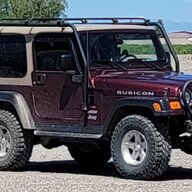
Wildman's TJ is getting a face lift

the rod/shaft should move in the bushing, no? if the axles droops or rises level, the bar rolls yes, no?.
once force is applied from the axle in an articulated or opposing manor the bar would twist, only then exerting it's leverage to counter the action.
 
I think it would depend on the angle of the link to the sway bar arm (90 degrees being the most supple because the leverage is highest). Imagine link-arm angle at 0 degrees (parallel): it wouldn't move at all. So, as the angle moves from 90 toward 0, the sway bar bar feels stiffer. It also feels stiffer as you shorten the arm. Unless I've completely missed something...
I'd have to go back and find a page that I stumbled on that explained this exact subject if you want definitive proof, but yes, the closer you are to 90° the more force is applied to the lever. the more you move towards 0° or 180° the lower the force. And the closer you get to the fulcrum the more force needed to affect movement.

So the "softest" setting for any "anti" sway bar is 90° at the very end of the arm.
 
The only thing that changes is the amount of vertical force transmitted to the arm, thus changing the amount of torque and "anti-rock". As the angle between the arm and link changes (from 90*), that force gets smaller.

What matters in practicality is that you still have enough anti-roll and enough difference in angle to prevent the links from inverting. I'd buy some cheap 1/2" all-thread and play around with finding the right length that will still work. with the tire. You're coming from having no anti-roll bar so anything is better than nothing lol

Yes,
I've got an appointment at the VA tomorrow but will pickup some all thread and mess around with some different lengths and see what I can come up with. The main concern is the hyper-extension at full droop where it can come back on you. And yes coming from NO rear swaybar to having something back there I'm sure that even a little resistance will be nice.
 
  • Like
Reactions: reddvltj
I'm amused that somebody blocks you from reading their posts, yet continues to read yours. Then takes offense to your posts and has to have a hissy fit about it. Chickenshit is the term that comes to my mind.

...
Lots of assumptions packed into how you think this all started.
 
  • Face Palm
Reactions: Wildman
maybe i'm confused
to me the bar takes X amount of force to twist from any rested point and the adjustment holes are leverage points.
Yes, the torsion bar has a fixed resistance to twisting, the holes are to adjust how stiff or loose the sway control is. Changing the angle at which the link bar connects to the bar will also affect the leverage. 90° being the most amount of leverage at any fixed point. The further you move away from 90° to the bar the more torque required to twist the torsion bar.

Here's one of the sites I found that explains it. Specifically this section.

A bit more about torque​

When pedaling a bike, you can not deliver a constant torque to the pedals. Torque is not only the product of the applied force times the lever arm ... it also depends on the direction the force is applied.

peddle.gif


When you pedal a bike, there are parts of the "pedaling cycle" where you are doing nothing to provide power to the wheels because you are producing no torque to the pedals.. As a result, the power you provide to the wheels actually looks like a half sine wave no matter how hard you may be pushing on the pedals (unless you have those "clip on" devices that racers use which harness the foot to the pedal). You will find the same effect in an engine and electric motor.

bikepower.gif


https://ecampus.matc.edu/mihalj/scitech/unit1/levers/levers.htm
 
Last edited:
maybe i'm confused
to me the bar takes X amount of force to twist from any rested point and the adjustment holes are leverage points.
The adjustment holes on the axle do nothing to change the leverage of the arm. The adjustment holes on the axle tabs only exist for the purposes of packaging. To change the leverage of the arm, change where the link attaches to the arm. In this case, drill a new hole. The Universal rear AR kit has adjustment holes in the arm.
 
The adjustment holes on the axle do nothing to change the leverage of the arm. The adjustment holes on the axle tabs only exist for the purposes of packaging. To change the leverage of the arm, change where the link attaches to the arm. In this case, drill a new hole. The Universal rear AR kit has adjustment holes in the arm.
If you mount the tab horizontally it does, the angle the link intersects the bar does have an effect on effort required to push the arm. Keeping the link as close to 90° to the bar as possible because that's where the least amount of effort is needed to move the arm at any of the fixed points on the arm.
 
If you mount the tab horizontally it does, the angle the link intersects the bar does have an effect on effort required to push the arm. Keeping the link as close to 90° to the bar as possible because that's where the least amount of effort is needed to move the arm at any of the fixed points on the arm.
No, it really doesn't. The arm doesn't care where the link is on the axle. The position the axle mount is placed in may introduce a lateral component of force, but the force of the arm doesn't change.

Draw a free body diagram. Where does the force come from?
 
If you mount the tab horizontally it does, the angle the link intersects the bar does have an effect on effort required to push the arm. Keeping the link as close to 90° to the bar as possible because that's where the least amount of effort is needed to move the arm at any of the fixed points on the arm.
Incorrect
 
  • Dislike
Reactions: reddvltj
No, it really doesn't. The arm doesn't care where the link is on the axle. The position the axle mount is placed in may introduce a lateral component of force, but the force of the arm doesn't change.

Draw a free body diagram. Where does the force come from?
Wow, whipping out free body diagram 😂 that’s a blast from the past. Brought me back to college!



The position of the axle mount does not change the direction, or the amount of force the axle is placing on the torsion bar. It’s movement path is fixed. Sure, it places more stress on the link to have it at an angle, but the amount of force and direction going through the other end of the link does not change. The only variable you can change to make it stiffer or softer, is your leverage on the bar which is done by the adjustment holes on the torsion bar itself.

Edit: free body diagram was bad but I stand the overall point
 
Last edited:
Been a long time since I took statics, but the link is pinned on each side and is a two force member. The forces on that member has to be in line and equal and opposite. Not sure that FBD is correct. Also, the two force member can only transfer a load inline with the pins, but there will be a vertical (Y) and horizontal (X) component at the connections which will be determined by the angle (theta).
 
Been a long time since I took statics, but the link is pinned on each side and is a two force member. The forces on that member has to be in line and equal and opposite. Not sure that FBD is correct. Also, the two force member can only transfer a load inline with the pins, but there will be a vertical (Y) and horizontal (X) component at the connections which will be determined by the angle (theta).
And only the perpendicular component would create the moment.
 
Last edited:
Edit: free body diagram was bad but I stand the overall point
?? How is the stress in the link going to go up with increase in angle. The more the angle, the more the axle or body is free to move in the Y direction and the load on the link will actually go down. The force in the link due to the body/axle moving in Y direction will be highest when the link is inline with the movement of the axle/body.

Softness??
Now this angle has nothing do with "softness" as it has been called, it just relates to applying the most vertical load into the arm. Where that load is applied on the arm (adjustment holes on arm) will affect the moment arm and thus apply more or less torque to the torsion bar (furthest hole will apply more moment and will twist the bar more). "Softness" is a weird term, because what is "soft", you can disconnect the arm all together and it will be "soft".

Sway bar is a weird animal because it uses torsion as a spring to apply a rated vertical load to the body/frame to allow for the controlled roll of the body but most people only look at the axle and the movement of the axle and not the body.

I don't want to get into the debate on how to set up the AR, I just took a break on reviewing this report this morning and the FBD diagram caught my attention. Back to your regularly scheduled show :)
 
And only the perpendicular component would create the moment.
Well this is fun (seriously). I hope I'm remembering this right... Here's my quick drawing of the the difference in torque on the sway bar with the arm at 90 degrees to the link vs 45 degrees. As the angle (alpha in my drawing) decreases from 90 towards 0, torque decrease is calculated by multiplying by sine of the angle ( examples: sine 90 deg = 1, Sine 45 deg = 0.707 and sine 0 = 0). Or to put it another way using the picture below, Force x effectiveRadius = Torque.
AEDEDB92-0CE9-423C-942B-CA8D05B2E852.jpeg

Note that as the sway bar arm to link angle (alpha) decreases, the same force on the link produces less twist of the bar (which would make it feel stiffer). (edit The "2" in the above upper equation should be "R" for Radius-oops)
 
Last edited:
Well this is fun (seriously). I hope I'm remembering this right... Here's my quick drawing of the the difference in torque on the sway bar with the arm at 90 degrees to the link vs 45 degrees. As the angle (alpha in my drawing) decreases from 90 towards 0, torque decrease is calculated by multiplying by sine of the angle ( examples: sine 90 deg = 1, Sine 45 deg = 0.707 and sine 0 = 0). Or to put it another way using the picture below, Force x effectiveRadius = Torque.
View attachment 311538
Note that as the sway bar arm to link angle (alpha) decreases, the same force on the link produces less twist of the bar (which would make it feel stiffer).
In a simplified way, that would be correct. However, you need to account for the linkage being at an angle and then you'd have to resolve the force from that two force member into it's components.

So the picture on the right should have force F resolved into both a vertical and a horizontal based on the angle of the two force member that's applying the load. Unless the axle moved enough to keep force F purely vertical.
 
In a simplified way, that would be correct. However, you need to account for the linkage being at an angle and then you'd have to resolve the force from that two force member into it's components.

So the picture on the right should have force F resolved into both a vertical and a horizontal based on the angle of the two force member that's applying the load. Unless the axle moved enough to keep force F purely vertical.
Also, the arm is pinned with a torsion spring at the frame, the pin is able to resist loads and the torsion spring is able to resist the moment. The arm will actually start to take axial loads from this resolved vertical and horizontal loading and thus reduce the amount of moment needing to be reacted. Now how that axial load vs moment affects softness or stiffness, I do not know because you also have to consider that to get this "spring" you have to also look at the other side to see what is going on there because currently you are assuming the moment is purely being reacted, but it is actually being reacted by a spring and the spring rate is dependent on the torsion bar, if the torsion bar is free to spin then there is no moment reacted but if the bar is fixed or if the other side is actually moving in the opposite direction this spring rate will change. I can say that if the bar was in a purely vertical direction, there would be NO moment induced from a link vertical load and it would be "stiff".
 
I should mention that I may be or may not be the one to listen to, I partied pretty hard my first two years in college and had to take Statics twice. Also, I am old enough that I was taught in lbf and inches, not Newtons and meters. Possibly, this European method is different :)
 
In a simplified way, that would be correct. However, you need to account for the linkage being at an angle and then you'd have to resolve the force from that two force member into it's components.

So the picture on the right should have force F resolved into both a vertical and a horizontal based on the angle of the two force member that's applying the load. Unless the axle moved enough to keep force F purely vertical.
Agreed. Trying to keep it simple. Its also interesting to me that as the axle moves, the link-arm angle will change and therefore the "perceived stiffness" of the sway bar will then change.
 
The adjustment holes on the axle do nothing to change the leverage of the arm. The adjustment holes on the axle tabs only exist for the purposes of packaging. To change the leverage of the arm, change where the link attaches to the arm. In this case, drill a new hole. The Universal rear AR kit has adjustment holes in the arm.
The axle only gives input 0nce it begins to move. I've never mentioned the rod or link . I'm talking clocking of the arm only. Moving the link end closer or further from the anchor point is the leverage adjustment. I think we agree.
 
  • Like
Reactions: reddvltj
Novak Conversions Jeep Wrangler TJ radiator