Novak Conversions Jeep Wrangler TJ radiator

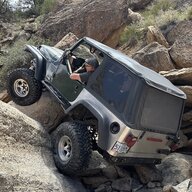
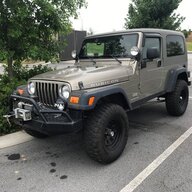
Woodrow's 97 Green TJ Moderate Build

I'd thought when I started mine that going for more in the rear without doing a comp-cut wouldn't be as hard but now I know differently. And if you're going to try and keep your fuel filler somewhat stock looking instead of using the GR filler that IMO doesn't work for those of us who live in a muddy area. Getting that filler hose around the rear shock tower to is a PITA.... I KNOW I'm no expert and have only done my one rig but I "hope" I learned a thing or three along the way...
That is an unresolved issue I've thinking about. Exhaust is another. I think in both cases I won't be able to fully decide until I'm in the middle of it.
I got 5" out of mine & I've got the CRD60 and the Comp23 tank so I'm not sure what the difference is between your tank & mine but I've still got a little more push back I think if I wanted..
Well the 60 is probably an inch bigger than my 44 so there you go, 5+1=6 :) (actually, the Dana 60 ring gear is 9.75" vs 8.5" in my LJ 44. so that only nets 5/8". Dang, gotta find another 3/8")
The front is a whole other animal... I did the TNT steering box rotation and pushed mine forward approx 2.75" or close to that. Since mine was built more as a trail rig I again sometimes wonder if I should have just gone full hydro... Could of pushed the front out more then if I'd wanted.
I've got 2 1/4"- 2 3/8" between the track bar and steering gear at ride height so the track bar can move that much (hopefully I'll at least 2" front stretch).
There are times I think I should of gone with a fuel cell instead of but I'm sticking with what I've got for now.
No way I'd give up the bed space.
 
Exhaust is another.

I'm looking at two solutions for my exhaust...one, looking for a 2003-2006 skid plate...I've cut mine down, so it would need reworked if I cut the rear frame and tuck up the bumper. That will lift the rear exhaust hanger up an inch.

Second I found some silicone bushings I can french into the frame and lift up the exhaust.

More soon!

-Mac
 
  • Like
Reactions: Woodrow
That is an unresolved issue I've thinking about. Exhaust is another. I think in both cases I won't be able to fully decide until I'm in the middle of it.

Mine is a whole other animal and I haven't figured out how to route my exhaust out to the rear... But so far I don't have any fumes from it dumping under the tub.

Well the 60 is probably an inch bigger than my 44 so there you go, 5+1=6 :) (actually, the Dana 60 ring gear is 9.75" vs 8.5" in my LJ 44. so that only nets 5/8". Dang, gotta find another 3/8")

I actually have a Super 60 ring gear so it's 10" but that doesn't matter....

I've got 2 1/4"- 2 3/8" between the track bar and steering gear at ride height so the track bar can move that much (hopefully I'll at least 2" front stretch).

I'm sure if anyone can figure it out it'll be YOU....

No way I'd give up the bed space.

Since I don't have a real need for the bed space plus have a drawer back there it wasn't much of a leap for me to add a fuel cell on top of the drawer... But yes I totally get not wanting to lose that space... The only thing that comes close would maybe be the Motobilt YJ fuel cell that fits behind the seat. But you're still giving up space.
 
  • Like
Reactions: lBasket and Woodrow
Since I don't have a real need for the bed space plus have a drawer back there it wasn't much of a leap for me to add a fuel cell on top of the drawer... But yes I totally get not wanting to lose that space... The only thing that comes close would maybe be the Motobilt YJ fuel cell that fits behind the seat. But you're still giving up space.

Do you have a spare tire?
 
On the original run back in September of '21, Lambda was 0.945. So, on pump gas (stoichiometric of 14.7:1) AFR should've been 13.89. Seems lean. I'm fairly new to all of this so hopefully I have my numbers right. Also I'm not sure how good the data is since the mixture info was obtained using a tailpipe probe. This time around, the wideband will be pre-cat in the down tube.
Definitely lean. The AFR on my '04 still 4.0L with its' stock injectors and stock fuel base map just touched 10.85:1 at +5000ft elevation which I've read is where they're expected to make max power. On WOT pulls it will generally be in the low 12s through the 11s and gets richer as rpms rise.

There is an injector offset in the JTEC PCM which applies a correction factor across the basemap.
1761167103300.png

Alternatively you should have a similar option under Open Loop/Base to apply a multiplication across the basemap selectively as I've done here adding 5% to the 92.3 and 105.0 rows. Note, the 2004 and 1997 models used different fuel pressures and different injectors, so you have to work from your basemap. Where I live the pressure average in kPA is around 92.3, so that's what I get at WOT. This results in it coming into that 10.85:1 ratio a little earlier. I can probably back off the pulsewidth at RPM 4480 and 4992 cells just bit as I now go a tiny bit past 10.85:1. If your short term and long term fuel trims are off expected values, you might need to adjust the whole base map.

1761167243868.png


On the other end of the tuning, once you get the fuel up to a safe level, you should be able to push the timing up as well. You should be able to add 5-6 deg to the advance on the bottom 3 rows of the table without issue across the board. Just listen for low rpm detonation and back off at lower rpms if it stumbles. I don't know if the stroker will like more advance at midrange rpms. It's relatively fine margins and the dyno is the only way to know what will make power. I definitely didn't "feel" any more power on ye old butt dyno just bumping the advance up. It just runs better on the whole.
 
Last edited:
One more thing, before you go do this dyno test, make sure to "disable" the speed governor. It's under Speedo, Limiter, Limit By Fuel. I'd set this at 155mph for the dyno run so you don't risk the fuel cut ruining your data.
1761169766566.png
 
@Rec_Rider has a stroker tj6 on 40s. Maybe he can weigh in on that?

On a TJ-6? You betcha! But what motor???
Hemi?
LS?
Boosted Coyote??!

I didn't see this thread until I was tagged. TJ6 on 40s with a 4.7 stoker and manual... Yep, that's what I run. No high HP here but it gets me where I want to go including JV and the Rubicon.
 
Today I worked on fixing an issue I’ve had with my Coyote beadlocks. I really like the Coyote set up because:

1) it is light weight at +6# per wheel.
2) locks both beads.
3) the inner high pressure tire stands about 3 inches off the rim so the set up works as a complete run flat if need be.
4) the entire cost for the set is about the same as one traditional bead lock rim, which is another bonus.

However, there is no protection for the rim’s stock valve stem and I have managed to rip one off twice. The first time was a legitimately tough spot. I was struggling to get up winch hill one on Fordyce. The second time was random. I was just driving along on Cliffhanger. The run flat idea would work in a pinch but would likely trash the tire. So, on both occasions, I put in a Colby emergency valve stem and finished the day without issues. But to avoid the problem, I decided to try moving the stock valve stem for the outer tire to a more protected location. Here is my original configuration:
IMG_0645.jpeg

You can see how exposed the stock valve stem for the outer/low pressure tire (chrome cap) is compared to the inner tire valve stem (red cap). To move it more centrally, I needed a new hole and a longer air channel as well as a way to plug up the old hole. I decided to try this with my spare before committing to all five. Here’s the rim with three holes in it:
IMG_0630.jpeg

The overlap of the nylon tread of the inner tire is significant and adds about 100 g of weight eccentrically (that’s about 3.5 oz. for @JMT🤣). The new air Channel is 7 inches long instead of the original 5 inches and weighs about 60 g.
IMG_0625.jpeg

The innertube valve weighs about 20 g and my solution for plugging the stock valve hole is about 10 g. So all of that is placed on the opposite side of the rim from the nylon tread overlap to help with balance. While milling around the nuts and bolts isle at the CO-OP, I happened upon some rubber grommets with 1/4-20 nuts inside (not sure what they’re called, edit: they are well nuts. Thx @sab) that, combined with a short 1/4-20 chrome cap bolt and washer, seemed a promising solution for plugging the original valve hole:
IMG_0622.jpeg

IMG_0635.jpeg

IMG_0634.jpeg

Even though it’s pretty smooth and low profile, I put a square of gorilla tape over it to protect the inner tube and help with sealing.
IMG_0629.jpeg

Also for additional air seal, I put plumbers tape on the bolt.
IMG_0633.jpeg

Then I put it all back together:
IMG_0638.jpeg

Much lower profile/more removed from harm’s way👍
If it holds air and balances OK, I think it may solve the problem🤞(edit: 2 weeks later and both chambers without leaks).

IMG_0640.jpeg
 
Last edited:
While milling around the nuts and bolts isle at the CO-OP, I happened upon some rubber grommets with 1/4-20 nuts inside (not sure what they’re called)
Those are called Wellnuts. We used them to hold the windscreens on superbikes. They are essentially a rubber nutsert, and they’re used when removability or vibration damping is required. Unfortunately, I doubt you’ll get them airtight. It’ll be a slow leak, like a nail in a tire. ☹️

I hope I’m wrong, though!
 
Those are called Wellnuts. We used them to hold the windscreens on superbikes. They are essentially a rubber nutsert, and they’re used when removability or vibration damping is required. Unfortunately, I doubt you’ll get them airtight. It’ll be a slow leak, like a nail in a tire. ☹️

I hope I’m wrong, though!

Is it a well nut that our TJ’s have on the ac condenser connection to the grille?
 
Last edited:
  • Like
Reactions: Woodrow
Novak Conversions Jeep Wrangler TJ radiator