Novak Conversions Jeep Wrangler TJ engine mounts

Welding Axle Trusses

Status
Not open for further replies.
I already stated the purpose for the addition. I will expound on it though.

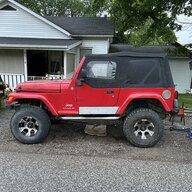
I wrecked my jeep. Tore up the front axle. Got a killer deal on a parts jeep. $200 for a HP Dana 30 and an 8.8 with ARB air locker, 4.56 gears for my 33" rubber. That donor jeep is a YJ. I used the truss kits to solve the problem of not having spring buckets or any of the of the appropriate brackets to mount on my jeep. I also used the truss kit because I like the look. Putting them on my jeep solves the problem of not having that look. It's really that simple. Adding the truss kits solved those problems.

The only problem left is you assuming our intended use of them. I used them to solve those problems, not the problems that you are assuming every truss runner is trying to overcome. The more mostest mostiest mostly immediate problem that I had was a wrecked jeep no way to mount two awesome axles. Again, the trusses solved that problem for me. TAH DAH truss kits do solve problems after all!

I caught that edit too! HA and there you go again! The classic "one upper" at it again. so graciously allowing me extra credit. give It up already!

You've got to be trolling at this point dude. This is next level shit. Now you are relying on me not being able to pinpoint where you said it because you know you only implied it. You're not just sneaky dude, its like snake level reasoning and behaviors at this point. Again, I'm happy to oblige.

Your words "The push back comes in cases like this one where it is better to not weld something, despite knowing how to. It becomes an exercise in restraint." Before you continue on trying to snake your way around the implication, I'll address that too! If you weren't implying that the weight adds to stress on the weak link, then why is better to not weld something? What else could possibly be the reason for not doing it when all your reasoning is so focused on the weakest link. If you are in fact not implying that it further weakens them then there is absolutely no reason not to add truss kits. Without the very implication that you are denying, your entire objection to truss kits is dead on its face.

At the end of the day, you decorated the Jeep with trusses. Got it!

Meanwhile, the rest of us are having a technical discussion of function, purpose and design.
 
Once we address the issue on a factory axle of the ball joints falling out of the stretched yokes, the value of a truss may increase.

The conflict with that premise is that the tire size where this stretching tends to accelerate is also the tire size where bigger wider axles ought to be considered as a matter of function. Use the appropriate axles for the tire size and multiple other issues of strength are addressed as a result, including any need for trusses.

100%
 
That's all folks!

I'm done with this nonsense. I'm gonna go grab a shower with my hot wife.

The problem with being done with any premise that doesn't align with your myopic view of how things should be done and referring to it as nonsense is that closes off any ability to learn.

I'll relate my own truss or not to truss story while fully understanding that you won't learn anything, you won't allow it to modify any of your thought processes and it is a near complete waste of time for you, but I'll still do it in the hopes that it may benefit someone else.

When I started on my journey to solving the poor brakes on the TJ, I made all the rookie mistakes. I managed to convince myself that if I could get the rear drum brakes working better, I would be doing some good. Narrow focus, fully committed.

I bought a new set of brake shoes from Mopar. I went over to Porterfield and had them strip the linings off and reline them with their grippiest compound. Installed them and did some testing. Those 3 sentences took a few moments to type in order to describe what was a 3-4 week process that was not cheap.

Several things became very clear during testing.
1- shoes were not very strong since the ends bent over when the anchor pin tweaked over a bit.
2 - Porterfield does in fact have a pretty grippy compound.
3- Drum backing plates are not strong enough to resist grippy compounds.

I spent some time narrowly focused again on solving the "problems" Worked with a shop to see if we could cut some pieces to reinforce the ends of the shoes to stop them from folding over sideways. Fetched up a drum brake backing plate to see if we could find a way to stiffen up the anchor pin and stop it from bending.

Then I had a "weak link" epiphany. There is a reason all this stuff isn't stronger and more robust. It is more than enough for the task at hand. I was working on the wrong end of the vehicle. I'll never be able to make it stop satisfactorily with the rear brakes. All I'm ever going to be able to do is induce rear lock up sooner and compromise safety.

When I abandoned my incorrectness and started working on the right end, things were much better.

Your flaw in your haste to come across as an expert fabricator and weldor is your narrow focus misses all the things that matter far more.

The TJ housings generally work just fine for 35's. 35's generally don't stress the tubes enough to require a truss. If you get to where you may find yourself in need, at no point does throwing 60 pounds of metal at it make any sense whatsoever. Weight is not your friend and it never will be.

Bigger than 35's requires the tire to move outward to be able to get back to the same turning radius. Moving the tire outward increases the leverage and forces on the ball joints and inner C. Moving the tire outward compromises the steering response and handling and creates less than desirable steering.

No matter how well you reinforce the inner C, no matter what fancy ball joint system you use to get around the normal problems, what you can't readily do is create a stronger ball joint retention design that stops the hole from stretching out under higher loads.

If you can't solve that problem to keep the axle viable under use, not much else matters. You're solving the wrong "problems". The worst part of your problem solving is what took you 60 pounds of metal to do, I can do with a third of that.
 
I'll relate my own truss or not to truss story while fully understanding that you won't learn anything

Isn't that the definition of insanity?


I will say that I know I, along with many others, really appreciate the insight! So please don't ever stop doing this because you think someone might not be wanting to understand 👍
 
  • Like
Reactions: rasband and Woodrow
Isn't that the definition of insanity?
Whose, mine or his? I know I expect things to improve and the communal knowledge pool to grow, I'm rarely not disappointed.
I will say that I know I, along with many others, really appreciate the insight! So please don't ever stop doing this because you think someone might not be wanting to understand 👍
Ever wonder why I stepped over my self described line of hypocrisy and put a "truss" on the Savvy mid arm?

That's right, it was easier than spending endless amounts of time arguing about why it wasn't necessary. Easier to design and add it than deal with the why I didn't.
 
Ever wonder why I stepped over my self described line of hypocrisy and put a "truss" on the Savvy mid arm?

We've had that conversation here. Looking at the design and trying to determine the "why", my thought was that since it goes to a 3 link, all the force now goes to the single upper mount. Adding some strength would make sense. The original UCA mount mechanically ties it to the pumpkin, which gives it longitudinal strength. The truss then makes sense to give it the lateral strength, but for the mount itself, not for the tubes.

At least that's what I can come up with.
 
We've had that conversation here. Looking at the design and trying to determine the "why", my thought was that since it goes to a 3 link, all the force now goes to the single upper mount. Adding some strength would make sense. The original UCA mount mechanically ties it to the pumpkin, which gives it longitudinal strength. The truss then makes sense to give it the lateral strength, but for the mount itself, not for the tubes.

At least that's what I can come up with.
The long side stiffener is purely there so I don't have to talk about why I didn't do it. The mini truss over the pumpkin needs nothing else to do the job that the original cast mount was doing except doubling that which is does easily due to the design and way too much metal thrown at it. If I wasn't concerned about access to the breather and electrical ports, I could have dropped a tight fitting to the casting flange down on the rear face and reduced the material thickness by half. It is easier to throw metal at it.
 
Whose, mine or his? I know I expect things to improve and the communal knowledge pool to grow, I'm rarely not disappointed.

Ever wonder why I stepped over my self described line of hypocrisy and put a "truss" on the Savvy mid arm?

That's right, it was easier than spending endless amounts of time arguing about why it wasn't necessary. Easier to design and add it than deal with the why I didn't.

I assumed (there’s that word) it was because the new single UCA mount was not in quite the original location because of geometry. So because it was no longer integrated into the diff housing, it needed the longer “mini-truss” to strengthen the attachment, not the tube. Also, a 2.5” JJ wouldn’t fit in the housing hole.
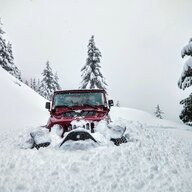
 
I assumed (there’s that word) it was because the new single UCA mount was not in quite the original location because of geometry. So because it was no longer integrated into the diff housing, it needed the longer “mini-truss” to strengthen the attachment, not the tube. Also, a 2.5” JJ wouldn’t fit in the housing hole.

If the weld to the tube at the right side of the truss isn't enough, the stiffener isn't going to solve that problem. The truss being cut around the two lower halves of the cast boss is not an accident. The forces on the truss base are fore and aft at the basic level and then as they increase, they become rotational trying to tilt the base of the UCA up and down. In order for the mount to rotate, it has to stretch the flanged side plates that go over to the spring mount on the left and the axle tube on the right. That won't happen easily and the flanges prevent deflection of the large flat areas.

Although we like to see the holes filled in with weld around the cut off cast mount, it is unlikely we will achieve a good weld bond and we aren't trying to. The weld joint will likely crack, but, it won't crack in a perfect shear line so the non linear joint left acts as a mechanical joint and stops all fore and aft movement. That also converts the lateral forces into rotational or tipping forces which are mitigated by the "gusset" feature of the two side plates.

So again, the stiffener is only there to stop the "why didn't you?" conversations, because it was easy, and I kind of like the aesthetic which I rarely give into but this one was easy.
 
  • Like
Reactions: Woodrow
To answer your basic question, yes, anytime you weld on an axle you should be mindful of distortion. Anytime you weld on anything, really. This isn't a difficult issue, though.

You didn't say what your plans are for this jeep. 99.9% of tjs don't need a Dana 30 truss, just like mrblaine said. The exception is go-fast rigs. Jeepspeed is dead (and I haven't followed it for some time), but they bent housing enough that reinforcing the housing was standard.

Are you building for bombing through the desert, or tough truck racing? If not don't worry about it.

 
How did you verify that you did not bend the axles after the truss install?

Same still applies though. You would have to be a complete moron to truss that axle. If you feel the need to truss an axle, you don't have enough axle.

I wasn’t saying to truss the 44, but there are factory options that were factory that are more stout than the newer ones, just a comparison
You concerns about weakness are valid but adding a truss to a Dana30 will not improve real world durability as the tubes are not what fails on a trail ride. You’ll generally break almost everything else first.

i have 3 bent dana 30’s, 2 were bent tubes, 1 was a bent C, and I have a bent 44 that was a C, realistically a 30 is just not a enough, and a 44 is marginal if you are hard on equipment.
 
i have 3 bent dana 30’s, 2 were bent tubes, 1 was a bent C, and I have a bent 44 that was a C
I've fixed a couple of bent Dana 30 and Dana 44 TJ front housings for bent long side tubes. All of them happened in rolls. Had the tube not bent, the C probably would have and I'm not even going to try and fix that.
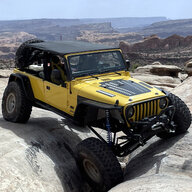
 
I've fixed a couple of bent Dana 30 and Dana 44 TJ front housings for bent long side tubes. All of them happened in rolls. Had the tube not bent, the C probably would have and I'm not even going to try and fix that.

Yes, easier to replace than to repair.
 
I've fixed a couple of bent Dana 30 and Dana 44 TJ front housings for bent long side tubes. All of them happened in rolls. Had the tube not bent, the C probably would have and I'm not even going to try and fix that.

How do you check for straightness, Blaine?
 
How do you check for straightness, Blaine?

Concentric circles. But, be very aware that very few of them were straight from the factory. EGCS found that out the hard way when they bought up as many stock Dana 44 TJ front housings as they could get their hands on. During a chat, the owner related that an alignment bar showed almost none of them were what we would call acceptable.
 
  • Wow
Reactions: Apparition
I wasn’t saying to truss the 44, but there are factory options that were factory that are more stout than the newer ones, just a comparison
...

The very moment we move away from TJ,XJ,MJ axles that are direct bolt on, there is no point in comparing all other Dana 30, 35, 44 variant axles any differently than all other axles that require modification to fit on our TJs.
 
  • Like
Reactions: mrblaine and srimes
Two words: concentric circles

Edit two things: #1, I know I'm not Blaine 🤣, and #2, watching your method was cool 😎

Concentric circles. But, be very aware that very few of them were straight from the factory. EGCS found that out the hard way when they bought up as many stock Dana 44 TJ front housings as they could get their hands on. During a chat, the owner related that an alignment bar showed almost none of them were what we would call acceptable.

You mean you don't use a straight edge and an angle finder? Huh...

;)

This is how I've done it in the past - full float 14 bolt in this case. Lathe milled plugs tight fitting in each spindle and a center-marked plug in the carrier bearing journal. Acceptable?

IMG_5329.JPG


IMG_5328.JPG


IMG_5323.JPG
 
  • Haha
  • USA Proud
Reactions: lBasket and Wildman
At the end of the day, you decorated the Jeep with trusses. Got it!

Meanwhile, the rest of us are having a technical discussion of function, purpose and design.

So you agree then, they do look pretty cool. haha

At the end of the day, I used trusses to facilitate mounting two axles under a jeep they weren't originally designed for. They solved the immediate problem that I had and didn't cause any other issues. It's really that simple!

I never intended them to solve any other underlying issues. Technically they are designed to hold the axle on my jeep. Weather you accept it or not, they function really well for that purpose.

This has been entertaining. I addressed every point of every post you made. When met with a logical line of thought and reason, you only resort to half witted dismissive remarks. Then after that oral trash is just another self inflating statement. None of which offers any logic or reason to the conversation.
 
Status
Not open for further replies.
Novak Conversions Jeep Wrangler TJ engine mounts