Novak Conversions Jeep Wrangler TJ engine mounts

TJ accelerates on it's own

Blackiosh

Member
Original poster
Joined
Sep 17, 2020
Messages
45
Location
Overland Park, KS
Ok, guys, let me preface this by saying that I know nothing about cars and most things I read on this forum come across as a foreign language to me. Seeing that there is so much knowledge on this site, I would like to run this problem by you so when I take my TJ to the repair shop, I can run your knowledge past the mechanic. I have researched this problem and some have had similar problems, but none of the posts were ever updated with what the actual cause ended up being.

So, this weekend I went wheeling in my 2000 TJ. four times during my ride, which lasted about five hours, the TJ took off on its own. If it wasn't for my cat like reflexes and hitting the brake and hand brake, I would have taken out a couple parked Rubicons and a tree. (Easy way to get banned from the Jeep club). Every time it happened, I was in 4x4 low. The first time, I was going down a steep hill, foot on and off the brake, no accelerator, and it suddenly revved up and then drove forward quickly, maybe 3-5 feet. I have no idea how far it would have driven on its own if I hadn't hit the brake. Once I hit the brake and handbrake, the TJ stopped as well as the revving. The second time I had just started it, put it in drive, no gas, just let off the brake, and again it revved and took off. The third time was the same but I was in reverse. And the 4th time I had just stopped, brake on, and was getting reading to put it in park and the engine revved. I put it in park and it stopped. I found it interesting that the revving and its desire to drive stopped once I hit the brake, so there was no sign that it was trying to push through my braking. It would have been nice to have been in an open field where I could have let it play out and see if it is just lunging forward briefly or if it would have continued on its own.

I bought the TJ a few months back and the previous owner had put a new 4.0l 6 in it and it currently has about 4k miles on it. The engine compartment is clean enough to eat off of. Automatic tranny rebuilt about 10k miles ago and it has cruise control if that matters. The Jeep guys I was with visually inspected it and saw nothing obvious. I was too busy crapping my pants so I wasn't able to see what the RPMs were at when it happened.

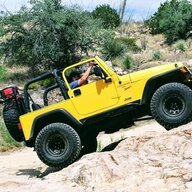
Any ideas? If you have additional questions, I will try to answer them, but all I pretty much know about the Jeep is that its yellow.
 
A worn failing throttle position sensor will contribute to that symptom.
 
Last edited:
Two things come to mind.
There are reports of the engine surging (mine included), usually when coming to a stop. Some say it idles up to compensate and keep the auto from killing the engine before the TC disengages. For me, it's usually when I'm pulling in my garage.
Also, if you're new to this vehicle, you might be accidentally hitting the gas pedal when braking. The pedals are closer together than some other vehicles. I've been sitting at a light, engine revs up, then I realize my foot is hanging half way off the brake pedal and touching the gas.
I could see where being in 4 low would make the vehicle lunging that much more dramatic.
 
Last edited:
  • Like
Reactions: Modoc Guy
A worn failing throttle position sensor will cause that to happen.
Not really. By itself, the TPS doesn't have that ability. Its job is solely to report the throttle position/butterfly valve plate opening position so the PCM can keep the fuel flow up with the amount of air flow the throttle body is allowing into the engine. But an air (vacuum) leak by itself absolutely will cause higher if not high engine rpms.

About the only realistic things that can cause that is a vacuum leak letting more air than needed into the engine, which like stepping on the gas pedal to open the throttle body to let more air in, or a problem with the cable between the gas pedal and and throttle body which is very unlikely.

A vacuum leak usually comes from a vacuum hose that came loose, or a crack or breakage in a vacuum hose or vacuum fitting.

Check for a disconnected, loose, cracked, or broken vacuum line/hose. Possibly a defective or dirty IAC (idle air controller) too, it could conceivably allow extra air into the engine too.

Anything that allows unwanted extra air into the engine will cause higher engine rpms. The more air let into the engine the higher the rpms.
 
Not really. By itself, the TPS doesn't have that ability. Its job is solely to report the throttle position/butterfly valve plate opening position so the PCM can keep the fuel flow up with the amount of air flow the throttle body is allowing into the engine. But an air (vacuum) leak by itself absolutely will cause higher if not high engine rpms.

About the only realistic things that can cause that is a vacuum leak letting more air than needed into the engine, which like stepping on the gas pedal to open the throttle body to let more air in, or a problem with the cable between the gas pedal and and throttle body which is very unlikely.

A vacuum leak usually comes from a vacuum hose that came loose, or a crack or breakage in a vacuum hose or vacuum fitting.

Check for a disconnected, loose, cracked, or broken vacuum line/hose. Possibly a defective or dirty IAC (idle air controller) too, it could conceivably allow extra air into the engine too.

Anything that allows unwanted extra air into the engine will cause higher engine rpms. The more air let into the engine the higher the rpms.
My thoughts were a possible crack somewhere in the intake or vacuum system that is somehow lending itself to open up briefly under certain conditions.
 
Not really. By itself, the TPS doesn't have that ability. Its job is solely to report the throttle position/butterfly valve plate opening position so the PCM can keep the fuel flow up with the amount of air flow the throttle body is allowing into the engine. But an air (vacuum) leak by itself absolutely will cause higher if not high engine rpms.

About the only realistic things that can cause that is a vacuum leak letting more air than needed into the engine, which like stepping on the gas pedal to open the throttle body to let more air in, or a problem with the cable between the gas pedal and and throttle body which is very unlikely.

A vacuum leak usually comes from a vacuum hose that came loose, or a crack or breakage in a vacuum hose or vacuum fitting.

Check for a disconnected, loose, cracked, or broken vacuum line/hose. Possibly a defective or dirty IAC (idle air controller) too, it could conceivably allow extra air into the engine too.

Anything that allows unwanted extra air into the engine will cause higher engine rpms. The more air let into the engine the higher the rpms.
Pardon me if my suggestion was misleading I defer to the experts, when I was reading information and trying to understand the live data using my OBD2 scanner one of the things it mentioned was uneven throttle response, dead spots and surging not necessarily solely from the sensor but because of the dead spots along the sensors path of travel, kind of what they describe is the computer not properly recognizing the throttle position then suddenly as the operator applies more skinny pedal the information being sent to the PCM instead of smoothly increasing fuel, timing advance and other related adjustment compensating for the increased throttle position there are surges. this occurring in tight technical driving could be alarming even for brief periods I was guessing?
 
  • Like
Reactions: Jerry Bransford
is this happening right at idle speed? Mine will temporarily surge up if I try to climb an incline at idle, like the load drags the engine speed down and the IAC opens up in response, maybe overreacts a little bit and then takes a second reposition again. I've never thought of it as anything but normal.
 
is this happening right at idle speed? Mine will temporarily surge up if I try to climb an incline at idle, like the load drags the engine speed down and the IAC opens up in response, maybe overreacts a little bit and then takes a second reposition again. I've never thought of it as anything but normal.

Yeah it happens from idle through second gear. If it’s at idle and I barely touch the throttle, it revs the same as if I punched it half throttle. If I’m in first or second gear and start up any incline, it will climb it on its own with my foot off the throttle. If there’s any load on the engine that drags the RPM’s down any at all, it will react by throttling itself until the RPM’s reach around 1750. I took the IAC and throttle body off and cleaned it real good but didn’t help. I wanted to get a few opinions before spending the money on a new one.
I look like I’ve never driven a manual before at the gas station the way it revs when pulling out of the parking lot haha
 
Have you found a fix for this? I have had this problem since I've owned my Jeep, and still haven't found a solution to it. Some days it's really apparent, and other days it doesn't happen at all. I've cleaned the throttle body, replaced the IAC, and changed the TPS just in case, and still have this problem.
 
Novak Conversions Jeep Wrangler TJ engine mounts