Novak Conversions Jeep Wrangler TJ engine mounts

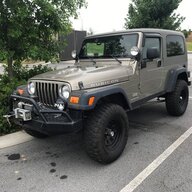
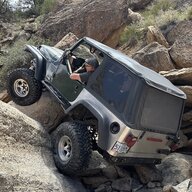
The Silver Fox LJ Build

I'm under attack here!! I do build with weight in mind and I would say my jeep has a very minimal amount of heavy unnecessary junk. Aluminum for all armor so far (those sliders aren't installed yet 😉 that's a cost issue), I'm just happy I can use 8oz extra metal in welding vs. engineering calculations that I really don't even know how to do for the ideal minimal amount possible
You are absolutely not under attack here, Basket. These build threads are wonderful exchanges of information, and even if you can't do engineering calculations, you can learn new ways to approach design. And the most amazing thing about the community here is that you have friends here who can help you work through those engineering calculations/decisions - all you or anyone else has to do is ask for help (and keep an open mind). That parenthetical phrase seems to be tough to overcome for some members (myself included). Thick skin helps, too, I've learned! ;)
 
The old advice is to add weight slowly 😉
Yeah, and partly why that advice came about is that, unlike adding weight, where you have a choice to add it slowly or quickly, when it comes to removing weight, it's almost always impossible to remove it quickly.
 
  • Like
Reactions: jjvw
My answer was a bit simpler.
Weight (see what I did there?) a minute Mr. Blaine. You never answered or replied to Basket, but I guess it's true that a non-answer is simpler than mine! :ROFLMAO:
 
I'm under attack here!! I do build with weight in mind and I would say my jeep has a very minimal amount of heavy unnecessary junk. Aluminum for all armor so far (those sliders aren't installed yet 😉 that's a cost issue), I'm just happy I can use 8oz extra metal in welding vs. engineering calculations that I really don't even know how to do for the ideal minimal amount possible

With deference to @sab who is a pretty smart engineer, I think reasonably intelligent people (@lBasket certainly qualifies) can do allright figuring things out intuitively (without doing or even knowing the math). @mrblaine strikes me as someone able to get most places he needs to go this way. Not that your instinct will always work. Sometimes, you absolutely need the math.
 
Last edited:
With deference to @sab who is a pretty smart engineer, I think reasonably intelligent people (@lBasket certainly qualifies) can do allright figuring things out intuitively (without doing or even knowing the math). @mrblaine strikes me as someone able to get most places he needs to go this way. Not that your instinct will always work. Sometimes, you absolutely need the math.
I wish I could do the math. I'm just not that smart so I have to brute force most things via trial and error. SAB is different than most engineers who fall into 2 main categories and are similar to machinists. Some machinists use their machines to build stuff, some machinists can ONLY run parts from good drawings. An engineer who can apply what they know to building stuff is very rare and SAB excels at that.
 
With deference to @sab who is a pretty smart engineer, I think reasonably intelligent people (@lBasket certainly qualifies) can do allright figuring things out intuitively (without doing or even knowing the math). @mrblaine strikes me as someone able to get most places he needs to go this way. Not that your instinct will always work. Sometimes, you absolutely need the math.
Mr. Blaine is an exceptionally intuitive "natural engineer." He's a better engineer than nearly all engineers that I know. Intuition and experience trump "book learnin'" all day long. However, intuition is part of one's natural intelligence and can't be learned, as far as I'm concerned. Experience is the one thing that anyone can gain, and if intuition isn't one's strong point, leaning on those around you as you build experience by piggybacking on both their experience and their intuition is a powerful tool.

That said, "world class engineers" have the book learnin', the natural intuition, and the experience. Like a three-legged stool - engineering ability is not fully developed with a weak leg. I don't share Mr. Blaine's gift of incredible intuition, and my four-wheel offroad vehicle design and driving experience is limited, so this forum teaches me something new every time I log in! I'm constantly building stronger legs for my stool. My book learnin' leg is pretty solid, as I've always been good at book learnin'. However, the other two legs will always be weaker, and I have to work harder on those. It's always leg day on this forum for me!
 
An engineer who can apply what they know to building stuff is very rare and SAB excels at that.
I appreciate the kind words, but I can't take much credit for the skills I've accumulated because they're really not mine. As noted above, I've leaned on a lot of people far more talented than I (you're one of them) over the years to build my stool, to continue a corny analogy. Without them, I'd still be the skinny, pimple-faced kid in Mom and Dad's basement building stupid things with Legos.
 
I'm under attack here!! I do build with weight in mind and I would say my jeep has a very minimal amount of heavy unnecessary junk. Aluminum for all armor so far (those sliders aren't installed yet 😉 that's a cost issue), I'm just happy I can use 8oz extra metal in welding vs. engineering calculations that I really don't even know how to do for the ideal minimal amount possible

I like the idea of using enough metal that the engineering doesn't really matter that much. Way easier

Jack Black Yes GIF
 
Mr. Blaine is an exceptionally intuitive "natural engineer." He's a better engineer than nearly all engineers that I know. Intuition and experience trump "book learnin'" all day long. However, intuition is part of one's natural intelligence and can't be learned, as far as I'm concerned. Experience is the one thing that anyone can gain, and if intuition isn't one's strong point, leaning on those around you as you build experience by piggybacking on both their experience and their intuition is a powerful tool.

That said, "world class engineers" have the book learnin', the natural intuition, and the experience. Like a three-legged stool - engineering ability is not fully developed with a weak leg. I don't share Mr. Blaine's gift of incredible intuition, and my four-wheel offroad vehicle design and driving experience is limited, so this forum teaches me something new every time I log in! I'm constantly building stronger legs for my stool. My book learnin' leg is pretty solid, as I've always been good at book learnin'. However, the other two legs will always be weaker, and I have to work harder on those. It's always leg day on this forum for me!


Well said.
 
With deference to @sab who is a pretty smart engineer, I think reasonably intelligent people (@lBasket certainly qualifies) can do allright figuring things out intuitively (without doing or even knowing the math). @mrblaine strikes me as someone able to get most places he needs to go this way. Not that your instinct will always work. Sometimes, you absolutely need the math.
One aspect of this frame mess that is often overlooked and also tends to mess with me more than a fair bit is we are essentially dealing with a beam. If we look at an I beam, the web (skinny vertical section) is thinner than the top and bottom flanges.
1766238441998.png


The load capacity is created by the top and bottom flanges resisting lateral deflection and holding the web vertical. If the flange(s) deflect, that allows the web to see lateral loads and the beam will fail very quickly. Put another way, an I beam laid on its side is dramatically weaker than when it is vertical. (I understand that the flanges add a fair bit of tension and compressive load capacities to the web under load)

So, the part that messes with me is we spend a lot of time reinforcing the web and fully ignore the flanges. I'm pretty sure there is some engineering stuff I'm overlooking but I've never been able to reconcile why we just don't add some stiffness to the top and bottom of the frame, a thin internal weld backer and call it a day.
 
  • Like
Reactions: sab
For an engineer to analyze the stresses in a part, he must know that load case for that analysis. The load case is how forces and moments are applied to the part. So, we start with that, first. With complex load cases, like that of a vehicle frame, inadequately developing that load case is a common way to miss something and have field failures that make you scratch your noggin'. Been there, done that - more times than I can count. Additionally, it doesn't take much for a load case to get so complex that the only way to analyze it is by using finite element analysis (FEA).

Here are some of the questions an engineer has to ask himself, with the analysis required for each one that applies:
  • Is there a significant shear force involved? - perform a shear stress analysis
  • Is there an axial force (compressive or tensile) involved? - perform an axial stress analysis
  • Is there a bending moment involved? - perform a bending stress analysis
  • Is there a torsional (twisting) moment involved? - perform a torsional stress analysis
  • Is the part a thin member, subject to buckling (like if you push on both ends of a straw)? - perform a buckling analysis
  • Is the part likely to fail due to fatigue? - perform a fatigue analysis
  • Is the part subject to many of these, all at once? - perform a finite element analysis
All but the last one above can be done by hand. The last one, though, requires a computer due to the millions of individual calculations involved. Finite element analysis breaks the part up into thousands of tiny pieces, all connected. The computer looks at each piece (an "element"), starting at the edges, where the external forces and moments are applied, and performs a force/moment analysis on each element. These analyses occur in succession - starting at the edges, you calculate the forces on the inside of the first elements in response to the external forces, and then those reaction forces become the external forces on the next element. The computer repeatedly applies those forces to the next elements, and keeps working inward in an iterative process to find a solution. Like 3D printing, it takes hours to complete.

So, to make a long story short and attempt to shed light on Mr. Blaine's ponderings above, the reason we strengthen the vertical frame sections is that the load case on a frame is complex, so we cover all bases because no one on here, myself included, is going to do a full engineering analysis using FEA. The driving factor for strengthening the "webs" (outside vertical walls of the frame) is that the frame definitely sees torsional loads (twisting), and resisting torsion is similar to resisting bending. In simple bending, the driving factor in the stress calculation is the moment of inertia of the part, and the strength depends heavily on portions of the part that are far from the neutral plane (the plane within the part that sees zero stress, with compression on one side of the neutral plane and tension on the other).

Same thing in torsion, but it's the polar moment of inertia that is the driving factor in the analysis, and torsion doesn't have a zero stress plane, it has a zero stress axis. That means that it's a distance from line, not a plane. So, for torsional resistance, instead of an I shape being ideal, a circle becomes ideal. Since tube frames are expensive to manufacture (and because the load case is complex), square or rectangular tubing is used because it's the next best choice. So, for the same reason the factory engineers choose a rectangular tubing, we strengthen all four sides when we modify the frame.

 
  • Like
Reactions: Tob and NashvilleTJ
For an engineer to analyze the stresses in a part, he must know that load case for that analysis. The load case is how forces and moments are applied to the part. So, we start with that, first. With complex load cases, like that of a vehicle frame, inadequately developing that load case is a common way to miss something and have field failures that make you scratch your noggin'. Been there, done that - more times than I can count. Additionally, it doesn't take much for a load case to get so complex that the only way to analyze it is by using finite element analysis (FEA).

Here are some of the questions an engineer has to ask himself, with the analysis required for each one that applies:
  • Is there a significant shear force involved? - perform a shear stress analysis
  • Is there an axial force (compressive or tensile) involved? - perform an axial stress analysis
  • Is there a bending moment involved? - perform a bending stress analysis
  • Is there a torsional (twisting) moment involved? - perform a torsional stress analysis
  • Is the part a thin member, subject to buckling (like if you push on both ends of a straw)? - perform a buckling analysis
  • Is the part likely to fail due to fatigue? - perform a fatigue analysis
  • Is the part subject to many of these, all at once? - perform a finite element analysis
All but the last one above can be done by hand. The last one, though, requires a computer due to the millions of individual calculations involved. Finite element analysis breaks the part up into thousands of tiny pieces, all connected. The computer looks at each piece (an "element"), starting at the edges, where the external forces and moments are applied, and performs a force/moment analysis on each element. These analyses occur in succession - starting at the edges, you calculate the forces on the inside of the first elements in response to the external forces, and then those reaction forces become the external forces on the next element. The computer repeatedly applies those forces to the next elements, and keeps working inward in an iterative process to find a solution. Like 3D printing, it takes hours to complete.

So, to make a long story short and attempt to shed light on Mr. Blaine's ponderings above, the reason we strengthen the vertical frame sections is that the load case on a frame is complex, so we cover all bases because no one on here, myself included, is going to do a full engineering analysis using FEA. The driving factor for strengthening the "webs" (outside vertical walls of the frame) is that the frame definitely sees torsional loads (twisting), and resisting torsion is similar to resisting bending. In simple bending, the driving factor in the stress calculation is the moment of inertia of the part, and the strength depends heavily on portions of the part that are far from the neutral plane (the plane within the part that sees zero stress, with compression on one side of the neutral plane and tension on the other).

Same thing in torsion, but it's the polar moment of inertia that is the driving factor in the analysis, and torsion doesn't have a zero stress plane, it has a zero stress axis. That means that it's a distance from line, not a plane. So, for torsional resistance, instead of an I shape being ideal, a circle becomes ideal. Since tube frames are expensive to manufacture (and because the load case is complex), square or rectangular tubing is used because it's the next best choice. So, for the same reason the factory engineers choose a rectangular tubing, we strengthen all four sides when we modify the frame.

None of this is disagreement in the least. We tend to overlook other aspects of the frame that add high amounts of torsional resistance. If we start at the front, we have a large tubular crossmember tying the two sides together. A bit back from that we have two motor mounts which turn the engine into another crossmember that ties the two sides together. Then the body mounts start right at the firewall, shortly past that we have the belly skid which is large, and very stiff. Just past the end of that we have a very substantial crossmember between the frame sides for the shock mounts and gas tank mounting. Finally, at the rear of the frame, we have one or two crossmembers depending on wheelbase. Counter to the belly skid which picks up the bottom of the frame, the body mounts pick up the upper part of the frame and use the tub itself as a crossmember.

Without looking, I'd guess the longest section of frame that isn't directly or indirectly tied to the other side is from the front tube back to the engine frame mounts.

Most of that is to point out that we are very glad they designed it that way because the frame itself is basically crap and without it being tied into the tub to create a more unitized structure, it would not endure what we put them through. Sadly, the one thing it needs to be much better is counter to what we work so hard to create which is better clearance and the only way to make the frame better is to make it taller and that isn't going to happen.
 
  • Like
Reactions: sab
None of this is disagreement in the least. We tend to overlook other aspects of the frame that add high amounts of torsional resistance. If we start at the front, we have a large tubular crossmember tying the two sides together. A bit back from that we have two motor mounts which turn the engine into another crossmember that ties the two sides together. Then the body mounts start right at the firewall, shortly past that we have the belly skid which is large, and very stiff. Just past the end of that we have a very substantial crossmember between the frame sides for the shock mounts and gas tank mounting. Finally, at the rear of the frame, we have one or two crossmembers depending on wheelbase. Counter to the belly skid which picks up the bottom of the frame, the body mounts pick up the upper part of the frame and use the tub itself as a crossmember.

Without looking, I'd guess the longest section of frame that isn't directly or indirectly tied to the other side is from the front tube back to the engine frame mounts.

Most of that is to point out that we are very glad they designed it that way because the frame itself is basically crap and without it being tied into the tub to create a more unitized structure, it would not endure what we put them through. Sadly, the one thing it needs to be much better is counter to what we work so hard to create which is better clearance and the only way to make the frame better is to make it taller and that isn't going to happen.
No doubt - all those things tying the frame rails together are part of the overall rigidity and strength design for the vehicle, and the engineers would consider their contributions when designing the frame. That's one way we keep overall weight down - don't build a redundant frame member if something else can do the job!
 
  • Like
Reactions: mrblaine
Novak Conversions Jeep Wrangler TJ engine mounts