Novak Conversions Jeep Wrangler TJ radiator

Help dialing in bump stop

As a spring compresses, does it increase it’s upward pressure? Meaning as I compress the spring, it would get to a point where it’s pushing upward with the same force as the jeep is pushing down (rear wheel up 2.5’ on a dirt pile, front on level ground) and get to the point where the jeep doesn’t get any closer to bump because they are equal forces? Or is the springs upward force constant until it reaches solid bind?

The easier way to understand it is under normal operation, the springs can NOT support more than the total weight of the rig. If we assume that each corner is 1000 lbs, when you diagonal it out (support it on opposite diagonal corners with the other two not supporting much) then the total weight of the rig is compressing two springs or twice as much as they do at ride height. Each of those will compress roughly double the amount they are at ride height and the other two will extend double the amount they are compressed at ride height since they aren't holding up anything now. (this all makes a whole bunch of assumptions but in general to illustrate the equilibrium all 4 springs will achieve as they compress and extend.
 
  • Like
Reactions: Granite
The easier way to understand it is under normal operation, the springs can NOT support more than the total weight of the rig. If we assume that each corner is 1000 lbs, when you diagonal it out (support it on opposite diagonal corners with the other two not supporting much) then the total weight of the rig is compressing two springs or twice as much as they do at ride height. Each of those will compress roughly double the amount they are at ride height and the other two will extend double the amount they are compressed at ride height since they aren't holding up anything now. (this all makes a whole bunch of assumptions but in general to illustrate the equilibrium all 4 springs will achieve as they compress and extend.

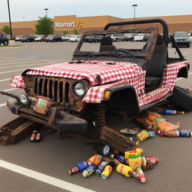
Ok so if double the compression distance/force isn’t enough to reach full bump in my setup, then the spring is technically what is stopping me from full bump?

Doubt it matters but these are HD OME 2” lift coils (no idea on age, they look to be fairly old). HD because I have a front ARB bumper and winch

I’ll still cycle my suspension without springs, just trying to understand. Because if at the end of the day, at slow speeds (not much momentum if any at all) I can’t drum up enough force to fully compress the springs that would be good to know. That may save me some head scratching if when I cycle my suspension and I can’t find anything that seems to be restricting me from reaching full bump (without springs), meaning when my springs are in, they restrict my upward travel
 
Ok so if double the compression distance/force isn’t enough to reach full bump in my setup, then the spring is technically what is stopping me from full bump?

Doubt it matters but these are HD OME 2” lift coils (no idea on age, they look to be fairly old). HD because I have a front ARB bumper and winch

I’ll still cycle my suspension without springs, just trying to understand. Because if at the end of the day, at slow speeds (not much momentum if any at all) I can’t drum up enough force to fully compress the springs that would be good to know. That may save me some head scratching if when I cycle my suspension and I can’t find anything that seems to be restricting me from reaching full bump (without springs), meaning when my springs are in, they restrict my upward travel

When you cycle the axle without springs, all you care about is whether or not you can reach full shock compression without interference.

The only way the springs can limit up travel is if they are reaching solid bind. If you care to confirm this, measure the wire thickness and multiply that by the number of winds the spring makes. Then compare that number to the distance between the upper and lower spring seats at full shock compression.
 
Ok so if double the compression distance/force isn’t enough to reach full bump in my setup, then the spring is technically what is stopping me from full bump?
No, it has already been pointed out that it would be very rare for the spring to be the compression limit until it reaches coil bind. Coil bind is when all the coils stack tightly with no air space between them. Basically a solid tube consisting of circles of spring steel stacked solid.

The illustration was to help understand equalibrium and why each coil supports its share of the total weight.
Doubt it matters but these are HD OME 2” lift coils (no idea on age, they look to be fairly old). HD because I have a front ARB bumper and winch

I’ll still cycle my suspension without springs, just trying to understand. Because if at the end of the day, at slow speeds (not much momentum if any at all) I can’t drum up enough force to fully compress the springs that would be good to know. That may save me some head scratching if when I cycle my suspension and I can’t find anything that seems to be restricting me from reaching full bump (without springs), meaning when my springs are in, they restrict my upward travel
Trust me, it is NOT the springs. You are however, kicking your own ass here. You have it in your head that somehow the springs are what is limiting uptravel and they aren't.
 
  • Like
Reactions: Bowhunter
The only way the springs can limit up travel is if they are reaching solid bind.

Or if you have a really stiff spring that limits uptravel before binding up.

Though I’m not sure whether such a spring is offered for the TJ.
 
  • Face Palm
Reactions: psrivats
Or if you have a really stiff spring that limits uptravel before binding up.
You can stop that crap right now. It has already been pointed out that a spring offered for the TJ is just that.
Though I’m not sure whether such a spring is offered for the TJ.
Then why fucking mention it? All that does is muddy the waters on an already confusing subject.
 
  • Like
Reactions: psrivats
Or if you have a really stiff spring that limits uptravel before binding up.

Though I’m not sure whether such a spring is offered for the TJ.

Metalcloak is the only spring brand I can think of that can realistically limit up travel. And that is the result of coil bind, not spring rate.
 
Again - I apologize for the distracting comment that sent the thread down an irrelevant path. My point was simply that you cannot effectively cycle to check for interference with the spring in. Just because one may not be able to fully compress the suspension on a given mound of dirt, does not mean that it cannot be fully compressed when driving at low speeds off road. Regardless, it's irrelevant to checking clearances.
 
  • Like
Reactions: Bowhunter
You can stop that crap right now. It has already been pointed out that a spring offered for the TJ is just that.

Then why fucking mention it? All that does is muddy the waters on an already confusing subject.

I was just pointing out my experience with stupid Evo springs. If it exists for a newer Jeep, it stands to reason it could exist for a TJ too.
 
I was just pointing out my experience with stupid Evo springs. If it exists for a newer Jeep, it stands to reason it could exist for a TJ too.
Starting to figure out why I have almost quit trying to help folks understand how suspension works yet? They make coil springs for Humvees, stands to reason they can also make them for the TJ.
 
  • Like
Reactions: psrivats
Metalcloak is the only spring brand I can think of that can realistically limit up travel. And that is the result of coil bind, not spring rate.

That’s an even dumber spring design. They should start offering it in a triple rate.

Starting to figure out why I have almost quit trying to help folks understand how suspension works yet? They make coil springs for Humvees, stands to reason they can also make them for the TJ.
Please don’t.

Again - I apologize for the distracting comment that sent the thread down an irrelevant path. My point was simply that you cannot effectively cycle to check for interference with the spring in. Just because one may not be able to fully compress the suspension on a given mound of dirt, does not mean that it cannot be fully compressed when driving at low speeds off road. Regardless, it's irrelevant to checking clearances.

No need to apologize, if anything, I learned something new from this thread too.
 
Starting to figure out why I have almost quit trying to help folks understand how suspension works yet? They make coil springs for Humvees, stands to reason they can also make them for the TJ.

I misunderstood your initial comment, didn’t mean to try to drag this thread back into trying to say the coil springs are my problem

I’ll get the springs out and cycle the suspension and see what my findings are and stop trying to diagnose the issue from my keyboard haha
 
That’s an even dumber spring design. They should start offering it in a triple rate.
It is a triple rate. Soft, not quite as soft, then solid.
Please don’t.
Why is it so hard to stay in context? I can stack 2 of these on a 14" coil over and stick that on the rear or even the front of a TJ, that doesn't mean it will work at all.

1692202612110.png

No need to apologize, if anything, I learned something new from this thread too.
We'll see if that is indeed true.
 
  • Like
Reactions: PNW_LJ
Since this thread is already derailed, can we discuss how sway bars affect spring compression?

Does running connected, disconnected or Antirock in front meaningfully affect spring compression.
 
  • Wow
Reactions: Granite
Since this thread is already derailed, can we discuss how sway bars affect spring compression?

Does running connected, disconnected or Antirock in front meaningfully affect spring compression.

If the axle moves up evenly side to side, there is zero effect since the torsion bar is not being twisted by the arms. If the axle moves up unevenly like during articulation, there can be some additive resistance to axle movement if the spring rate and arms combine to do so. If the spring rate and arms are construed in such a way that allows full articulation like the Anti-Rock, then the additive resistance winds up being converted to traction. In other words, the question is too vague for a definitive answer.

You can put it another way.
Least beneficial to offroad performance is stock sway bar connected.
Almost as bad is the stock sway bar disconnected.
Those two are only separated by a very small margin.
Most beneficial is something like the Anti-Rock.

Oddly, most will argue that lifting a tire is bad. Then you go look at all their offroad pictures and what is the rig doing that they collect the most pictures of? That's right, there is a tire in air. Not so bad now, is it?
 
If the axle moves up evenly side to side, there is zero effect since the torsion bar is not being twisted by the arms. If the axle moves up unevenly like during articulation, there can be some additive resistance to axle movement if the spring rate and arms combine to do so. If the spring rate and arms are construed in such a way that allows full articulation like the Anti-Rock, then the additive resistance winds up being converted to traction. In other words, the question is too vague for a definitive answer.

You can put it another way.
Least beneficial to offroad performance is stock sway bar connected.
Almost as bad is the stock sway bar disconnected.
Those two are only separated by a very small margin.
Most beneficial is something like the Anti-Rock.

Oddly, most will argue that lifting a tire is bad. Then you go look at all their offroad pictures and what is the rig doing that they collect the most pictures of? That's right, there is a tire in air. Not so bad now, is it?

Thanks for the info. While we’re off track, I’ve read up on anti rock vs sway loc in the past. Is the general recommendation still toward swayloc? I ask because my jeep doesn’t see a lot of on road driving(not by DD) but it does have to drive about 10 miles each way at 65mph on the highway to get to the off-roading area I frequent
 
Thanks for the info. While we’re off track, I’ve read up on anti rock vs sway loc in the past. Is the general recommendation still toward swayloc? I ask because my jeep doesn’t see a lot of on road driving(not by DD) but it does have to drive about 10 miles each way at 65mph on the highway to get to the off-roading area I frequent

The SwayLoc does everything the Antirock does. And it does what the factory sway bar does, only better.

If you don't want or need the improved on road handling of the SwayLoc, then go with the Antirock.
 
If the axle moves up evenly side to side, there is zero effect since the torsion bar is not being twisted by the arms. If the axle moves up unevenly like during articulation, there can be some additive resistance to axle movement if the spring rate and arms combine to do so. If the spring rate and arms are construed in such a way that allows full articulation like the Anti-Rock, then the additive resistance winds up being converted to traction. In other words, the question is too vague for a definitive answer.

Outstanding, thank you!

Least beneficial to offroad performance is stock sway bar connected.
Almost as bad is the stock sway bar disconnected.
Those two are only separated by a very small margin.

And just to clarify, the issue with stock disconnected is the instability/body roll it creates?
 
Novak Conversions Jeep Wrangler TJ radiator