Novak Conversions Jeep Wrangler TJ radiator

Help dialing in bump stop

I'm detecting a pattern.

I agree, was just trying to diagnose before pulling the front apart. It’s a little bit of a project the pull the springs out (I prefer to use a spring compressor and then full droop as much as possible so that I’m not removing items like track bar or control arms and over extending brake lines and factory locker air lines)
 
What was limiting the upward travel in that picture was the spring.

Ok thank you for the info, sorry if I overlooked this. If the spring is what is holding up my travel, how does one potentially remedy this so I can get to full bump? Longer overall (same lift height) springs? Like rock jock springs?
 
Ok thank you for the info, sorry if I overlooked this. If the spring is what is holding up my travel, how does one potentially remedy this so I can get to full bump? Longer overall (same lift height) springs? Like rock jock springs?

The spring is not limiting up travel unless it is reaching solid bind.
 
The spring is not limiting up travel unless it is reaching solid bind.

As a spring compresses, does it increase it’s upward pressure? Meaning as I compress the spring, it would get to a point where it’s pushing upward with the same force as the jeep is pushing down (rear wheel up 2.5’ on a dirt pile, front on level ground) and get to the point where the jeep doesn’t get any closer to bump because they are equal forces? Or is the springs upward force constant until it reaches solid bind?
 
Ok thank you for the info, sorry if I overlooked this. If the spring is what is holding up my travel, how does one potentially remedy this so I can get to full bump? Longer overall (same lift height) springs? Like rock jock springs?

The spring is not limiting up travel unless it is reaching solid bind.

The spring is not limiting up travel, but it is preventing you from fully cycling the suspension to bump.

As a spring compresses, does it increase it’s upward pressure? Meaning as I compress the spring, it would get to a point where it’s pushing upward with the same force as the jeep is pushing down (rear wheel up 2.5’ on a dirt pile, front on level ground) and get to the point where the jeep doesn’t get any closer to bump because they are equal forces? Or is the springs upward for constant until it reaches solid bind?

Let's say it takes 100lbs to compress the spring 1" and the spring rate is linear. In that case, it would take 200 lbs to compress it 2". At some point, you run out of force to keep compressing with the vehicle weight, such as you have in your photo. That's why you have to remove them to check for interference. It's practically impossible to fully compress the spring with the weight of the vehicle and a jack or a mound of dirt. If that weren't the case, you would bottom out all of the time.

edit - remember that when you are driving, you encounter dynamic forces. In those instances you can apply more force than the vehicle's weight, reaching bump. When you're testing with a jack or uneven ground in a static situation, you are not encountering dynamic forces and you will not overcome the spring resistance.

 
Last edited:
  • Like
Reactions: Bowhunter
As a spring compresses, does it increase it’s upward pressure? Meaning as I compress the spring, it would get to a point where it’s pushing upward with the same force as the jeep is pushing down (rear wheel up 2.5’ on a dirt pile, front on level ground) and get to the point where the jeep doesn’t get any closer to bump because they are equal forces? Or is the springs upward force constant until it reaches solid bind?

A spring requires more force to compress it further. This is a non issue on any spring intended to be run on a TJ by virtue of the very design parameters in order to be used on a TJ.
 
  • Like
Reactions: Bowhunter
The spring is not limiting up travel, but it is preventing you from fully cycling the suspension to bump.


Let's say it takes 100lbs to compress the spring 1" and the spring rate is linear. In that case, it would take 200 lbs to compress it 2". At some point, you run out of force to keep compressing with the vehicle weight, such as you have in your photo. That's why you have to remove them to check for interference. It's practically impossible to fully compress the spring with the weight of the vehicle and a jack or a mound of dirt. If that weren't the case, you would bottom out all of the time.

edit - remember that when you are driving, you encounter dynamic forces. In those instances you can apply more force than the vehicle's weight, reaching bump. When you're testing with a jack or uneven ground in a static situation, you are not encountering dynamic forces and you will not overcome the spring resistance.


Thanks for the edit, makes more sense. But it brings up the question, when slowly rock crawling, I won’t be able to drum up enough downforce to fully compress the spring and reach full bump?
 
Thanks for the edit, makes more sense. But it brings up the question, when slowly rock crawling, I won’t be able to drum up enough downforce to fully compress the spring and reach full bump?

Mine has more travel than most and it is a non issue. Identity what the actual problem is on yours.
20230401_102459~2.jpg


20210904_134356.jpg


IMG_20220402_210910.jpg
 
  • Like
Reactions: Bowhunter
Thanks for the edit, makes more sense. But it brings up the question, when slowly rock crawling, I won’t be able to drum up enough downforce to fully compress the spring and reach full bump?

I apologize for derailing the conversation, the point I was trying to make is that to see what is preventing you from reaching full compression requires you to remove the springs and cycle to test. With the springs installed, you may not be able to generate enough force to reach your limit of upper travel.
 
  • Like
Reactions: Bowhunter
I apologize for derailing the conversation, the point I was trying to make is that to see what is preventing you from reaching full compression requires you to remove the springs and cycle to test. With the springs installed, you may not be able to generate enough force to reach your limit of upper travel.

All good thanks for the info. Once I begin cycling the suspension without coils how do I tell what is holding me up? It won’t be the shocks (as far as I can tell) so it’s down to the control arms or the adjustable track bar. Other than either of those physically hitting something else on the jeep and stopping up travel, what should I be looking for?
 
All good thanks for the info. Once I begin cycling the suspension without coils how do I tell what is holding me up? It won’t be the shocks (as far as I can tell) so it’s down to the control arms or the adjustable track bar. Other than either of those physically hitting something else on the jeep and stopping up travel, what should I be looking for?

I guess my question is how do you know something is holding you up and stopping travel?
 
All good thanks for the info. Once I begin cycling the suspension without coils how do I tell what is holding me up? It won’t be the shocks (as far as I can tell) so it’s down to the control arms or the adjustable track bar. Other than either of those physically hitting something else on the jeep and stopping up travel, what should I be looking for?

You look for things that are physically limiting movement. Put the tires on at some point to see what those are digging into, as well.
 
I guess my question is how do you know something is holding you up and stopping travel?

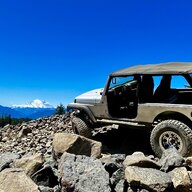
Guess I don’t know forsure, just assumed since it wasn’t compressing the jounce all the way with the rear tire up 2.5’ on a mound. There was a lot of the jeeps weight on the front corner so I assumed it should be enough to fully compress the jounce
 
  • Like
Reactions: deadbeat son
Guess I don’t know forsure, just assumed since it wasn’t compressing the jounce all the way with the rear tire up 2.5’ on a mound. There was a lot of the jeeps weight on the front corner so I assumed it should be enough to fully compress the jounce

Maybe my logic is flawed and my argument has been incorrect the whole time and the mound was enough to compress it all the way. Unfortunately, I don't think you'll be able to verify until you fully cycle without springs and look for physical contact and/or binding that limit movement. Please post back either way.
 
  • Like
Reactions: Bowhunter
I agree, like you and other have said I need to pull the springs, just a little bit of a project so was hoping I could diagnose without removing

As far as the shock goes, it’s not the limiting factor in that bump stop picture, I checked and the shock had approx 1.5” left of travel.

My shocks aren’t quite 50/50 but close. I’d need to reduce lift (not a good option in my case) or get a longer shocks. The 5000s allow more a bit more travel but I prefer the 9000s over the 5000. I tried the sky jacker black maxes and fox IFP, neither were closer to 50/50 split so kind of a give and take thing.

If my shocks aren’t stopping my upward travel in that picture, what would you guess would be the next thing holding up the flex? The stock control arms?

How are you going to change the amount of bumpstop without removing your springs anyway?
 
Novak Conversions Jeep Wrangler TJ radiator