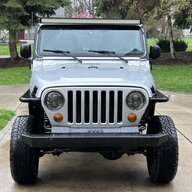
2003 Sahara 4.0 5sp. Got some problems so thought I would ask for feedback before venturing on a folly.
So mine decided to not cooperate with my timeline and gave up sooner. Kind of loud noise after coming off the highway a while ago. Was thinking it was heatsoak (happens sometimes as the weather got warmer after interstate driving), start the next day, no issues. Until recently. Was not long out of the driveway to work and check engine light came on. Got to work and checked codes, P0155 (comes on in winter past few years with low ambient temps, weird to happen in spring), and P0301 which was a new one never happened before. After work due to slow/heavy traffic the engine light started flashing like crazy so pulled into a parking lot and AAA to the rescue. Didn't want to take a chance damaging anything and realized later I was just dumping unburnt fuel.
Started the usual checks, changed plugs (worn and out of gap) and the O2 sensors (NGK). Cleared, started, P0301 back. Dig further, watch videos. Checked compression.
Cyl 1 Dry 25 Wet 45,50
Cyl 2 Dry 120
Cyl 3 Dry 120
Cyl 4 Dry 105
Cyl 5 Dry 125
Cyl 6 Dry 120
Only tested Cyl 1 wet as others were consistent. Cyl 1 was audible difference in stroke so could tell when turning key it was a problem. When compression increased indicates piston/ring issue. Don't have a leak down tester yet, but from what I was able to tell pushes me toward a direction. Rebuild or swap. I did disconnect the cyl 1 injector so it would stop dumping fuel but that threw the injector code. Figured I could move/drive it minimally if needed but haven't had to yet.
Pros of motor: no leaks other than valve cover and oil pan seals. Already have a full gasket set, was planning on a refresh in July when I am off work. Also picked up a new timing chain set, figured since I was in for the gaskets to check that too. RMS doesn't drip, amazingly...at least until if I start opening things up I would guess. Doesn't burn oil, little usage if I accidentally extend my changes but I usually keep at 6500m/change. Good pressure per the gauge, etc. Occasional tap on start but has shown probably thermal so hasn't been priority concern. It has been a good motor.
Cons of motor: just shy of 275,000. Was planning/thinking by 300K would need to do some preventative upgrades even if no issues just as insurance.
What I am looking at (pending what pulling the pan reveals):
Dirty rebuild in frame, only pistons and rings as would not be able to change cam bearings without pulling motor. Potentially fastest way to restore. Biggest caution is how to interpret main and rod bearings as I have never had to do that before and it is like a foreign language complete with deer in the headlights look. Cheapest, estimate about $1K-ish. No telling if it will last 500m or 5000m, and back to square 1 if it goes. However, from what I have seen of those who have done it has been good results if you take your time.
Donor swap. Priced out would be around $1500-$2000. That is me doing all the labor. Pro is less mileage motor, con is no history so it is a crap shoot.
Reman swap. Priced would be around $2700-$3600 depending on rebuilder. All labor is on me. Pro is 0m motor, con is potential issues from rebuilder. Limited options on head, some offer a TUPY, others say "new improved" but offer no proof like a TUPY stamp or the obvious build up like Clearwater does. Mine came with a TUPY so I am not really wanting to chance a 331 if it can't be verified. Limited rebuilders do offer a TUPY for an upcharge. (Titan and Promar for example).
Reman through reseller. Priced estimated between $5500-$7000 locally. Turn key, but some of the places around here do shoddy work especially on older vehicles. Jasper seems to be the flavor of choice, most are hesitant or refuse to do a swap if they can't sell the motor. Probably make too much off it that way.
Other than the dirty it would be approching into a loan or financing for the others. Might be able to pull the swap without but it would stretch things a lot (had some other unexpected house costs recently too). These are the only real 4 options I can look at as it is my daily and we are adjusting for a 1 car family right now so it needs to be back (relatively) soon. Stroker is not a option/choice as yes the power would be nice but cost is greater and it doesn't seem applicable for what I drive (more fuel usage, no real benefit, etc). Same with a local rebuilder, either too busy, too costly, or just not what they do (ie: muscle cars or speed shops).
Other factors, work would be outside. I do have a pop up 10X10 for shade and an area of my driveway to work, but it is still outside so weather is a concern. Tool wise I am mostly covered except for a few things that I included in the budget estimates. I have swapped engines in vehicles before with my father, but I was significantly younger then and needed less ibuprofen. Deepest internal I remember doing was a valve job and timing chain swap on a V8.
If a dirty would get me another year or two at least I am thinking it would be best. Looking at the rebuild kit from Cleggs I am not sure what option to order and measuring the main and rod bearings is something I have never done. Gotta ask, what kind of bad idea/total disaster would it be to reuse the existing ones if they appear in good shape still? Like I said, it is minimal to no oil usage so flow is still good from what I can tell from reading/videos.
Beyond the engine I have done a lot of the work on it too. Suspension, axle seals/bearings, clutch, etc. Just nothing internal this big. IMO, I've done enough to warrant keeping and fixing as it is good to go...at least until the next thing comes along.
So, given the info above, what would you do? Overthinking it or over my head?
So mine decided to not cooperate with my timeline and gave up sooner. Kind of loud noise after coming off the highway a while ago. Was thinking it was heatsoak (happens sometimes as the weather got warmer after interstate driving), start the next day, no issues. Until recently. Was not long out of the driveway to work and check engine light came on. Got to work and checked codes, P0155 (comes on in winter past few years with low ambient temps, weird to happen in spring), and P0301 which was a new one never happened before. After work due to slow/heavy traffic the engine light started flashing like crazy so pulled into a parking lot and AAA to the rescue. Didn't want to take a chance damaging anything and realized later I was just dumping unburnt fuel.
Started the usual checks, changed plugs (worn and out of gap) and the O2 sensors (NGK). Cleared, started, P0301 back. Dig further, watch videos. Checked compression.
Cyl 1 Dry 25 Wet 45,50
Cyl 2 Dry 120
Cyl 3 Dry 120
Cyl 4 Dry 105
Cyl 5 Dry 125
Cyl 6 Dry 120
Only tested Cyl 1 wet as others were consistent. Cyl 1 was audible difference in stroke so could tell when turning key it was a problem. When compression increased indicates piston/ring issue. Don't have a leak down tester yet, but from what I was able to tell pushes me toward a direction. Rebuild or swap. I did disconnect the cyl 1 injector so it would stop dumping fuel but that threw the injector code. Figured I could move/drive it minimally if needed but haven't had to yet.
Pros of motor: no leaks other than valve cover and oil pan seals. Already have a full gasket set, was planning on a refresh in July when I am off work. Also picked up a new timing chain set, figured since I was in for the gaskets to check that too. RMS doesn't drip, amazingly...at least until if I start opening things up I would guess. Doesn't burn oil, little usage if I accidentally extend my changes but I usually keep at 6500m/change. Good pressure per the gauge, etc. Occasional tap on start but has shown probably thermal so hasn't been priority concern. It has been a good motor.
Cons of motor: just shy of 275,000. Was planning/thinking by 300K would need to do some preventative upgrades even if no issues just as insurance.
What I am looking at (pending what pulling the pan reveals):
Dirty rebuild in frame, only pistons and rings as would not be able to change cam bearings without pulling motor. Potentially fastest way to restore. Biggest caution is how to interpret main and rod bearings as I have never had to do that before and it is like a foreign language complete with deer in the headlights look. Cheapest, estimate about $1K-ish. No telling if it will last 500m or 5000m, and back to square 1 if it goes. However, from what I have seen of those who have done it has been good results if you take your time.
Donor swap. Priced out would be around $1500-$2000. That is me doing all the labor. Pro is less mileage motor, con is no history so it is a crap shoot.
Reman swap. Priced would be around $2700-$3600 depending on rebuilder. All labor is on me. Pro is 0m motor, con is potential issues from rebuilder. Limited options on head, some offer a TUPY, others say "new improved" but offer no proof like a TUPY stamp or the obvious build up like Clearwater does. Mine came with a TUPY so I am not really wanting to chance a 331 if it can't be verified. Limited rebuilders do offer a TUPY for an upcharge. (Titan and Promar for example).
Reman through reseller. Priced estimated between $5500-$7000 locally. Turn key, but some of the places around here do shoddy work especially on older vehicles. Jasper seems to be the flavor of choice, most are hesitant or refuse to do a swap if they can't sell the motor. Probably make too much off it that way.
Other than the dirty it would be approching into a loan or financing for the others. Might be able to pull the swap without but it would stretch things a lot (had some other unexpected house costs recently too). These are the only real 4 options I can look at as it is my daily and we are adjusting for a 1 car family right now so it needs to be back (relatively) soon. Stroker is not a option/choice as yes the power would be nice but cost is greater and it doesn't seem applicable for what I drive (more fuel usage, no real benefit, etc). Same with a local rebuilder, either too busy, too costly, or just not what they do (ie: muscle cars or speed shops).
Other factors, work would be outside. I do have a pop up 10X10 for shade and an area of my driveway to work, but it is still outside so weather is a concern. Tool wise I am mostly covered except for a few things that I included in the budget estimates. I have swapped engines in vehicles before with my father, but I was significantly younger then and needed less ibuprofen. Deepest internal I remember doing was a valve job and timing chain swap on a V8.
If a dirty would get me another year or two at least I am thinking it would be best. Looking at the rebuild kit from Cleggs I am not sure what option to order and measuring the main and rod bearings is something I have never done. Gotta ask, what kind of bad idea/total disaster would it be to reuse the existing ones if they appear in good shape still? Like I said, it is minimal to no oil usage so flow is still good from what I can tell from reading/videos.
Beyond the engine I have done a lot of the work on it too. Suspension, axle seals/bearings, clutch, etc. Just nothing internal this big. IMO, I've done enough to warrant keeping and fixing as it is good to go...at least until the next thing comes along.
So, given the info above, what would you do? Overthinking it or over my head?
Last edited: