4.0 intake manifold lesson learned

Javashoveler

New Member
Original poster
Supporting Member
Joined
Sep 30, 2021
Messages
5
Location
Prineville Oregon
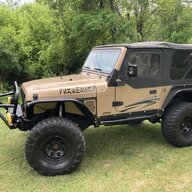
This is my first rodeo with a TJ with a 4.0. I'm sure I'm not the first to run into this. Probably not the last. Just trying to share the knowledge. Pictures included as I can.
The story starts with a cracked exhaust manifold. A well known problem and one that came with the 1999 TJ I bought a few months ago. I sourced a new and improved one with the flex pipes to prevent future cracks. I finally got around to replacing it recently. First problem, the manifold bolts were rusted to the point I was surprised they came out at all. So, had to get a bolt kit. Yesterday they came in and I went to put it together. After struggling to get proper torque on the bolts, I thought I had it ready to go. It was past dark by the time I got to fire it up. After few seconds cranking, it fired up, and immediately went to the rev limiter, 5K+! I shut it down and checked everything. Couldn't figure out why so I tried it again. Same thing happened. I tried to see what it was doing and then saw the exhaust glowing so I shut it down again. After doing some research, I came up with a couple possibilities. Vacuum leak and improperly installed intake. I ruled out the vacuum leak as I had recently smoke checked everything and already replaced worn out boots. Today I was able to look at the intake manifold better and found the lower side to have a gap. When I got everything apart again, I found out why. I had not gotten the intake on the alignment dowels/pins correctly. What was worse, I had cracked the manifold in a couple places.
In conclusion, make sure to get the manifold attached properly before torqueing down. Or you will be waiting on parts, again.
Cheers

IMG_1109.JPG


IMG_1111.JPG
 
Dang. I am glad that didn't happen to me. Funny story though...I had no idea the intake manifold was aluminum when I started. I thought it was cast iron...until I took it off and saw silver inside...after a pressure wash and some throttle body cleaner, SILVER! haha

I had that exhaust leak and bought the exhaust manifold with 'bellows' on the outside pipes. Worked like a charm and I had no idea my Jeep could be so quiet.
 
Im having this issue right now. My Jeep just revs like crazy when turned on. What did you do different the second time to get it to align better and was it the air intake or exhaust manifold? Or both?
 
Im having this issue right now. My Jeep just revs like crazy when turned on. What did you do different the second time to get it to align better and was it the air intake or exhaust manifold? Or both?

I've done mine a few times. I generally have a second set of hands to hold everything in place and I use a scope camera to check all around and ensure a good fit. If you don't have a second set of hands, bungees or ratchet straps may be a suitable sub. Torquing to spec is a bit of a challenge, at least for me.
 
Last edited:
  • Like
Reactions: Javashoveler
Im having this issue right now. My Jeep just revs like crazy when turned on. What did you do different the second time to get it to align better and was it the air intake or exhaust manifold? Or both?

Only the intake manifold will cause the huge air leak and send your idle speed to the stratosphere. I just pulled and replaced my intake/exhaust manifolds, but note that I did mine on a stand. Here's a couple of notes:

1) The FSM has a decent writeup about how to install the exhaust/intake manifolds.​
2) Below is for the two piece exhaust manifold, my guess is the one piece would be easier to deal with​
3) Install the exhaust manifolds first​
A) use the nuts and studs at either end of the motor and the center bolt in the head. These fasteners aren't used for the intake​
B) Install these just tight enough to hold on the exhaust manifolds, as you will have to wiggle em a bit to get the lower bolts in with the intake​
4) Place the intake in place, have a couple of bolts handy to hold it once its properly positioned​
A) Wiggle it around. Once it's on the dowels you will feel it drop into place.​
B) An extra pair of eyes would help, somebody needs to verify the manfold is on the dowels. Go thru fenderwell, undereneath use a mirror, whatever​
C) install a few bolts JUST tight enough to hold manifold in place (finger tight), a couple on the lower and upper is best​
D) Re-verify it's on the dowls.​
E) Install all the remaining bolts and lightly snug everything up​
F) Tighten all bolts in the sequence and torque per the FSM. I did it in two torque steps​
G) You should be good to go!​

Good luck!
 
Patience, patience, patience! Go into the job knowing that its going to either be dead simple or super frustrating and the margin between those two extremes is tiny. If you accept you may need to have the manifold on and off 3 or 4 times to get it right at least you wont be so frustrated. I tend to remove any excess stuff like the charcoal canister to give me more room - but I'm in a RHD 99 so that may not be applicable to you.

Wiggling it onto the dowels and then finger tightening a couple of bolts without moving the alignment even a fraction is all you have to do - simple right? Bwahaha - one day it just works first time, second day it takes 4 goes to get it right.
 
  • Like
Reactions: Javashoveler
Patience, patience, patience! Go into the job knowing that its going to either be dead simple or super frustrating and the margin between those two extremes is tiny. If you accept you may need to have the manifold on and off 3 or 4 times to get it right at least you wont be so frustrated. I tend to remove any excess stuff like the charcoal canister to give me more room - but I'm in a RHD 99 so that may not be applicable to you.

Wiggling it onto the dowels and then finger tightening a couple of bolts without moving the alignment even a fraction is all you have to do - simple right? Bwahaha - one day it just works first time, second day it takes 4 goes to get it right.

The evap cannister is up front on mine and yes I pulled it for that job. I know it sounds mundane for you but it would be cool to drive a RHD some day. ha haa Most of the mail trucks were CJs around here back in the day. They were RHD but most are long gone. Im sure there are some still living good lives!
 
We don't put salt on our roads in Western Australia so unless we go hunting out on the edge of the Western Desert where there are big saltpans our old Jeeps tend to stay alive for much longer out here than in the Rust Belt of the US. CJ's are not common here though - the TJ's whilst not the first Wranglers here were the only ones to be widely imported.