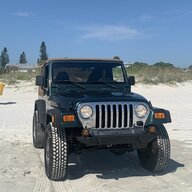
2001 TJ Starter Problem

Crabman

Member
Original poster
Joined
Apr 2, 2024
Messages
40
Location
Denver Colorado
I have a 2001 TJ Sport. It has started doing something odd. When the engine compartment heat up the starter quits working. I get ignition lights but the starter will not work. After everything under the hood cools down (several hours) it starts great. I pulled the starter relay and swapped it with another one - no affect. I can jump it from the battery through the relay slot. I am thinking PCM.
 
When this problem occurs verify there is or is not 12V incoming at the starter solenoid to actuate the solenoid.
When heat increases resistance increases and amperage draw increases causing the starter to not work properly.
Check the condition (loose or oxidized connections/cable wiring) of the battery cables going to the grounding stud and hot lead on the starter solenoid.
 
When this problem occurs verify there is or is not 12V incoming at the starter solenoid to actuate the solenoid.
When heat increases resistance increases and amperage draw increases causing the starter to not work properly.
Check the condition (loose or oxidized connections/cable wiring) of the battery cables going to the grounding stud and hot lead on the starter solenoid.

I checked the pin voltage for the relay "coil" when the compartment is "cold". It is 12.3 VDC. I started it and drove around long enougn for the compartment to get very hot. The starter was no bueno. I checked voltage for the rlay coil and it was zero! I wait 10 minutes and it was 5 VDC. 15 more minutes and it was 10 VDC - still no start.

I just checked voltage again (45 minutes). 12.5 VDC at starter coil - engine starts! Does the solid state relay need the full 12 VDC to actuate?
 
Verify the incoming voltage to the relay at terminal B5 and the ground at B3 which pulls in the relay in the PDC.
Resistance in the relay coil can cause the coil not the engage the relay.
Replace the starter relay in the PDC if the voltage does not pull in the relay.
Check pages 8W21-2,3 in the FSM for schematics on Starter circuit.

https://wranglertjforum.com/attachments/2002-tj-service-manual-pdf.14039/
 
Thank you for your reply , the service manual, and some places to check voltage measurrements from the wiring diagram. I did get voltage measurement between B3 and B5 in the "no start engine compartment hot " condition. The first measurement (with key turned to start position/clutch pedal in) by my wife was zero volts (no start), the second measurement was 4.5 volts (no start), third 10 volts (no start), forth 12.5 volts (start!). The time between measurements from the first to the 4th was about 1 hour with the hood open - so it cooled down faster. I am thinking corroded connection at B5. I will test again tomorrow with a cut into the yellow/red wire insulation before the connector. That all I can come up with as to why the voltage would increase as the temperature reduced. PLEASE let me know if you have other ideas!

PS - My voltage mensurements were made on the connector itself - not the wire. That's why I will check the wire tomorrow.

Thanks again for the help!!!

 
Jumper the wires on the clutch position switch (attached to clutch pedal) to see if this resolves the problem of the starter relay (PDC) engaging when HOT.
IF no power; then remove Fuse 20 (20A) power to starter relay coil, clean fuse terminals and reinstall fuse.
Verify if there is power present at the relay after cleaning the fuse terminals.
 
  • Like
Reactions: Crabman
Jumper the wires on the clutch position switch (attached to clutch pedal) to see if this resolves the problem of the starter relay (PDC) engaging when HOT.
IF no power; then remove Fuse 20 (20A) power to starter relay coil, clean fuse terminals and reinstall fuse.
Verify if there is power present at the relay after cleaning the fuse terminals
I found the location for the starter relay in the fuse block. Position 20 is labeled as "AUTO TRANS" and there is no fuse in that position. According to the wiring diagram it must be either the clutch pedal position switch or the ignition switch.
 
Last edited:
I found the location for the starter relay in the fuse block. Position 20 is labeled as "AUTO TRANS" and there is no fuse in that position. According to the wiring diagram it must be either the clutch pedal position switch or the ignition switch.

It turns out that if I put a fuse into fuse block #20 the clutch pedal position switch is bypassed.This is what the wiring diagram shows - sort of.
 
I found the location for the starter relay in the fuse block. Position 20 is labeled as "AUTO TRANS" and there is no fuse in that position. According to the wiring diagram it must be either the clutch pedal position switch or the ignition switch.

Remove the starter relay and measure the resistance across terminals 1&2 of the relay when engine compartment temperature is HOT and the relay will not engage. The resistance normally across terminals 1&2 of the relay coil when cold should be read 85-90 ohms.
As the engine compartment temperature increases the resistance across the coil windings increases which requires more voltage to create the magnetic field of the coil to close and hold the relay closed.
IF the resistance across terminals 1&2 is too much; the relay coil will not close to engage the starter.
If the problems are as explained above; replace the starter relay in the PDC.
 
Remove the starter relay and measure the resistance across terminals 1&2 of the relay when engine compartment temperature is HOT and the relay will not engage. The resistance normally across terminals 1&2 of the relay coil when cold should be read 85-90 ohms.
As the engine compartment temperature increases the resistance across the coil windings increases which requires more voltage to create the magnetic field of the coil to close and hold the relay closed.
IF the resistance across terminals 1&2 is too much; the relay coil will not close to engage the starter.
If the problems are as explained above; replace the starter relay in the PDC.

I will do that tomorrow.