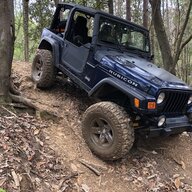
Going to pull my front springs/shocks this morning and cycle the suspension to measure for new shocks. Do I leave my Sway Loc connected in the off road position or disconnect it completely?



Disconnect it. You want no limiting factors to start with. That way you'll have a true baseline. Then, as you make changes, you can assess their impact.Going to pull my front springs/shocks this morning and cycle the suspension to measure for new shocks. Do I leave my Sway Loc connected in the off road position or disconnect it completely?
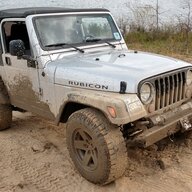
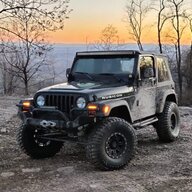
 After clearancing I still contact there with about another inch to go until the tire tickles the fender flare. Short of trimming the reinforcement surrounding the track bar mount (which I don't plan on doing as I'm sure it's there for a reason) I think that's the best it's gonna be.

2" of bump extension up front might be typical. Mine is closer to 1.5" or whatever the lowest amount Currie bumps have without spacers.Two inches of bump stop doesn't necessarily sound excessive to me (although I'm pretty new at this). On mine, the compressed shocks only needed about 1/2" of bump stop. And the 31" tires on stock rims, both fully tucked, were slightly inside the fender flares, but turned lock to lock without touching. But with one tire up and the other end of the axle fully extended, the tire chewed the flare badly on turns. A 1.5" bump stop extension fixed that. And tilted like that, the tire rubs badly on the spring tower when turned, which wanted 3" of bump to fix. I compromised on 2" with some rub on the spring tower. The tower is rounded and smooth, and I'll be crawling when fully flexed and turning sharp, so it shouldn't rip up the tires. Rims with different backspacing might fix the spring tower problem, but might increase the fender flare problem.
Due to the torsion bar, this is exactly what you'd expect to see. One side goes down, one goes up. What you're now starting to learn is something most won't see, unless you take the time to do the work. When the knowledgeable folks here say "one thing impacts another", this is what they're talking about. Sometimes it's good, like in this case, sometimes it's not good.So interesting thing; I got more stuff with the SwayLoc connected than disconnected. Why? Because the tire was getting in to the "switch" on the SwayLoc at full stuff and steering turned to lock with it disconnected. When I connected it, it pushed itself up out of the way more. It's still the first point of contact on the pax side, but only barely and I only lose like 1/4" of travel vs the tire into the fender flare anyways, so I'm content there.
Driver's side limfac was the RockJock track bar (reinforcement) vs the diff cover. I made a yuge mess with my dye grinder clearancing the diff cover. Fun facts--aluminum shavings are both sharp AND impossible to clean up with a magnet
View attachment 290840
A 2" bumpstop isn't excessive, but my guess is that could be reduced. However, we'll need the ride height numbers to know what your actual travel will be.So I'm looking at slightly more then 2" bump stop extensions which seems like a lot to me? Compressed shock length of 16". On extended length, I have to shove the tire down and there's still more flex to be had. Is that normal? I will determine ride height when I put the springs back in which I think will also shove extended length down to where it wants to be. Am I missing anything? Is it okay to use big washers to fine tune the bump stops?

Cycling with an antisway bar connected will only limit flex and show very clearly that an antisway bar will work to keep the frame parallel to the axle.So interesting thing; I got more stuff with the SwayLoc connected than disconnected. Why? Because the tire was getting in to the "switch" on the SwayLoc at full stuff and steering turned to lock with it disconnected. When I connected it, it pushed itself up out of the way more. It's still the first point of contact on the pax side, but only barely and I only lose like 1/4" of travel vs the tire into the fender flare anyways, so I'm content there.
...
Everything in that picture is so clean…it makes me feel good for some reasonDue to the torsion bar, this is exactly what you'd expect to see. One side goes down, one goes up. What you're now starting to learn is something most won't see, unless you take the time to do the work. When the knowledgeable folks here say "one thing impacts another", this is what they're talking about. Sometimes it's good, like in this case, sometimes it's not good.
The reinforce tab can absolutely be trimmed. I had to trim mine to get it to clear at full bump. Also, that large ribbed cover isn't doing you any favors. Although they not available now, the Alloy USA cover offers strength, clearance, and a reasonable price.
https://www.amazon.com/gp/product/B003E7NO6S/?tag=wranglerorg-20
View attachment 290962
A 2" bumpstop isn't excessive, but my guess is that could be reduced. However, we'll need the ride height numbers to know what your actual travel will be.

You completely removed the bolt or simply loosened it?I hated my spring compressors. I found that if I kept disconnecting things, I eventually had inches of air between the springs and the perches. Disconnect shocks, sway bar, track bar, drag link, driveshaft, brake hose (just remove brackets so they can flex farther), diff vent hose. And the last one was the lower control arms at the axle, because the CAs hit the axle bracket at steep angles. That finally did the trick for mine. Check if your CAs are limiting it here:
View attachment 291255
Sorry, I just noticed that you have Currie/Savvy CAs, so that's probably not the problem. Maybe.
Loosen any bolts that hold a rubber bushing. That allows them to rotate within the mount rather than stretch. Bolts holding joints like rod ends or Johnny Joints can be left tight.You completely removed the bolt or simply loosened it?
I removed a bolt on one side, and lifted the other end of the axle. That dropped the axle far enough on the unbolted end to simply lift out the old springs and lift in the new ones (OME 2" lift). No spring compressor needed. Then straighten the axle, replace the bolt, and do the other side. That keeps 3 control arms in place, holding the axle steady.You completely removed the bolt or simply loosened it?
On the front, bump stop is usually added on the bottom, exactly as you said, by drilling and tapping the pad inside the spring. Or drilling and using a self tapping bolt. If you add length to that top bump cup, it just runs into the spring. Coming up from the bottom evens out the angle where the top and bottom meet. Bumpers can be metal or rubber, some people use hockey pucks....how you guys do bump stop? All up top? I don't even know how I'd go about installing bump stop extensions on the bottom save for drilling and tapping the pad inside the spring.
Sorry, what did you mean by “rise allows them…” here?Loosen any bolts that hold a rubber bushing. Rise allows them to rotate within the mount rather than stretch. Bolts holding joints like rod ends or Johnny Joints can be left tight.