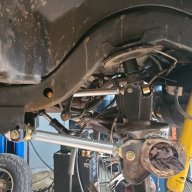
Novak Conversions Jeep Wrangler TJ radiator

Dave Kishpaugh's (Jeep West) geometry correction brackets are now available

Status
Not open for further replies.
Might be a bit of an odd set up, but I'm thinking I might pair this rear geometry correction with a 3 link front.... Need a little research to find out whose frame brackets are preferred.

 
Might be a bit of an odd set up, but I'm thinking I might pair this rear geometry correction with a 3 link front.... Need a little research to find out whose frame brackets are preferred.
@David Kishpaugh does this. I have seen him use a Savvy truss and he has his own mid arm frame mounts but you could just use all Savvy and be good to go.
 
  • Like
Reactions: Pressurized
Might be a bit of an odd set up, but I'm thinking I might pair this rear geometry correction with a 3 link front.... Need a little research to find out whose frame brackets are preferred.


Short arm rear with geometry correction and 3 link mid arm front is about the best we can do running upto 12" travel rear outboards. The only reason for a rear mid arm is to goto 14" travel or you don't already have high dollar adjustable control arms.
I do often use the savvy offroad front truss instead of the ce9112m2 joint when it's a rig we know will take an extraordinary amount of abuse

The mounts visible in these pics are all available.

20210128_150713.jpg


20210128_125129.jpg


20210127_182600.jpg


20210109_192352.jpg


20201011_192736.jpg
 
@David Kishpaugh thanks again for the insight. We have talked several times about my rig, and really would like to bring it to you, but it is just not feasible right now. I know I will no get close to what your mid arm can do with my short arms, but I need to put something together that will work for 2-3 years. I have redriled the frame LCAM with the template, but did nothing with the axle LCAM as there is not much room to redrill with the Artec axle setup. Also my LCA are turned all the way in, and my pumpkin is about 1/8" away from my gas tank even though I have raised it 1.25" with my body lift.

View attachment 213676


View attachment 213677

View attachment 213678

View attachment 213679


This is how I fix the artec truss issue that are incorrectly installed. (Humor here,, not trying to put down the use of artec) I pretty much never preweld a truss on. It all gets mocked up at ride height with the proper pinion angle and stock length 13.25" control arms, or at least not exceeding 13.75" upper arm with a 15.75" lower. If memory serves, the pinion angle lands in the 17 degree area on the flange, @ 4" lift and a 97-02 belly skid, which is a high clearance on a 03-06. I will rarely pay attention to what the actual angle number is because the priority in the mock up is proper pinion angle with a fixed length arm.

I also have patterns to raise the upper links on the artec truss for those that don't have track bar/tank clearance issues.

20201012_172653.jpg


20201012_202232.jpg


20201014_181548.jpg
 
This is how I fix the artec truss issue that are incorrectly installed. (Humor here,, not trying to put down the use of artec) I pretty much never preweld a truss on. It all gets mocked up at ride height with the proper pinion angle and stock length 13.25" control arms, or at least not exceeding 13.75" upper arm with a 15.75" lower. If memory serves, the pinion angle lands in the 17 degree area on the flange, @ 4" lift and a 97-02 belly skid, which is a high clearance on a 03-06. I will rarely pay attention to what the actual angle number is because the priority in the mock up is proper pinion angle with a fixed length arm.

I also have patterns to raise the upper links on the artec truss for those that don't have track bar/tank clearance issues.

View attachment 222573

View attachment 222574

View attachment 222575

@David Kishpaugh - Thank you for the input and the pictures. Since I am currently out of work so I have had some extra time on my hands, and thought I would give it a try to make my setup a bit better. I have detailed what I have done here:

https://wranglertjforum.com/threads...-it-binds-suspension.45203/page-3#post-786587
https://wranglertjforum.com/threads...-it-binds-suspension.45203/page-2#post-769683
I really did not notice much difference in handling after I got done. Maybe set the LCA back to stock position to get it closer to the anti-squat line?
 
@David Kishpaugh

When I install the brackets, they go flush with the sway bar mounts on the axle, correct? So, my process is cut factory brackets off. Grind the remaining bracket pieces and old weld off the tubes. Tack the new brackets in place, centered axially and flush rotationally with the sway bar mounts. Cycle and check for clearances. Finally, burn them in. Any gotchas to worry about? heat concerns? Like should I pull the axles and brake lines or anything? How stripped should the axle be, so I don't cook anything?

probably 6-ish hours off work for a rank amateur?
 
Parallel to the sway bar mount, they won't exactly be flush tho. If you push it into the bracket so it's flush, it'll tip it. Just weld up the smal gap. I'd expect probably 6 hours. There's been a couple installs I've done that the customer actually stayed and waited.
 
  • Like
Reactions: Mike_H and astjp2
This is how I fix the artec truss issue that are incorrectly installed. (Humor here,, not trying to put down the use of artec) I pretty much never preweld a truss on. It all gets mocked up at ride height with the proper pinion angle and stock length 13.25" control arms, or at least not exceeding 13.75" upper arm with a 15.75" lower. If memory serves, the pinion angle lands in the 17 degree area on the flange, @ 4" lift and a 97-02 belly skid, which is a high clearance on a 03-06. I will rarely pay attention to what the actual angle number is because the priority in the mock up is proper pinion angle with a fixed length arm.

I also have patterns to raise the upper links on the artec truss for those that don't have track bar/tank clearance issues.

View attachment 222573

View attachment 222574

View attachment 222575
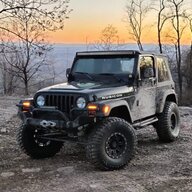
Do you use a swaybar with the raised roll height?

 
Do you use a swaybar with the raised roll height?
I do not run a rear sway bar on my rig with geometry correction. in a tj without geometry correction, I'm not comfortable with the sway bar removed. It'll be a personal preference, If you can't get used to it in a couple miles, put the links back in.
 
Here are my comments on the Jeep West rear geometry correction brackets for the TJ/LJ platform. If you want a set, you can reach out to Dave Kishpaugh at jeep.west.dave@gmail.com. These require some fabrication skills as you have to cut off your factory upper axle control arm mounts and weld on these brackets. This is for correcting the rear geometry on TJ/LJ’s lifted from 3” and up that are still running factory control arm locations. Part of the correction process is also relocating the lower arms in the factory mounts. This requires drilling both frame and axle side mounts. The rear geo correction works best with a 1.25 body lift for clearance under the tub at full compression. But this is common on built TJ/LJ's with a tummy tuck.

Dave has said that if you aren't going over a 10" travel shock in stock mounts or 12" if mounted outboard, there is little or nothing to gain with either a mid arm or long arm setup over the geo correction... I'm at 10's in the stock location and plan for 12's outboarded in a future mod.

Why? As we lift a TJ, we move the instant center of the rear suspension. Depending on lift height, it typically is moved way above the 100% anti squat line. Mine was calculating at 198%. This means that when you accelerate, the rear of the Jeep actually wants to rise instead of squat. This causes the rear end to hop and lose traction at times when trying to climb an obstacle. The geometry correction moves the instant center back down towards the 100% anti squat line depending on lift height. Mine corrected is at 137%. This creates more rear traction and eliminates or at least drastically reduces the wheel hop experienced by many lifted TJ’s.

This geometry change also corrects the excessive body roll known to exist in many lifted TJ’s. I’ve seen some that will actually lift the inside front tire off the ground going around a corner, especially when running no rear sway bar or an anti rock. The raised track bar mounting location raises the roll center which also reduces body roll.

While doing this fab work, it’s also HIGHLY beneficial to relocate the lower spring perches if the uppers haven’t already been done. I am using alignment wedges for more lift height so I am not doing the perch relocation. Perch relocation also gains you clearance for the rear shocks which often require extensions in the lower mount if not relocated.

So here’s the list of benefits of doing both rear geo correction and spring pad relocation…

1. Instant Center correction – improves traction eliminates wheel hop
2. Flattened links – drastically reduces rear steer
3. Flattened links – eliminates tire and tub interference due to wheelbase change
4. Flattened links – improves ride quality
5. Raised Track Bar mount - Higher roll center - reduced body roll
6. Huge increase in clearance for the rear track bar
7. No more spring bow
8. Perfect bump stop alignment
9. Rear Shock clearance

If I missed anything or got it wrong, I'm sure Dave will chime in with a correction.

I removed the rear sway bar and ran a few days that way, not a big difference, but decided I liked it better with the bar. I'm one of the few still running the factory front bar, so that has to be taken in to account.
 
Dave has said that if you aren't going over a 10" travel shock in stock mounts or 12" if mounted outboard, there is little or nothing to gain with either a mid arm or long arm setup over the geo correction... I'm at 10's in the stock location and plan for 12's outboarded in a future mod.

Why? As we lift a TJ,

Lifting a Jeep doesn't inherently change shock length. So the decision is based on shock length or lift height?

 
Lifting a Jeep doesn't inherently change shock length. So the decision is based on shock length or lift height?
As I understand it, and why I went this way, with short arms you are limited on total travel due to bushing and control arm geometry bind, etc... About 10" travel in stock locations or 12" if outboarded. If you want to go longer travel shocks, you need to move to a mid-arm or long arm setup to allow the axle to travel with the longer shocks.

So knowing what length shock you plan to run is part of the decision process on how to build your suspension.
 
  • Like
Reactions: Wildman
As I understand it, and why I went this way, with short arms you are limited on total travel due to bushing and control arm geometry bind, etc... About 10" travel in stock locations or 12" if outboarded. If you want to go longer travel shocks, you need to move to a mid-arm or long arm setup to allow the axle to travel with the longer shocks.

So knowing what length shock you plan to run is part of the decision process on how to build your suspension.
I've done a couple short arm outboards with 12s split in half. We have not seen the suspension bind on the trail. On jack stands, yes. But not with the weight of the Jeep acting on the axles.
 
I've done a couple short arm outboards with 12s split in half. We have not seen the suspension bind on the trail. On jack stands, yes. But not with the weight of the Jeep acting on the axles.

Maybe the geometry correction is for is using OEM control arms? :rolleyes:
 
  • Face Palm
  • Haha
Reactions: D M and Wildman
I don't think anyone is suggesting stock arms, but stock length arms tuck a 35 in the stock flair nicely.
 
  • Like
Reactions: Wildman
Status
Not open for further replies.
Novak Conversions Jeep Wrangler TJ radiator