Novak Conversions Jeep Wrangler TJ radiator

Tire PSI for sand driving

Everyone on here recommending a specific PSI sounds silly. Sand isn't one thing and one consistency. Vehicles aren't one weight with one tire size, tread pattern, and construction. <facepalm>

I’m happy to provide general info rather than not help at all.

If you’d like to break it down to each specific vehicle, tire model, and variation of sand in existence then go ahead.
 
Everyone on here recommending a specific PSI sounds silly. Sand isn't one thing and one consistency. Vehicles aren't one weight with one tire size, tread pattern, and construction. <facepalm>

You have to start somewhere. So random poster on the internet recommends 20psi so you start there. Later, you decide to try 15psi and 10psi. You decide you think 15psi works the best for you so that’s what you do.

Griping about peoples recommendations is pretty silly when a poster specifically asked what other people recommend.

Lots of people made recommendations. Apparently you know more than the rest of us but you make no recommendations. Sounds pretty silly to me
 
You have to start somewhere. So random poster on the internet recommends 20psi so you start there. Later, you decide to try 15psi and 10psi. You decide you think 15psi works the best for you so that’s what you do.

Griping about peoples recommendations is pretty silly when a poster specifically asked what other people recommend.

Lots of people made recommendations. Apparently you know more than the rest of us but you make no recommendations. Sounds pretty silly to me

He’s right that there is no one size fits all answer, but we can get pretty darn close based on experiences.

And as you mentioned, if the pressure is too soft or too stiff, go ahead and adjust it to your preference or needs.

Seems reasonable enough.
 
Just air down. It will be more comfortable and give you better traction. I just air down to 8psi on everything. Moving on.
 
Lots of people made recommendations. Apparently you know more than the rest of us but you make no recommendations. Sounds pretty silly to me
Actually I did in post number 8.

Did my comment hit a little close to home for you?
 
The pressure that is "best" for driving on sand depends on many factors. Just keep in mind what the goal is: you want increase the contact patch of the tyre touching the ground. So, just air down to e.g. 15psi and observe how far the sidewalls bulge out. The contact patch gets longer with less pressure, not wider. If you don't see much change go further down. I already went down to 12 psi and didn't have a tyre pop off so far.
Super soft sand requires going down a lot, sand on a beach is frequently moist and less of a problem.
 
I like to stay around 15-18 for the Mexico beaches but like the others said there are a lot of considerations. One thing I haven't seen mentioned is speed. There are stretches of hard pack where you can easily get up to 40-50 on the beach and I don't feel comfortable being aired down too much at those speeds due to sidewall flex generating excess heat which is not good. Last year I stayed at 18 for that reason. If I ever have a situation where I need to go really low at least with the on board air I can air back up for speed.

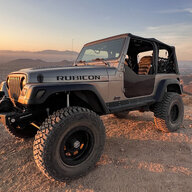
Your weight has a lot to do with it also, With me and a passenger I'm only around 4,000 lbs. The first time I took the TJ on the beach I would get "stuck" sometimes just stopping in the powdery stuff but all I had to do to get rolling again was scrape the mounds from in front of the tires, took all of 30 seconds and I was rolling again.

In contrast, we managed to bury my 8800 lb Superduty in the powdery dunes once and it took a good 45 minutes to get it out with shoveling and airing the 275's down to 20. We were probably loaded close to 10,000 so I had to keep the speed way down when I reached the hard pack. The TJ is way more capable in the sand even aired up all the way.

How do you guys determine how much to air down if the tires are hot? Say your highway pressure is 30 cold and you want to air down to 15, and your tires are hot and reading 35 so do you let out 15 or 20?

 
I like to stay around 15-18 for the Mexico beaches but like the others said there are a lot of considerations. One thing I haven't seen mentioned is speed. There are stretches of hard pack where you can easily get up to 40-50 on the beach and I don't feel comfortable being aired down too much at those speeds due to sidewall flex generating excess heat which is not good. Last year I stayed at 18 for that reason. If I ever have a situation where I need to go really low at least with the on board air I can air back up for speed.

Your weight has a lot to do with it also, With me and a passenger I'm only around 4,000 lbs. The first time I took the TJ on the beach I would get "stuck" sometimes just stopping in the powdery stuff but all I had to do to get rolling again was scrape the mounds from in front of the tires, took all of 30 seconds and I was rolling again.

In contrast, we managed to bury my 8800 lb Superduty in the powdery dunes once and it took a good 45 minutes to get it out with shoveling and airing the 275's down to 20. We were probably loaded close to 10,000 so I had to keep the speed way down when I reached the hard pack. The TJ is way more capable in the sand even aired up all the way.

How do you guys determine how much to air down if the tires are hot? Say your highway pressure is 30 cold and you want to air down to 15, and your tires are hot and reading 35 so do you let out 15 or 20?


It is common in JV to air down at camp to 8ish psi, run 30-50 mph for 10-20 miles to reach some of the outer trails. I've done that 100's of times with no ill effect. Many 100's if you count all the folks in line behind me doing the same.
 
It is common in JV to air down at camp to 8ish psi, run 30-50 mph for 10-20 miles to reach some of the outer trails. I've done that 100's of times with no ill effect. Many 100's if you count all the folks in line behind me doing the same.

Good to know. With the TJ being so light there's probably not the same risk as on some heavy vehicles.
 
You'll see trucks driving anywhere from 30-70 mph out in the dunes (I was one of them). I've never experienced, seen, or heard of a tire failure (for the purpose of this discussion).

In contrast, we managed to bury my 8800 lb Superduty in the powdery dunes once and it took a good 45 minutes to get it out with shoveling and airing the 275's down to 20. We were probably loaded close to 10,000 so I had to keep the speed way down when I reached the hard pack. The TJ is way more capable in the sand even aired up all the way.

There are thousands of HD trucks with toy haulers on the CA sand every year, and they learn quickly to air down or get stuck.

Google and many corners of the internet say to put a tow rig's tire pressure between 8-12 psi.

How do you guys determine how much to air down if the tires are hot? Say your highway pressure is 30 cold and you want to air down to 15, and your tires are hot and reading 35 so do you let out 15 or 20?
Based on your question, I would air down to 15 (not 20) since you may want to be lower than that anyways. Then check the pressures a bit later to see how the readings look cooled down. My guess is you'll want to air down more or leave it alone.
 
How do you guys determine how much to air down if the tires are hot? Say your highway pressure is 30 cold and you want to air down to 15, and your tires are hot and reading 35 so do you let out 15 or 20?

1000004134.png


😉
 
Just to be clear, the sidewall failure I am referring to is not anything immediate, it is the cumulative effect that can result in a failure much later, even a year or more later. Most people wouldn't even connect the two. For example, once a highway tire has been run low for a while it is advised by tire experts to replace it as it has suffered irreversible sidewall weakening which can lead to separation and failure down the road.

After having a sudden and catastrophic failure years ago on the front an F250 at highway speed I tend to error on the extreme side of caution, that's something you never forget.

There is a blog by a forensic tire engineer named Roger Marble and although a lot of it has to do with RVs there is a lot of information that pertains to every tire and use scenario. During his career he did forensic studies on failed tires and almost every early/sudden failure could be traced to a period of running low at some point during the tire's life.
 
Last edited:
Just to be clear, the sidewall failure I am referring to is not anything immediate, it is the cumulative effect that can result in a failure much later, even a year or more later. Most people wouldn't even connect the two. For example, once a highway tire has been run low for a while it is advised by tire experts to replace it as it has suffered irreversible sidewall weakening which can lead to separation and failure down the road.

After having a sudden and catastrophic failure years ago on the front an F250 at highway speed I tend to error on the extreme side of caution, that's something you never forget.

Just to be clear, we run the same tires for years and some even drive them home on the highways.
 
Novak Conversions Jeep Wrangler TJ radiator