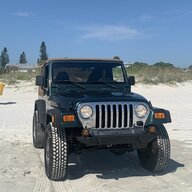
My turn for a no crank

hear

Can't type
Original poster
Lifetime Supporting Member
Joined
Oct 18, 2020
Messages
5,537
Location
Prosper, TX
Helping a friend but I don’t have access to wiring diagrams. Here’s what I know.

When we turn the key the starter relay clicks.

We jumped the starter relay and the starter turned.

I jumped the NSS and it still won’t start. I have 12v at the NSS.

Im at a loss at this point.
 
Is the click of the starter relay as strong using the ignition vs jumping?

Probe the positive stud on the starter relay again with the multimeter, but this time, have your friend try to start the engine while you're monitoring the voltage. A poor connection between the circuit from the key switch could be causing a voltage drop, letting the relay sound like it's engaging, but in reality, there's not enough voltage to give the coil full power to pull in the contact.
 
Last edited:
What's the battery voltage when the starter turns?

My guess is the battery doesn't have enough cranking amps.

Jump pack?

-Mac
 
Helping a friend but I don’t have access to wiring diagrams. Here’s what I know.

When we turn the key the starter relay clicks.

We jumped the starter relay and the starter turned.

I jumped the NSS and it still won’t start. I have 12v at the NSS.

Im at a loss at this point.

Test the relay coil side (terminals 85&86) by measuring for continuity (ohms).
Relay coil Ohms should be approximately 70 ohms; too much resistance and dirty electrical connections can cause the relay to either not engage or not engage properly. The dirty connection resistance can lower the voltage required to engage the relay properly.
Hope these schematics assist you in troubleshooting the starter problem.

Screenshot 2025-08-19 at 5.01.24 AM.png


Screenshot 2025-08-19 at 5.00.44 AM.png
 
Last edited:
I’m going to trace the circuit from the diagrams now that I’m back at my desk. We did swap relays with no change in the result. And I tried to measure the voltage at the relay (without the relay) but my probes wouldn’t really make good contact with the contacts down inside the cavity. That or I have very little voltage there.

The jeep had been running ok but he found a broken wire behind the valve cover. In repairing it, he introduced the no-crank issue. So I’m guessing the problem is actually in the harness somewhere but I’m hoping to test enough to isolate it before we start ripping out wiring.

Bubba also has lots of other wires that don’t go anywhere (the harness itself doesn’t appear to be hacked) so really it could be anything.
 
There is a known problem in that harness where the threaded head stud wears thru the split wire loom and harness insulation exposing the copper strands to grounding out or in extreme cases it will cut thru the wiring totally.
Suggest you examine the other wires it that loom for cuts and abrasions.
Cuts off communications between sensors and ECU.
 
  • Like
Reactions: Rickyd
You have 12v at the small wire on the starter in the crank position?

When you leave the ignition on and jump the starter it turns the motor over fine and it won't start?
 
  • Like
Reactions: macleanflood
You have 12v at the small wire on the starter in the crank position?

When you leave the ignition on and jump the starter it turns the motor over fine and it won't start?

With the key off, we jumped the big side of the relay cavity and hear the starter turn. That was good enough for me (at the time?) to prove that power can get to the starter and make it spin. I'm reasonably confident it will start from there, I'm focused on why the key won't make it spin.

I'm also trying to understand the starting circuit in the wiring diagrams but it's complicated. I only have a physics degree so I have to go slow.
 
With the key off, we jumped the big side of the relay cavity and hear the starter turn. That was good enough for me (at the time?) to prove that power can get to the starter and make it spin. I'm reasonably confident it will start from there, I'm focused on why the key won't make it spin.

I'm also trying to understand the starting circuit in the wiring diagrams but it's complicated. I only have a physics degree so I have to go slow.

Check the YL/RD 14 gauge wire from C106 to verify continuous 12V terminal 86 at starter relay when turning the ignition switch to start.
Check the BR/LB 20 gauge wire from C104 to verify continuous Ground terminal 85 at starter relay.
This will determine if you have the ability to engage the coil side of the starter relay.
 
I’m doing some of this remote, but he says not have any voltage at the little black wire on the starter, which is really the starter solenoid, right? So where does that little wire go? It goes into the harness and I haven’t had a chance to look at the wiring in depth, but first glance at the starter circuit didn’t show a solenoid.

I feel like we’re super close to making this work…
 
Ok, this is a real mystery now.

The "little black" wire at the starter is actually the 12ga brown wire that goes from the starter relay, through C104, and down to the starter solenoid. We've torn a bunch of the wiring apart for an unrelated reason, but as a recap, when we turned the key the starter relay would click. To confirm - if the starter relay clicks, it means the NSS check has passed, corrrect? Moreover, if the starter relay clicks with the key then can everything up to that point be assumed to be reasonably solid?

I have verified we have continuity from pin 30 to the battery, and from pin 86 to to the end of the brown starter wire. It seems like everything in the path works correctly, but we don't get 12V at the starter.
 
Pin 86 supplies the positive side power for the PDC starter relay coil to engage the relay; where are you hearing the click ?
At the Starter Relay in the PDC or the Starter Solenoid attached to the starter motor ?
You have measured Pin 30 to the battery and you have continuity, but do you have power from Fuse 6 (40A) in the PDC ?
When you state you jumpered the Starter Relay; are you talking the cube relay in the PDC or the Starter Solenoid that engages the Bendix gear attached to the starter motor ?
IF you jumpered across the Starter Solenoid attached to the starter and the starter motor cranks; then the solenoid and starter are good.
Have you checked Ignition Switch wiring harness terminal 6 for 12V (contact 1 inside the Ignition Switch) which is the beginning of the starting circuit ?
The ignition switch can have a bad set of contacts OR the pin between the Ignition Switch key tumbler and the switch contacts assembly might be twisted and not engaging the start circuit; only power for Run.
 
I've been pretty specific; if I say relay I mean the relay in the PDC. If I say solenoid I mean the solenoid attached to the starter. (I didn't mean for that to read like "I said what I said a-hole" but I couldn't figure out how to tone down the language, lol). So hopefully I haven't added any confusion there.

I couldn't quickly find the relay pinout, chatGPT says it's this but I'm pretty sure it's wrong in how they're numbered, @CharlesHS can you help me correct that before we go too much further? I also have an inline relay tester that doesn't have the pins labeled and they just stick out the side so you just have to do continuity tests to see what test lead corresponds to which relay pin if that makes sense.

Code:
|  |  |
      [ Relay Bottom View, Pins Facing You ]


        ┌───────┐
        │  87a  │   (Normally Closed – NOT used in starter circuit)
   85 ──┤       ├── 86
 (Coil – PCM GND)│       │ (Coil – IGN START power)
        │       │
        │   30  │   (Battery feed, hot at all times)
        │       │
        └── 87 ─┘   (Output to starter solenoid “S” terminal)


> Pin 86 supplies the positive side power for the PDC starter relay coil to engage the relay; where are you hearing the click ?
The click is felt inside the relay. Similar to fuel pump relay, ASD, and horn, which we've swapped around with no change.

> You have measured Pin 30 to the battery and you have continuity, but do you have power from Fuse 6 (40A) in the PDC ?
Have not checked anything related to fuse 6, other than to look if any fuses were blown (they were not). What specifically are you asking me to check here?

> When you state you jumpered the Starter Relay; are you talking the cube relay in the PDC or the Starter Solenoid that engages the Bendix gear attached to the starter motor ?
We removed the relay and briefly put a paperclip across the two "big" cavities (cavities 30 & 87 as labeled above), and immediately heard activity down below.

> IF you jumpered across the Starter Solenoid attached to the starter and the starter motor cranks; then the solenoid and starter are good.
Agree there, as well as the starter ground & 12V supply from battery are also all good.

> Have you checked Ignition Switch wiring harness terminal 6 for 12V (contact 1 inside the Ignition Switch) which is the beginning of the starting circuit ?
We haven't looked at the ignition switch, with the reasoning that if the turn the key to start fired the relay, then the ignition is probably not at fault.
 
I've been pretty specific; if I say relay I mean the relay in the PDC. If I say solenoid I mean the solenoid attached to the starter. (I didn't mean for that to read like "I said what I said a-hole" but I couldn't figure out how to tone down the language, lol). So hopefully I haven't added any confusion there.

I couldn't quickly find the relay pinout, chatGPT says it's this but I'm pretty sure it's wrong in how they're numbered, @CharlesHS can you help me correct that before we go too much further? I also have an inline relay tester that doesn't have the pins labeled and they just stick out the side so you just have to do continuity tests to see what test lead corresponds to which relay pin if that makes sense.

IF I understand your question correctly; on 8W-21-3 above; the starter relay terminals on the drawing are as follows:
B1 is relay terminal 30, B2 is relay terminal 87, B5 is coil positive from ign sw 86 and B3 is coil ground 85.
 
Last edited:
I have reread your responses above and your testing....
When you turn the Ignition key to Start the Starter Relay clicks (verified its that specific relay).
You jumper Starter Relay (terminals 30 and 87) and the starter spins (power thru brown wire to starter solenoid) .
You have swapped Starter Relay with known good relays; same problem.
Since you know the Starter will spin when you jumper the Starter relay; the problem is on the coil side of the Starter Relay.
Verify 12v remains constant at Starter Relay terminal 86 when turning Ignition Switch to Start mode.
You felt the Starter Relay click when tested, but is there enough continuous power to keep the relay pulled in while the Ignition Switch is in Start mode ?
IF not sure... remove fuse 20 (20A) in Fuse Block (behind glove compartment), with Ignition Switch in OFF place test wire from battery positive to Starter Relay terminal 86 to ensure relay coil stays pulled in.
The NSS may show continuity, but still could be a problem if it's dirty.
Verify the Starter Relay has a good continuous ground to terminal 85 while Ignition Switch is in Start mode.
IF not sure... place test wire from Starter terminal 85 to ground to bypass NSS.
Place Ignition Switch in Start mode to see if starter cranks.
 
  • Love
Reactions: hear
For whatever reason I'm having a hard time understanding this circuit, so your words are helping it come together against the diagrams. Here is the description of the circuit trace, which is probably just a restatement of what you've said in several posts already, but at least now I can follow along with the diagrams and maybe even explain it.

B1 = 30 ==> 12 PK/BK to Splice S111
>>> S111 has 2 branches
  • 12 PK/BK to Ignition switch SUPPLY via C106 (pin 6)
  • 12 PK/BK to PDC Fuse 6; the other side of Fuse Six is 6 RD to BAT+
I understand why they handled this with a splice, but it would be easier to understand if these were 2 different wires. Because I'm an amateur.

B2 = 87 ==> 12 BR to starter solenoid via C104 (pin 12)

B3 = 85 ==> 20 BR/LB to NSS via C104 (pin 5)

B5 = 86 ==> 14 YL/RD to Splice S333 via C106 (pin ?)
>>> S333 is interesting when it comes to LHD A/T
  • 14 YL/RD ==> Fuse 20 ==> 14 YL ==> S331
  • 14 YL/RD ==> Clutch pedal switch (not used) ==> 14 YL ==> S331
Then S331 ==> START position of Ignition switch

QUESTION: Does "not used" mean not even wired up? Because otherwise wouldn't that make the path of least resistance be the pass-thru clutch switch, and it would bypass Fuse 20? On page 8W-10-11 it seems to indicated it's not even wired up. I have definite confusion here.


Then as far as the relay goes, I think I've translated that earlier ASCII art into what's actually happening at the circuit. There are (at least) 3 states:

(1) Key OFF:
  • 12V at the ignition supply but the circuit is open because the key is OFF
  • So no power on B5/86.
OUTCOME: relay should remain open.

(2) Ignition at START, transmission in Park/Neutral:
  • 12V supply at ignition passed through fuse 20 to 86/B5 on relay
    • I don't understand how the clutch safety works yet
  • Relay circuit completed to ground through a closed NSS
  • Relay closes
  • 30/B1 & 87/B2 are now tied together
  • 12V passed to starter solenoid from 87/B2
OUTCOME: Starter should fire

(2) Ignition at START, transmission in gear/unplugged:
  • 12V supply at ignition passed through fuse 20 to 86/B5 on relay
  • Relay circuit remains open due to no ground path, due to open NSS
OUTCOME: relay should remain open.

Code:
      [ Relay Cavity View, View looking into the PDC ]

                        ┌───────┐
                        │       │
              86 / B5 ──┤ |   | ├── 85 / B3 
    (Fuse 20 ==> START) │       │ (20 BR/LB to NSS via C104 [pin 5] )
                        │       │
                        │ 30/B1 │   (12 PK/BK to Ign supply & Fuse 6 ==> BAT+)
                        │       │
                        └─87/B2─┘   (12 BR to starter solenoid via C104 (pin 12)


I realize that's a ton of circuitry, but if someone could at least vet my relay diagram and then the walkthrough of the3 use cases, it would be very helpful.

 
The "Not Used" parallel to Clutch Pedal Position Switch in S331 is for Automatic Transmissions which they wire differently (P and N only allow starter circuit to engage).
I forgot to mention that Fuse 20 (not normally installed) is the Clutch Pedal Position Switch bypass fuse so the clutch pedal does not need to be depressed to start the vehicle.
 
  • Face Palm
Reactions: hear
The "Not Used" parallel to Clutch Pedal Position Switch in S331 is for Automatic Transmissions which they wire differently (P and N only allow starter circuit to engage).
I forgot to mention that Fuse 20 (not normally installed) is the Clutch Pedal Position Switch bypass fuse so the clutch pedal does not need to be depressed to start the vehicle.

Ok lemme get this straight. On a M/T, the fuse is NOT present, and the switch opens/closes that section of the circuit. If you wanted to bypass the clutch safety, you'd put Fuse #20 back in?

And on an A/T, is the fuse there or not? I guess I can look once it gets below 200F outside... The wiring diagram isn't very clear on those variations. Or at least not to me.
 
Ok lemme get this straight. On a M/T, the fuse is NOT present, and the switch opens/closes that section of the circuit. If you wanted to bypass the clutch safety, you'd put Fuse #20 back in?

And on an A/T, is the fuse there or not? I guess I can look once it gets below 200F outside... The wiring diagram isn't very clear on those variations. Or at least not to me.

You are correct about the switch and the fuse on the M/T.
As for the A/T I believe the fuse is also installed.
 
  • Like
Reactions: hear
Well after tearing the engine bay harness apart and tracing tons of wires.... we fixed 2 things (coolant temp sensor and the wire from the alt to the PCM, which also runs to the leak detection pump). Put it all back together, and it fired right up, time after time. I can't explain why it didn't work before, since I had power & continuity at the relay, which is basically the last thing in the circuit. Maybe the starter ground was bad and by disconnecting everything and reconnecting we resolved it?

I know a lot more about the starter circuit now, so that's a win.


You are correct about the switch and the fuse on the M/T.
As for the A/T I believe the fuse is also installed.

I commented on this in another thread, but on my 97 auto that fuse is labeled as a spare, which would suggest the A/T just "hard wires" that connection to replace the switch; the fuse path is not the primary and may not even be wired up. It's gonna take some work to figure out, and I may decide I just don't care enough.