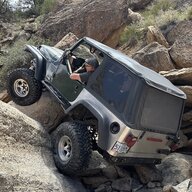
Ha ha. Yep, no going back now!
Ready by Sand Hollow?


Ha ha. Yep, no going back now!
The kids were home for Christmas and it was really nice but they have their lives and returned to them by the beginning of the week. Regardless, I had last week off and therefore, most of it was available for Jeep work. There were delays encountered but progress happened as well. In my last post, I cut the rear frame off and began fabricating the a new rear frame rail. That went pretty well so I figured the other side would be a cinch because I had a pattern. It was not as easy as I had hoped to make make a perfect replica but I did it.
View attachment 664585
Now is also a good time to go over what I’m doing with the back of the frame and why. Here are some pics of a new rail next to the old:
View attachment 664580View attachment 664579View attachment 664578
You can see the arch is not only farther back to keep it over the axle with the stretch, but also it is lower. Because the arch center is now moved back to roughly the level of the body mounts in front of the tank, fabrication of the new crossmember in that area will be easier because there is much more metal below the tub floor. As noted previously, the height of the arch can be lower with coilovers because the room between the frame and axle tube for the stock coil spring isn’t required. You can also see the rear end of the frame rail is a little longer and the length of flat section behind the arch is maintained. These both have to do with my goal of moving the tank back a little so that I can mount a decent sized tank in a stock-ish location instead of using a very small tank or a fuel cell in the bed.
The new rear cross member will also be the bumper and was fabricated out of 2”x3” rectangular 1/4” wall tubing. I angled up the underside of the ends and capped them. I also designed some 1” thick recovery points that embed into cut outs on the rear face of the bumper. This allows them to be welded all around on the back face and also get plug welded to the front face of the rectangular tubing.
View attachment 664590View attachment 664591View attachment 664592
Next up: Preparing the joints between the old and new frame sections. I used 4” long cards of 3/16” steel on each of the 4 inner surfaces of the frame. 2” of steel on either side of the joint with four 1/2” plug welds on each side of the joint for the wide cards and 2 on each side for the narrow cards. In total this amounts to 24 plug welds per joint plus the weld at the actual joint seam.
View attachment 664593
A note about frame quality: Here is one of the new frame rails after drilling the plug weld holes. Look how pristine the junkyard 05 frame is inside:
View attachment 664584
And look at my ‘97 frame in front of the cut. Not as pretty. I have done the Eastwood internal coat a couple of times in the past but there was some significant scale which was adherent enough to not rinse or blow out. The pic below is after running a crow bar down the inside surfaces a bunch of times to rub off the scale and then vacuum and blow out the loose stuff. It seems to get a lot better before the corner where you can see the first T-case skid bolt. I will re-coat inside when this is all done.
View attachment 664581
Once the 3 new pieces were ready and the original frame portion of the joint was prepared, it was time to assemble the new rear frame. First I welded the rear bumper to the frame rails making sure they were square and at the correct width between rails. This dimension was 37 3/4” - 37 7/8” depending upon where you measure on my old frame, which makes the point that the tolerances aren’t to the micron on these things. Sorry for that obtuse term@JMT.
View attachment 664595View attachment 664597View attachment 664599
In preparation for joining the old and new, there was a ton of measuring both of the position of the new frame sections and the rear of the tub. Multiple people warned me beforehand that the tub and front portion of the frame must be well secured before cutting the rear. I am doing this on a lift and one concern is that removing a bunch of weight from the rear could make the Jeep front heavy and fall forward off the lift. To prevent that I put a pole jack under the front bumper and strapped the back of the rocker armor rails to the rear lift arms with 1000# capacity straps. I felt ( and still do feel) good about the stability of the jeep in the air. BUT what I didn’t pay enough attention to was supporting the rear of the tub so that it couldn’t droop once the frame with it 4 rear mounts were out. If you look at the back of the door gap in this picture closely, you can see widening at the top. Oops.
View attachment 6645861
I guess I figured with the empty rear tub and the cage, it wouldn’t be so flexible. WRONG. And to be clear, I was warned this would happen. But however, no biggie. A pole jack under the back of the tub fixed the issue. Of course the question is how hard/high to push on the tub. I used several methods to figure this. 1) push until the resistance begins to sharply increase (lots wrong with this method). 2) Look at the door gaps (seems reasonable) 3) Laser line on top of the back of the tub matched up with body line at same level in front of door which continues to hood (I felt better about this one). And 4) mount the tub armor and see if it lines up with rockers. That one is interesting:
When I originally put on GR TJ pre-cut corner armor, I had to trim the bottom of the front to get it to be parallel with the rocker armor on both sides. Without the trim, it looked as if the back of the tub was sagging a degree or 2. Before I cut the frame, I checked the fit of the new GR blank armor (I did this mostly to see if the holes lined up and they did very nicely) and the same issue was present. I checked the bottom and top of the new armor it is parallel. The rocker armor is also parallel to the bottom of the door cut out so I concluded my almost 30 year old Jeep has a slightly saggy butt. After considering this for a while, I decided this was an opportunity for a restorative butt lift. So I cranked on the pole jack a little more until the bottom of the new tub armor was parallel to the rocker armor:
View attachment 664583View attachment 664582
I also rechecked the laser and the door gaps as well as door opening/closing on both sides. All seemed good so I made some new perches for the rear body mounts:
View attachment 664596
Then I welded them on and bolted the body onto the mounts:
View attachment 664589View attachment 664598
Finally, I welded the new rear frame to the front.
View attachment 664587
Outstanding work. Well reasoned plan, great execution and eye for detail!

Having completed the perimeter of the rear frame, the next step is positioning the gas tank. This defines how far the axle can move back and therefore where the control arm brackets for the mid arm go. To move the tank back, it needs some notching in 3 locations:
1) rear, to clear the torque box across the back of the tub (2”).
2) sides, to clear the bump ins in the frame rails for the coil overs (2 5/8”). These aren’t done yet but there are 2 options I’ve considered. One is 1.5” thick and the second is 2.5”. I’’m not 100% certain I need 2.5” but I’m going to build it for that. It will look better, be at least as strong and give a noob some wiggle room.
3) top. I didn’t anticipate this originally, but moving the tank back brings the fuel pump pressure regulator (highest point on the Genright ext tank) under a stamped tub crossmember leaving zero room for anything to flex up. To avoid a potential trail failure, I decided to lower the tank height 3/4”. I cut the notches and test fit before having the final TIG welding of the 1/8” 5000 series aluminum done.
View attachment 667332
The final product:
View attachment 667321
View attachment 667320
I did not do this. I paid a guy I’ve used in the past to notch the tank and TIG in new panels. Someday I hope to add TIG to my bag of tricks but today is not that day. It turned out well. I filled it with water after bringing it home to measure the new (reduced) volume and ensure no leaks. I was pleasantly surprised that the volume only dropped 2.5 gal from 19.5 to 17. I guessed a 4-5 gal loss. Also no leaks
Next, test fitting:
Here you can see the filler neck in good position and the rear notch for the torque box:
View attachment 667322
View attachment 667323
Lots of room for coil over bump in:
View attachment 667324
Plenty of room on top:
View attachment 667325
Here you can see the the rear of the skid is almost back being at the level of the body and the front of the moved back bumper:
View attachment 667333
And the axle at full stuff. This is with the axle moved back 4.5”. I’ve a solid 2” of room so I should easily get my goal of 6”. I believe I will set the UCA brackets in this position and gain the additional length by adjusting the CAs which are now at min length. This will allow me room to shorten them in the future if I decide to go to 37s and possibly a larger axle. Not actually planning this but trying to leave the door open.
View attachment 667326
View attachment 667327
Here is the tub clearance at full stuff. No problem above the diff:
View attachment 667328
The UCAs do contact but only just and the tub is easily massaged for 1/4” or so here in the rear footwell area.
View attachment 667329
Then I started doing some of this:
View attachment 667330
View attachment 667331
Lots more of that to come. Not worried about the body yet. Above, I’m trying to locate the bump in for the coil overs. They will move more side to side with flex than front to back with droop/stuff. The sequence for building theses is a puzzle. Frame side control arm brackets are first. Next, I think I will tack the lower brackets on the axle, then hoops on frame and upper bracket on hoop. Then cut and weld the bump ins. Finally, cycle and burn it all in.
Notching the tank was a smart idea. Do you think you're going to miss those 2 gallons? What is a coilover bumpin?
).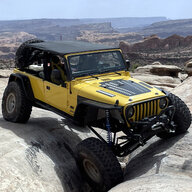
. This will allow me room to shorten them in the future if I decide to go to 37s and possibly a larger axle. Not actually planning this but trying to leave the door open.

Awesome work and great attention to detail!
Stop kidding yourself