Novak Conversions Jeep Wrangler TJ engine mounts

The Red Dragon Build

S/C-HD2002

TJ Enthusiast
Original poster
Ride of the Month Winner
Lifetime Supporting Member
Joined
Oct 17, 2020
Messages
261
Location
Wy
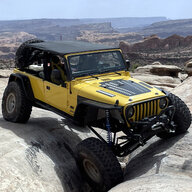
I will finally make time to post the story of The Red Dragon, and how it came to be.

The Jeep was originally purchased around November of 2020 as a stock 2000 Flame Red Sport. It was purchased as surprise replacement to give to my father for a stock 1987 YJ he purchased at the beginning of 2019. This purchase was against my advice as I knew the YJ was in need of quite a bit of work. Once the YJ was home with my dad, it quickly made its way to my shop to fix many of the apparent issues it had. After fixing a bunch of other problems, the 2.5 would not pass emissions and the engine ultimately proved to be junk. It had lost compression in several cylinders.

It became obvious the YJ could not be driven in its current state and this sparked a discussion about the direction to go with it. I ultimately talked my dad into letting me build the YJ (as it was not worth spending money on the 2.5). A common theme for all the vehicles I have put hands on in my life is one of ridiculousness. I typically follow the, "while I'm here" method, and my builds spin out of control with both time and expense very quickly. The YJ was no different which proved much to my dad’s dismay. The YJ blew into an LS swap, NV3550, NP241J, Bronco 44 front, 9" rear, full armor, custom cage, 37's, and four inches of stretch. After a while, my dad did not seem impressed with the length of time the build was taking and I began to feel bad he could not drive his jeep in the foreseeable future. I began looking for a replacement in an attempt to pacify him for a while.

IMG_1633.JPGIMG_2102.JPGIMG_2201.JPG

I was surfing Facebook Market in November of 2020 and found a decent priced, stock, Flame Red 2000 TJ Sport. I went to look at it and it checked various boxes for me. The Jeep was complete with a 4.0L, awesome shifting five speed (this will come up later), and a Dana 44 rear axle. I determined it was a nice Jeep for the money, I bought it, and loaded it on the trailer. Why did I trailer it you might ask? I have been bit in the past with other people's "repairs" on purchased vehicles and needed to drive this one around 40 miles to get it to the house.

After getting the TJ home, I made a plan to clean it up, fix a couple of cosmetic issues, and give it to dad. I had previously noticed it was leaking from the passenger rear axle seal and figured that is where I would begin. I began to disassemble the rear end and quickly counted my blessings I did not drive it home. As soon as the axle slid out of the housing, I was greeted with the sight of a cracked bearing retainer. The retainer slid off the axle with a little more than hand pressure. I definitely was thankful I followed my own standard of practice with this purchase. With drum rear brakes, it is likely I would’ve experience a catastrophic failure on the highway. I quickly checked the rest of the Jeep out, installed new flares, rear corner covers, and found a NOS khaki soft top to install.

IMG_3186.JPGIMG_3188.JPG

I gave the Jeep to my dad around the end 2020. The presentation went well and needless to say he was tickled. He began cruising the Jeep around town and taking it fishing.

IMG_3311.JPG

Once the temporary tag was about up, I took the Jeep to get emissions done and the hard plates on the vehicle. Everything was going great. The Jeep had great power, stopped well, and drove straight down the road. The total trip that day was about 100 miles. This was definitely the longest it had been driven at one time, and at continuous highway speeds. On my way home I exited the highway and began to down shift for the stop sign on the off-ramp. It was then I noticed the transmission had become very loud and shifts more difficult. The wind noise on the highway had obviously masked the increase in transmission noise and I immediately knew the damage was done. I continued the drive home with my now crappy shifts and a bunch of gear noise. When I got home, I immediately pulled the drain plug and was greeted with about an ounce of fluid. I obviously felt like a complete dumbass! This was the only compartment I did not check because the Jeep had shifted so well previously. There were no drips, and no leaks from the transmission. It was obvious for whatever reason the previous owner had forgotten to fill the transmission.

IMG_3197.JPG

I began a search for a replacement NV3550 and was fortunate to find a decent replacement locally. The old tranny came out and the new one went in along with a new clutch. My dad drove the stock TJ around for a while longer.

In February my dad mentioned one of our mutual friends and a possible father/son trip to Moab in June of 2021. I told him it was unlikely I would have the YJ finished by then, but felt confident I could get the TJ built to a respectable state. I felt bad with the prospect of taking the TJ back and tearing it apart, but knew the resulting build would be much “cooler.” While excited, I believe he reluctantly turned the keys back to me.

I immediately began looking for parts and ordering pieces. My “while I’m here” mentality began to rear its head. Before I knew it, the TJ was gutted and I had located and ordered a laundry list of parts for a marathon build. I knew I wanted to build the TJ around 35’s, with a great ride, and great off road performance. I still wanted it to drive well on the road and be something my 80 year old father was proud of.

I was fortunate to locate a bunch of desirable hard parts locally. I scored a set of super low mile Rubicon LJ 44’s and another NP241OR. I ordered RockJock springs, Fox 12” shocks, GenRight tank, Genright raised body mounts, and a bunch of other parts and pieces.

I spent every spare minute of my free time in the shop. I had a deadline and I needed to meet it or my dad would end me. :)
 
Last edited:
Start of The Red Dragon 1.0...

Following advice on this forum, I knew I wanted balanced suspension travel, tucking as many parts as I could, and maintain a decent belly height (without a crazy high center of gravity).

I got the new axles home and was not able to leave well enough alone. I wasn't ready to do gears and decided I would live with the 4.0 t-case and the factory 4.10 gears and lockers for the time being. I figured I could build everything thing else with the axles and do gears later. I hated the idea of pulling gears out that only had 26k miles on them. The front axle began taking shape and before I knew it, it had a Yukon 5x5.5 Free Spin kit, RCV's, Anti-rock with BMB relocation brackets, BMB big brakes and RockJock steering and track bar.

IMG_3712.JPG IMG_3714.JPGIMG_3706.JPGIMG_3701.JPG

In the interest of time, the front shock mounts remained stock. Collecting measurements at full bump and full droop/full compression, I confirmed an off the shelf Rancho shock (RS55255) would work for now. I used RockJock bolt on bumps and installed the shocks.

IMG_6333.JPG

At the time the Jeep was built, there was a back order on the Savvy skid. I ended up with a UCF 3/8" aluminum ultra high (blank) belly skid and engine skid. I was going to design my own transmission cross member as I wanted to be able to remove the skid plate and leave the engine/tranny self supported. I also knew I was going to have to come up with a solution to get my 241 fitted as high as possible and above the skid plate I was using.

I cut apart the factory tranny mount and began trying to figure out how I would securely support the transmission and t-case. I had a TMR universal transmission crossmember in my hands and started to go to work on it. Upon hanging the parts in place, I thought I was on easy street. It was then I noticed my exhaust was going to be an immediate problem.

IMG_3498.JPGIMG_3504.JPGIMG_3509.JPGIMG_3511.JPGIMG_3525.JPG

With the crossmember and exhaust fighting for the same space, I cut my crossmember tube and bent a piece of 1/4 plate to clear my cat.

IMG_3537.JPGIMG_3556.JPGIMG_3584.JPGIMG_3586.JPGIMG_3561.JPGIMG_3728.JPG

I had to clearance the skid slightly as well.

IMG_3697.JPGIMG_3693.JPGIMG_3690.JPG
 
Last edited:
Rear suspension and gas tank...

I decided to stay short arm for the time being. I knew I was extremely limited on time and told myself I would come back and address the arm length of the build. I knew it would eventually go to a midarm, I figured I would just do things twice :).

I ended up using a full set of Rokmen single adjustable arms. These things are beefy!

I am not a big fan of the "crack" created by a body lift. I wanted to do a tail tuck and move the fuel tank up as far as I could. I was able to gain the 1 1/4" the frame moved up in the height of the fuel tank. This was a win win for the build.

After figuring out where the tuck would land the rear portion of the frame, I started cutting out the stock rear shock mounts to make more room for the front of the tank to slide upward.

IMG_3563.JPGIMG_3577.JPGIMG_3635.JPGIMG_3784.JPGIMG_3632.JPGIMG_3649.JPGIMG_3650.JPGIMG_3638.JPGIMG_3641.JPGIMG_3644.JPGIMG_3642.JPGIMG_3811.JPG

I used a GenRight rear spring relocation bracket and made some custom mods to it to center the RockJock upper coil retainer/bump in place.

IMG_3757.JPGIMG_3758.JPGIMG_3764.JPGIMG_3759.JPGIMG_3760.JPGIMG_3761.JPGIMG_3788.JPG

I fabbed my new rear track bar bracket and started messing with suspension clearance and full bump. My initial bracket for the track bar was not the correct thickness material. I made the bracket a second time out of the correct material to take up the proper spread of the Johnny Joint.

IMG_3816.JPGIMG_3805.JPGIMG_3800.JPGIMG_3790.JPGIMG_3802.JPGIMG_3834.JPGIMG_3829.JPG


35x10.50r17 Kenda R/T's at full bump. They needed a little fender trimming.


IMG_3847.JPGIMG_3837.JPGIMG_3840.JPG

Rear outboard in the mix as well...

IMG_3808.JPGIMG_3803.JPGIMG_3833.JPGIMG_3827.JPGIMG_3834.JPG

With the Yukon Free Spin, the wheel bolt pattern is changed to 5x5.5. The rear rotors were modified to fit the rear multi-pattern Revolution USA shafts. I used the wheel studs in the 5x4.5 wheel pattern holes and bolted up my rotors. Using a transfer punch, I was able to easily punch the 5x5.5 bolt pattern into the rotor. I used a 9/16" RotaCut cutter and cleanly cut my new bolt pattern into the rotor.

IMG_3660.JPGIMG_3661.JPGIMG_3663.JPGIMG_3662.JPG
 
Last edited:
Exhaust...

I picked up a Pypes TJ cat back kit and modified it to fit. I used turbo flange connectors at several location to help with future disassembly or maintenance.

IMG_3864.JPGIMG_3865.JPGIMG_3866.JPGIMG_3867.JPGIMG_3868.JPG

GenRight raised body mounts...

In addition to raising the gas tank as high as I could. The raised body mounts have been awesome in the rocks!

IMG_3603.JPGIMG_3606.JPGIMG_3608.JPG
 
Last edited:
Air compressor and locker air...

When I purchased the LJ Rubi axles I was fortunate to get the same low mile factory locker pumps. I initially debated running those pumps and a separate compressor for my OBA system. I started researching the Rubi lockers and came to the solid understanding these lockers operated on very low pressure (5 psi). This peaked my curiosity to see if I could figure out a way to run a York for OBA and the Rubi lockers safely and reliably from the same system.

I found a Dwyer regulator that was specifically designed to operate at a max pressure of 5 psi and had a working range from 0-5 psi.

I set out to build my air system. I used a York pump and bracket setup from ORO. I then fabbed a bracket and plate to hold the air tank. Space is an obvious issue under the hood of the TJ, so it was positioned over the valve cover. I wanted to use a reliable air solenoid and figured I had extra ARB solenoids laying around, why not.

IMG_3891.JPGIMG_3892.JPGIMG_3880.JPGIMG_3875.JPGIMG_3894.JPGIMG_3895.JPGIMG_3896.JPGIMG_3893.JPGIMG_3874.JPG

Regulators, solenoids, and coalescing filter...

I used the evap canister bracket to mount my locker manifold and locker solenoids. This locker manifold was regulated down to a max 5 psi.

I was able to run a separate 3/8 hose that was regulated to 90 psi for tire fills and air tool use.

IMG_3907.JPGIMG_3910.JPGIMG_3914.JPGIMG_3915.JPGIMG_3918.JPGIMG_3916.JPGIMG_3912.JPGIMG_3911.JPG

Knowing the rear Rubi locker in my axle was in perfect shape, I wanted to keep it protected by making sure it was always locked as soon as the Jeep touched dirt. I robbed an ARB wiring harness and modified it to work with my switches, solenoids, and compressor.

IMG_3930 (1).JPGIMG_3922.JPGIMG_3931 (1).JPGIMG_3932.JPG
 
Last edited:
Bumpers...

Rounding out the build I added a Motobuilt front bumper and an XD9000i Warn. The rear bumper is an old school Currie bumper with tire carrier.

IMG_3924.JPGIMG_3929.JPGIMG_3734-1.jpg

I also located a set of Flame Red half doors and purchased those.

IMG_3841.JPGIMG_3843.JPG
 
Last edited:
The Jeep was completed the morning of the day we left for Moab. Upon seeing the final result my dad was ecstatic. I (needless to say) was a bit nervous the Jeep would go from rolling out of the shop for the first time, onto the trailer, and up Steel Bender in the same day. Fortunately the build performed flawlessly for the duration of the trip.

IMG_3935.JPG


IMG_E4262.JPG


IMG_4044.JPG


IMG_4932.JPEG
 
Last edited:
After returning from Moab in 2021, I quickly decided the TJ needed some form of rocker protection. A near miss to the passenger rocker on Gold Bar Rim made this an easy decision. I ordered a set of Savvy sliders and installed them, I was very pleased with their fit and finish.

KellyFlats.JPEG


IMG_3732.JPG


My dad would continue to drive the Jeep around for the next several years and it was his pride and joy. I would get a kick to see my mom and dad (in their 80's) driving around in a lifted TJ. He would brag about the compliments he got wherever he would go. My dad and I would take various wheeling trips in it with the same mutual friends during those years and got a great deal of enjoyment out of the build.

Unfortunately, in 2024 my dad unexpectedly passed away. Having previously discussed the future of the Jeep, it eventually came back home with me. Another stack of parts had accumulated for it and I had to picture what my dad was thinking watching me mull over what to do now. I imagined he would be saying something to the effect of, "why would you tear apart a perfectly good Jeep?" Then he would understand when my response was, "that's what I do." I imagine that would cause my dad to smile.

IMG_6158-1.jpg
 
Last edited:
After trying to sort through thoughts and emotions and get this all together last night, I see why it is so much easier to do a build thread as it is happening. :)

Needless to say finding pictures and providing details of something that got slammed together in four months, over four years later, was difficult.

I will try and go back to fill in some of the detail blanks when I get a chance. I should probably start on the 2.0 build thread while that is still fresh in my head.
 
I began taking an inventory of the parts I had amassed for the TJ and found a Savvy Mid Arm, PSC hyrdo assist, gears/ARB's, Flux Offroad front bumper, BMB tie rod, various LED lights, and other miscellaneous pieces. I tried to formulate a plan as to the next direction the build would go and how all these new parts would compliment each other. I knew I wanted to change the body work on the TJ and add front and rear aluminum armor. Complicating this thought process was the addition of an '06 LJ I traded for.

The LJ was currently riding on 40's, JK Rubicon axles (5.38's, RCVs, Rare Parts BJs, Rancho knuckles), King shocks, PSC steering, a Teraflex LCG Pro suspension kit, and an auto with a NP241OR. The LJ also came with a NIB full set of Nemesis aluminum armor and fenders.

IMG_6712.JPG


I was now trying to figure out what to do with two Jeeps. Cussing myself and my decisions, I quickly decided the LJ was not built to my liking and I began to tear it down. I figured since I had a set of new fenders, sliders, and armor for the LJ, I would use the GenRight Hi-Fenders (from the LJ) on the TJ. I ordered a set of custom cut Nemesis rear corner armor, GenRight Flak-Jackets and rear GenRight fenders. I also found a set of GenRight aluminum half door armor locally. I moved the LJ to the side and decided to focus on the TJ.

My initial plan for the TJ was to use the built TJ/LJ Rubicon 44's with my mid arm kit (and all the other parts I had gathered). The LJ was going to come down on 37's and the TJ would remain on 35's. Unfortunate for me, I stumbled across a steal on a lightly used Dynatrac JK width ProRock 44 complete with the 3” OD/ ½ wall tubes and Dynatrac BJs. At about the same time, I found a bare G2 JK rear housing in the blowout section at 4WP. Both of these axles made their way home with me.

Instead of building two similar builds, I made a determination the LJ was going to get completely gutted and built on ‘tons. I decided I would build the new Dynatrac and G2 JK axles for the TJ. In my mind I found myself justifying not cutting up a really nice set of Rubicon TJ/LJ axles and their factory attachment points. I figured if I was going to go through the hassle of cutting something up, I would also gain additional width and length in my build. After the addition of the NP241OR during its first build, I knew I wanted to stretch the rear of the TJ to assist with the rear driveshaft angle. I figured I would also stretch the front end at the same time. I formulated a plan where I could stretch the TJ (2" in the front and 2" in the rear) while still maintaining my current ride height and using my existing RockJock coils.

I wanted to stay with a 5x5.5 bolt pattern as I already had my Raceline beadlock wheels. To accomplish this, I acquired a Yukon JK freespin kit for the front and the corresponding RCV axle set (I already had a set of Reid knuckles, ARB, and 5.13's waiting in the shop). For the rear axle, I found a NIB set of (5x5/5x5.5 pattern) G2 35 spline gold series axles on eBay and the appropriate "metric" 35 spline ARB. I sourced a set of low mile JT rear brakes and copied the front Mopar JK big brake kit using Crown brackets, OEM Ram calipers and Teraflex big brake rotors.

The TJ was pulled into the shop in February and the surgery was started.

Apparently, because I like pressure, another Moab trip was planned for Father’s Day, and to make it a firm commitment, a condo was booked as well.
 
Last edited:
  • Like
Reactions: bbaldwin237
If some of the steps or pictures are out of order, I apologize in advance. Looking back on this build I jumped around a bunch and did not photograph every step apparently :).

I started the build by measuring the current ride height of the TJ and all of the bracket locations/angles of both the new and old axles.

I got my trusty Cutmaster plasma cutter out and began performing surgery.

IMG_8152.JPGIMG_8148.JPG
IMG_8153.JPG


IMG_8146.JPGIMG_8147.JPG
 
Last edited:
  • Like
Reactions: JMT and bbaldwin237
I ordered my new lower control arm brackets, spring perches, and front track bar brackets from Barnes, RuffStuff, and TNT. I began fitting these parts on my bare JK housings to make sure they were correctly located and had the proper amount of vertical separation. I compared measurement from my stock axles, dimensional prints I found online, and my JK housings to make sure I was going in the right direction.

Rear housing build...

I used another 44 housing I had to help me template the correct location of the rear Savvy truss. I used these dimensions to help me transfer it over to my JK G2 housing.

IMG_8132 - Copy.JPG

I began shaving the top of the G2 housing to lower the truss into the correct position.

IMG_8333.JPGIMG_8334.JPGIMG_8329.JPG

Because the G2 housing is bigger, wider, and has thicker tubes, I started chopping the rear truss to fit.

IMG_8316.PNGIMG_8320.JPGIMG_8330.JPGIMG_8343.JPG

I had to cut an access hole in the truss for the ARB air line. I used a magnetic base drill and a RotaCut to cut this access as cleanly as possible. Looking though my photos, I apparently only took a picture when modifying the front truss. Please use your imagination the below photos are of the rear truss :). After cutting these holes, I plated the rear truss around the cut.


IMG_8236.JPGIMG_8239.JPGIMG_8237.JPGIMG_8342.JPG

After the rear truss was welded on, I worked on setting up the rear ARB and gears. The G2 housing makes gear setup fairly easy as there are slack adjusters similar to a Ford 9-inch. I ended up ditching the crush sleeve and used a crush sleeve eliminator shim set.

IMG_8314.JPGIMG_8317.JPG
 
Last edited:
I started formulating my plan for the rear control arm frame mounts and cutting the OEM brackets off the frame. At some point I decided lifting the body from the frame would simplify this adventure (it was raised and lowered numerous times).

Seeing where pieces were going to fit, I quickly became tired of my decision to raise my body mounts during the first build. I chopped the existing GenRight raised body mounts back off the frame.

IMG_8418.JPGIMG_8419.JPG

The rear Savvy frame brackets were moved two inches rearward and tacked in place.

IMG_8431.JPG


The rear crossmember was modified to avoid conflict with the upper arms. The forward face of it was eventually boxed back in.

IMG_8430.JPG


In the mix at this time was the figuring of the lower spring perches, lower shock mounts and axle side control arm mounts. I used Barnes rear TJ/LJ lower control arm mounts and TNT rear lower relocation spring perches. Using the TNT perches, I was able to move the rear axle back two inches while retaining my previous coil location and ride height. I had to take into consideration the additional diameter of the G2 axle tubes and cut the appropriate amount out of the lower control arm brackets and spring perches.

I began figuring out where the rear Antirock would locate. With the two inch rear stretch and the wider JK axle, it looked like I would be able to fit my rear Antirock in front of the rear axle. I did not have any room in the rear of the axle because I had moved my fuel tank up so high. The body was ultimately trimmed to clear the torsion bar and the rear Antirock brackets fitted to the frame and axle.

IMG_8379.JPGIMG_8494.JPG

One hangup during this process was my switch to different rear shocks. I was replacing the 12" 2.0 Performance Series (used in my first build), with the 12" 2.0 Factory Race Series. If I could help it, I did not want to cut the rear outboard mounts back out of the frame. Taking measurements and looking at online specs, I knew I would need to accommodate around .77" of extra shock length. I fabbed new lower mounts to see if I could still hide the shock mount in the window behind the lower control arm mount.

IMG_8564-1.JPGIMG_8563.JPGIMG_8562.JPGIMG_8573.JPGIMG_8492.JPG

The rear JT brake rotors had to get cut to work with the 5x5.5 bolt pattern. I used the axle flange to template the new bolt pattern and bolted the rotor to the existing 5x5 pattern. A transfer punch was used to locate the centers of the 5x5.5 pattern and the holes were cut.

IMG_8390.JPGIMG_8388.JPGIMG_8391.JPGIMG_8392.JPG
IMG_8393.JPG


The corner armor was rough fit. It was quickly determined I would have to cut both the armor and sheet metal to clear the 37's I intended to run.

IMG_8505.JPGIMG_8506.JPG

The suspension was cycled again and again.

IMG_8571.JPGIMG_8566.JPG

After I thought I had a handle on the bracket and spring locations, I began figuring out my rear brakes and the line routing I was going to use. To keep the rear calipers out of the way, I swapped the JK backing plates from side to side. This allowed to mount the rear brake calipers on the front side of the rear axle.

IMG_8698.JPG

I used a 1/4-20 weld stud to secure the passenger side brake line with a p-clamp. I turned two mounting standoffs in the lathe and tapped 10-32 threads in them to secure my hard line to soft line brackets. I also turned a mounting standoff in the lathe for the brake line junction and tapped it to 1/4-20 thread.

A piece of round stock was used as a brake line protector on the back of the axle tube. I tapped it with the same 10-32 threaded holes and used stainless line clips and screws.

IMG_8708.JPGIMG_8701.JPGIMG_8702.JPGIMG_8705.JPGIMG_8706.JPGIMG_E8710.JPGIMG_8710.JPG

IMG_8707.JPG


I thought I had everything working in harmony with one another, including the JK parking brake. It wasn't until I had the axle mounted for the final time I learned I had some interference issues with the rear shocks and my parking brake brackets. Apparently I did not pay careful attention to what I was doing and I added my round stock after I had fit my lower shock mounts. I had cycled my suspension numerous times, never with the round stock or brake lines in place. I ultimately had to clearance the round stock around the shock body and change the parking brake mounting and cables from JK to a TJ Rubicon style cable.

I used a p-clamp (with a PEM nut pressed into one side) and a fabricated bracket to retain my newly routed parking cables. The cable tucked nicely under my lower spring perch and the p-clamp bolted to the perch. The TJ Rubicon cable attached to the JK backing plate with two pairs of fabricated sandwich plates and 1/4-20 hardware.

IMG_9180.JPGIMG_9181.JPGIMG_9182.JPG

Fortunately the additional clearance on the round stock and the new parking brake cable plan worked out perfectly.

IMG_9194.JPG
IMG_9191.JPG

IMG_9189.JPG
 
Last edited:
When I was fitting my rear armor, I quickly figured out the missing angle between the Savvy slider and my corner armor did not appeal to me. I mocked up a cardboard corner and transferred it to 3/16 aluminum. I welded the new piece in and finished out the panel.

IMG_8520.JPGIMG_8521.JPGIMG_8523.JPGIMG_8524.JPG
IMG_8525.JPG
 
Last edited:
  • Like
Reactions: Rickyd and Abendage
One thing I wanted, was matching armor hardware. Because I like the industrial look of the 5/16 Phillips head screw, I set to change all the hardware to match the Savvy sliders.

I continued working on the rear armor figuring out where my flares would clear my 37 inch tire at six inches of up travel.

I mocked the starting location for the flare and quickly determined I would have to cut more sheet metal, armor, and move the flare higher. This starting location also required me to eliminate one corner of the fuel filler hole and modify the filler bezel to match.

IMG_8543.JPG

IMG_8507.JPGIMG_8547.JPG

Cycling the suspension again, I had to continue cutting both sheet metal on the body and trim the corner armor higher and wider.

IMG_8575.JPG


This required me to weld up more of the filler hole and reshape the filler bezel again. The final resting place for the flare was as high as I could without the hardware going into the inner tub.

IMG_8576.JPGIMG_8585.JPGIMG_8579.JPGIMG_8578.JPG
IMG_8584.JPG


I was finally happy with the fit, clearance, and function of the corner armor and flares.

The GenRight door skins went on without issue...

IMG_8522.JPG


I moved on to fitting the front fenders. Due to the fact they were used, I determined I was not happy with the previous holes drilled for the inner fender attachment points. I figured the easiest way to correct this was to weld up the holes and re-drill them. I also wanted to counter sink the new holes and use 1/4-20 Phillips hardware to match the rest of my armor.

I set off to modify the fenders...

IMG_8533.JPGIMG_8535.JPG

I made plugs and began welding up the old holes...

IMG_8538.JPG

The end result...

IMG_8589.JPG
IMG_8590.JPG


Since I was going to the hassle of putting better looking hardware in the fender, I began rethinking using hex nuts to attach the inner fenders. I experimented with the idea of PEM nuts to attach the two panels. My idea was to press PEM nuts into the inner fender to provide a cleaner look. I found two pieces of material the same thickness as the fender and inner fender.

The result was promising!

IMG_8501.JPGIMG_8499.JPGIMG_8500.JPG
 
Last edited:
The Flak-Jackets were fit...

IMG_8542.JPGIMG_8531.JPGIMG_8529.JPGIMG_8528.JPG

And the Savvy backer was trimmed to fit around the front fender flare. After some careful layout, zip! It was blended with a Bandfile.

IMG_8518.JPGIMG_8519.JPG
 
Last edited:
After installing my armor, I determined I did not care for the standoff height the Rivnut shoulder thickness caused. I removed all the armor and counter-bored the back side of the armor pieces where it interfaced with a Rivnut.

IMG_8591.JPGIMG_8592.JPG
IMG_8593.JPG
 
  • Like
Reactions: Wildman and Fluxor
One thing I wanted, was matching armor hardware. Because I like the industrial look of the 5/16 Phillips head screw, I set to change all the hardware to match the Savvy sliders.

I continued working on the rear armor figuring out where my flares would clear my 37 inch tire at six inches of up travel.

I mocked the starting location for the flare and quickly determined I would have to cut more sheet metal and armor. This starting location also required me to eliminate one corner of the fuel filler hole and modify the filler bezel to match.

View attachment 646174
View attachment 646167View attachment 646185

Cycling the suspension again, I had to continue cutting both sheet metal on the body and trim the corner armor higher and wider.

View attachment 646176

This required me to weld up more of the filler hole and reshape the filler bezel again. I also moved the flare up as high as I could without the hardware going into the inner tub.

View attachment 646177View attachment 646183View attachment 646180View attachment 646179View attachment 646182

I was finally happy with the fit, clearance, and function of the corner armor and flares.

The GenRight door skins went on without issue...

View attachment 646193

I moved on to fitting the front fenders. Due to the fact they were used, I determined I was not happy with the previous holes drilled for the inner fender attachment points. I figured the easiest way to correct this was to weld up the holes and re-drill them. I also wanted to counter sink the new holes and use 1/4-20 Phillips hardware to match the rest of my armor.

I set off to modify the fenders...

View attachment 646170View attachment 646171

I made plugs and began welding up the old holes...

View attachment 646172

The end result...

View attachment 646194View attachment 646195

Since I was going to the hassle of putting better looking hardware in the fender, I began rethinking using hex nuts to attach the inner fenders. I experimented with the idea of PEM nuts to attach the two panels. My idea was to press PEM nuts into the inner fender to provide a cleaner look. I found two pieces of material the same thickness as both my fender and inner fender. The result was promising!

View attachment 646166View attachment 646164View attachment 646165

Did you buy the fuel filler bezel or make it?
 
Novak Conversions Jeep Wrangler TJ engine mounts