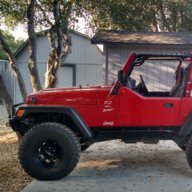
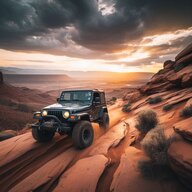
Embarrassingly enough, I fell in love with the idea of owning a jeep from an episode of the American version of Top Gear. You know the one. The one where they go to Death Valley and Tanner Foust has the jeep without air conditioning. I was 11 at the time, and I always had it in the back of my mind that I was going to own a wrangler one day.
And it happened. I went looking exclusively for a TJ and after about 6 months of on and off searching, I finally found one I loved. It was a silver 2005 rubicon and already had a 4 inch lift with brand new 33” tires. I saw that it had a small amount of surface rust, but really what TJ didn’t have any rust unless you were looking to spend a lot of money. So I had it inspected, it came back mechanically sound, and I bought it.
I did a couple of small things within the first month of owning it. Normal maintenance things like a new steering stabilizer, serpentine belt, and changing the power steering fluid. I also took it upon myself to clean up all of the faded black surfaces with some back to black, but really that wasn’t necessary. I was a happy camper… until I tried to take the rusted rock sliders (that were also upside down) off and discovered there was a little bit more rust than I had initially thought. Luckily I convinced my dad to help me get them off, and after a lot of cursing, they were off.I also quickly noticed that my muffler was pretty rusty, so that was going to have to be replaced sooner or later.
After about a week of spraying the skid plate bolts with some pb blaster, I got the skid plate off and was able to swap out the muffler pretty easily. I’m sure you can guess what the next issue was. Rust. Rust that I had not previously seen.
Now I think I need to clarify that none of the rust I had encountered was actually that bad. It wasn’t great, but there weren’t any holes or thin spots in the frame. There was just a lot of scaling and pitting.
I did my best to grind the rust off of the frame where the skid plate would mount back up to it, but I’m not that strong and holding a grinder up wasn’t an easy task. I converted whatever rust was still there, used a rust encapsulator for safe measure, and put the skid plate back up.
I managed to get by for about a year without having to deal with rust fixes, but I kept noticing more and more spots that would need to be dealt with at some point. The more rust I found, the more I started to be reminded of the phrase “You can put lipstick on a pig, but it’s still a pig”, so the jeep ended up being my pig.
In May 2021, I somehow talked my dad into letting me invade his shop garage, lift, and countless tools, and so project pig was born. I also somehow talked him into helping me with the things I couldn’t do on my own.
After thoroughly tarping areas off, removing bumpers, a pair of coveralls 3 sizes too big, some snazzy safety goggles, gardening gloves, headphones, and a portable sandblaster, I set to work sandblasting every single inch of the frame on the jeep. I focused mainly on the areas where scale had built up, but tried to get everything I could possibly reach.
After two full days of sandblasting, the jeep was put into the garage and on the lift. Step one was to get the tires off which was already proving to be a challenge in and on itself. Whoever previously put the tires on was either the hulk, or just severely over tightened the lugnuts with an impact. The rear tires came off without too much trouble, but the front ones might have taken a 30” breaker bar and my dad’s entire body weight to get off. Except for one. One welded itself in place and had to be drilled out.
So the tires were finally off, and the next step was to drop the front axle. I should take a second to mention that for a solid week before I even started this project, I soaked every single bolt I could find in pb blaster to try and help any rusty bolts break free. All of the steering stabilization was surprisingly easy to remove, and the lower control arm bolts weren’t that bad either. The front driveshaft was also easy to remove from the axle. Things were going smooth until the shocks got involved. After a couple of hours of fighting with all of the front shock bolts, the cavalry had to come out. All of the bolts had to be heated with a torch but then they came out.
The nice thing about working with a lift is that you can lower the jeep down, disconnect everything attaching the front axle to the frame, and then raise the lift back up and leave the axle behind.
I did my best to work in smaller sections so the overall project wouldn’t seem so overwhelming, so I started with the front of the frame to the lower control arm mount as my first section. I took my favorite tool out and started grinding as much of the frame as I could to get to bare metal. Eastwood’s contour sct… *chef’s kiss*
After I hit as much of the frame as I could, I took the POR 15 degreaser and metal prep, and prepped the frame for the paint I was going to put on there. It was really convenient that the metal prep was also a rust converter because the area of the frame around the bump stops was an area I couldn’t seem to reach with any tools. After the frame was prepped, I put two coats of POR 15 rust preventative coating, lightly sanded the gloss off, and top coated it with Eastwood’s matte black rust encapsulator.
The first section was done (for now) so it was time to move onto the next section. This time I worked between both lower control arm mounts. After supporting the transmission, I lowered the skid plate and set to work grinding to bare metal again. I repeated the same process of degreaser, metal prep, rust preventative coating, and rust encapsulator. I also took the time to sandblast, grind, degrease, metal prep, rust prevent, and rust encapsulate the skid plate while it was off of the frame.
I repeated this same process for the front axle, and boy did it come out looking clean.
The next area I had to tackle was the rear section, but the rear axle had to be dropped. I did some “research” so I knew what areas were going to be difficult, and had been spraying all of the bolts with pb blaster for a couple of days beforehand. I heard enough about the rear shocks being pains to get out and probably needing to use heat, so the decision to drop the gas tank was made. 5/7 of the nuts holding the gas tank to the frame came out easily. Two had to be cut (carefully) and then replaced later on. In hindsight, I should have done some more research on how to remove the gas tank, maybe looking at the correct years for starters, but the gas tank came out with minimal difficulty.
As for the rear axle, most bolts came out fairly easy, including the lower shock bolts. The upper shock bolts… they held up to the horror stories people were sharing. Two of the heads just snapped off, and the other two refused to move. Based on the amount of rust and limited access, it was easier to just cut the bolts and then plan on drilling them out later. The same method of removing the front axle was used for the rear axle.
I repeated the same process of grinding, degreasing, metal prepping, rust preventing, and rust encapsulating on the rear section of the frame as well as the rear axle.
I also cleaned up the gas tank a little bit by just wiping some of the dirt off of it and taking an air hose to blow the debris out of the sides. Interestingly enough, when I blew some of the debris out of it, a peanut shell flew out. Still to this day I have no idea how a peanut shell even got in there.
At some point I wanted to clean up behind the fender flares and well that wasn’t exactly my best idea. All of the bolts that were in nutserts just spun around. I don’t remember where I read it, but someone had luck getting them out by taking a trim removing tool and just ripping the bolts out. A sad discovery was also made while trying to remove the fender flares as well as the rocker guards. There were 2 rotted out spots on the body on the passenger side and one thin spot on the rocker panel. One spot was just a straight piece of metal that connected the rocker panel to the floor pan, another spot was at the middle body mount, and the third spot was the spot on the rocker panel. I’m no welder so I bribed my dad with beer to weld those three spots for me. I did end up getting a safetycap piece for the area around the body mount because that area was pretty thin in the areas it wasn’t already rotted.
After all of the welding was done, I still had to deal with the rear upper shock bolts. My original plan to drill out the bolts was immediately changed. It ended up being easier to take a dremel and cut as much of the welded nuts off of the frame as possible and then take a chisel to break them off.
After everything I could reach was cleaned up, it was time for reassembly. Nothing too exciting happened, this was definitely the easiest part of the entire project. Everything was put back into place and then it was just time for final adjustments. As I mentioned in the beginning of this, my jeep was already lifted when I purchased it. However it had a transfer case drop and I didn’t want that anymore. I realigned the driveshafts to compensate for the lack of drop, and of course did an alignment. I checked back over everything, tightened some bolts up, bled the brakes numerous times, and it was ready for a test drive.
It drove around the block great until I noticed a weird sound. Luckily I found the culprit pretty easily and it was the transfer case linkage binding. Again, it was because of the previous owner adding the transfer case drop, which meant that they added the transfer case linkage drop. Easy enough right? You just take 4 bolts out on the body bracket, take the linkage drop plate off, and put it back up. Well... not if you have any rust in there. 2 of the bolts snapped off, and the extra plate was thoroughly rusted to the body bracket. So I just decided it was debatably less hassle to just swap out the z-bar linkage with a cable style linkage. A couple of hours later (mainly due to me making silly mistakes), and it was done.
Everything was finally done and checked over repeatedly, only a couple of minor things remained but that wouldn’t stop it from being drivable. Eventually I will have to fix the passenger seat because the fold and tumble lever doesn’t work anymore, but I can use the bar underneath in the meantime. I’m also going to change the gear oil in the rear differential at some point, but that sounds like a next weekend thing.
I’ve been driving the jeep again for three weeks now and luckily everything has been behaving and I haven’t heard any strange noises. However, with the weather being so hot as of lately, my rear view mirror just fell straight off so I need to fix that as soon as I remember to stop by the store.
This project took me about 2.5 months in total due to working around my work schedule, and with so much production being limited due to the current state of things in the world. Despite numerous days of me complaining and wondering why I started this project, I’m glad I did it. Again, I’ve seen jeeps with way worse rust so this wasn’t entirely necessary, but I wanted to fix whatever I could before it got to that level of rust. I’ve also gotten numerous compliments on it so an ego boost is always nice
Some Before


Some During


After (Coming Soon)
Bonus: 12 hrs of sandblasting in 90 degree heat

And it happened. I went looking exclusively for a TJ and after about 6 months of on and off searching, I finally found one I loved. It was a silver 2005 rubicon and already had a 4 inch lift with brand new 33” tires. I saw that it had a small amount of surface rust, but really what TJ didn’t have any rust unless you were looking to spend a lot of money. So I had it inspected, it came back mechanically sound, and I bought it.
I did a couple of small things within the first month of owning it. Normal maintenance things like a new steering stabilizer, serpentine belt, and changing the power steering fluid. I also took it upon myself to clean up all of the faded black surfaces with some back to black, but really that wasn’t necessary. I was a happy camper… until I tried to take the rusted rock sliders (that were also upside down) off and discovered there was a little bit more rust than I had initially thought. Luckily I convinced my dad to help me get them off, and after a lot of cursing, they were off.I also quickly noticed that my muffler was pretty rusty, so that was going to have to be replaced sooner or later.
After about a week of spraying the skid plate bolts with some pb blaster, I got the skid plate off and was able to swap out the muffler pretty easily. I’m sure you can guess what the next issue was. Rust. Rust that I had not previously seen.
Now I think I need to clarify that none of the rust I had encountered was actually that bad. It wasn’t great, but there weren’t any holes or thin spots in the frame. There was just a lot of scaling and pitting.
I did my best to grind the rust off of the frame where the skid plate would mount back up to it, but I’m not that strong and holding a grinder up wasn’t an easy task. I converted whatever rust was still there, used a rust encapsulator for safe measure, and put the skid plate back up.
I managed to get by for about a year without having to deal with rust fixes, but I kept noticing more and more spots that would need to be dealt with at some point. The more rust I found, the more I started to be reminded of the phrase “You can put lipstick on a pig, but it’s still a pig”, so the jeep ended up being my pig.
In May 2021, I somehow talked my dad into letting me invade his shop garage, lift, and countless tools, and so project pig was born. I also somehow talked him into helping me with the things I couldn’t do on my own.
After thoroughly tarping areas off, removing bumpers, a pair of coveralls 3 sizes too big, some snazzy safety goggles, gardening gloves, headphones, and a portable sandblaster, I set to work sandblasting every single inch of the frame on the jeep. I focused mainly on the areas where scale had built up, but tried to get everything I could possibly reach.
After two full days of sandblasting, the jeep was put into the garage and on the lift. Step one was to get the tires off which was already proving to be a challenge in and on itself. Whoever previously put the tires on was either the hulk, or just severely over tightened the lugnuts with an impact. The rear tires came off without too much trouble, but the front ones might have taken a 30” breaker bar and my dad’s entire body weight to get off. Except for one. One welded itself in place and had to be drilled out.
So the tires were finally off, and the next step was to drop the front axle. I should take a second to mention that for a solid week before I even started this project, I soaked every single bolt I could find in pb blaster to try and help any rusty bolts break free. All of the steering stabilization was surprisingly easy to remove, and the lower control arm bolts weren’t that bad either. The front driveshaft was also easy to remove from the axle. Things were going smooth until the shocks got involved. After a couple of hours of fighting with all of the front shock bolts, the cavalry had to come out. All of the bolts had to be heated with a torch but then they came out.
The nice thing about working with a lift is that you can lower the jeep down, disconnect everything attaching the front axle to the frame, and then raise the lift back up and leave the axle behind.
I did my best to work in smaller sections so the overall project wouldn’t seem so overwhelming, so I started with the front of the frame to the lower control arm mount as my first section. I took my favorite tool out and started grinding as much of the frame as I could to get to bare metal. Eastwood’s contour sct… *chef’s kiss*
After I hit as much of the frame as I could, I took the POR 15 degreaser and metal prep, and prepped the frame for the paint I was going to put on there. It was really convenient that the metal prep was also a rust converter because the area of the frame around the bump stops was an area I couldn’t seem to reach with any tools. After the frame was prepped, I put two coats of POR 15 rust preventative coating, lightly sanded the gloss off, and top coated it with Eastwood’s matte black rust encapsulator.
The first section was done (for now) so it was time to move onto the next section. This time I worked between both lower control arm mounts. After supporting the transmission, I lowered the skid plate and set to work grinding to bare metal again. I repeated the same process of degreaser, metal prep, rust preventative coating, and rust encapsulator. I also took the time to sandblast, grind, degrease, metal prep, rust prevent, and rust encapsulate the skid plate while it was off of the frame.
I repeated this same process for the front axle, and boy did it come out looking clean.
The next area I had to tackle was the rear section, but the rear axle had to be dropped. I did some “research” so I knew what areas were going to be difficult, and had been spraying all of the bolts with pb blaster for a couple of days beforehand. I heard enough about the rear shocks being pains to get out and probably needing to use heat, so the decision to drop the gas tank was made. 5/7 of the nuts holding the gas tank to the frame came out easily. Two had to be cut (carefully) and then replaced later on. In hindsight, I should have done some more research on how to remove the gas tank, maybe looking at the correct years for starters, but the gas tank came out with minimal difficulty.
As for the rear axle, most bolts came out fairly easy, including the lower shock bolts. The upper shock bolts… they held up to the horror stories people were sharing. Two of the heads just snapped off, and the other two refused to move. Based on the amount of rust and limited access, it was easier to just cut the bolts and then plan on drilling them out later. The same method of removing the front axle was used for the rear axle.
I repeated the same process of grinding, degreasing, metal prepping, rust preventing, and rust encapsulating on the rear section of the frame as well as the rear axle.
I also cleaned up the gas tank a little bit by just wiping some of the dirt off of it and taking an air hose to blow the debris out of the sides. Interestingly enough, when I blew some of the debris out of it, a peanut shell flew out. Still to this day I have no idea how a peanut shell even got in there.
At some point I wanted to clean up behind the fender flares and well that wasn’t exactly my best idea. All of the bolts that were in nutserts just spun around. I don’t remember where I read it, but someone had luck getting them out by taking a trim removing tool and just ripping the bolts out. A sad discovery was also made while trying to remove the fender flares as well as the rocker guards. There were 2 rotted out spots on the body on the passenger side and one thin spot on the rocker panel. One spot was just a straight piece of metal that connected the rocker panel to the floor pan, another spot was at the middle body mount, and the third spot was the spot on the rocker panel. I’m no welder so I bribed my dad with beer to weld those three spots for me. I did end up getting a safetycap piece for the area around the body mount because that area was pretty thin in the areas it wasn’t already rotted.
After all of the welding was done, I still had to deal with the rear upper shock bolts. My original plan to drill out the bolts was immediately changed. It ended up being easier to take a dremel and cut as much of the welded nuts off of the frame as possible and then take a chisel to break them off.
After everything I could reach was cleaned up, it was time for reassembly. Nothing too exciting happened, this was definitely the easiest part of the entire project. Everything was put back into place and then it was just time for final adjustments. As I mentioned in the beginning of this, my jeep was already lifted when I purchased it. However it had a transfer case drop and I didn’t want that anymore. I realigned the driveshafts to compensate for the lack of drop, and of course did an alignment. I checked back over everything, tightened some bolts up, bled the brakes numerous times, and it was ready for a test drive.
It drove around the block great until I noticed a weird sound. Luckily I found the culprit pretty easily and it was the transfer case linkage binding. Again, it was because of the previous owner adding the transfer case drop, which meant that they added the transfer case linkage drop. Easy enough right? You just take 4 bolts out on the body bracket, take the linkage drop plate off, and put it back up. Well... not if you have any rust in there. 2 of the bolts snapped off, and the extra plate was thoroughly rusted to the body bracket. So I just decided it was debatably less hassle to just swap out the z-bar linkage with a cable style linkage. A couple of hours later (mainly due to me making silly mistakes), and it was done.
Everything was finally done and checked over repeatedly, only a couple of minor things remained but that wouldn’t stop it from being drivable. Eventually I will have to fix the passenger seat because the fold and tumble lever doesn’t work anymore, but I can use the bar underneath in the meantime. I’m also going to change the gear oil in the rear differential at some point, but that sounds like a next weekend thing.
I’ve been driving the jeep again for three weeks now and luckily everything has been behaving and I haven’t heard any strange noises. However, with the weather being so hot as of lately, my rear view mirror just fell straight off so I need to fix that as soon as I remember to stop by the store.
This project took me about 2.5 months in total due to working around my work schedule, and with so much production being limited due to the current state of things in the world. Despite numerous days of me complaining and wondering why I started this project, I’m glad I did it. Again, I’ve seen jeeps with way worse rust so this wasn’t entirely necessary, but I wanted to fix whatever I could before it got to that level of rust. I’ve also gotten numerous compliments on it so an ego boost is always nice
Some Before
Some During
After (Coming Soon)
Bonus: 12 hrs of sandblasting in 90 degree heat