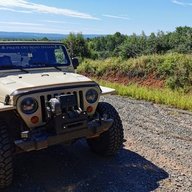
KO2's vs. Oregon Snot

StG58

TJ Guru
Original poster
Supporting Member
Joined
Oct 29, 2015
Messages
7,338
Location
On the road.
Just got back from the annual Elk hunting expedition, and thought I'd report on how the new KO2's did vs. the typical snot found up in the Oregon Coast Range.

First, a little background. TJ SE, no lockers, mild lift, new KO2's in 31x10.50's vs. Nissan full size pickup with essentially the same size Duratracs about half worn out and a locker in the rear vs. Oregon Coast Range snot.

First off, nobody got stuck. We both had to work at it a little once or twice, but the needed traction was there when required. The worn Duratracs gummed up occasionally, but the rear locker in the pickup made up for it. The KO2's cleaned very well for the most part. The center ribs filled up once in awhile and the edges stayed clean. The center ribs cleaned out once you got a little speed / RPM on the tire. This could be a problem as I spent almost the entire two days in Lo range and second or third gear. On most of these trails spinning a tire is instant death. If you dig in, you are done. Both the Dura's and the KO2's dig when spun. The biggest challenge experienced was going up steep grades on tight, untraveled trails. These have to be navigated at just under or at a walking speed to avoid blowdown, holes, trees, brush and all the normal obstacles found in the area. When you come to something that requires a little more skinny pedal, you have to be very judicious or you spin, dig in and slide off one side or another. One side is likely a nice ditch or wall, the other side is likely a near vertical drop of "Oh Shit!" magnitude. The KO2's give the needed control at low speed to navigate this terrain.

So far the KO2's are performing equally with the Duratracs in all of the conditions they have been exposed to. Both of the SIL's have Duratracs on their rigs, and the only discernible difference observed so far can be attributed to driver skill and the presence or absence of lockers.

 
Did you air down? If so, what did you air down to?

I think you really need two things: a locker and a winch. Those two things will make a huge difference.

It's good to know the KO2s perform pretty equivalent to the Duratrac. I really like my Duratracs for this Oregon type terrain.

Also, it's nice to see that you've kinda got a KO2 vs. Duratrac comparison here.
 
  • Like
Reactions: StG58
Thanks @Chris. I may be an opinionated asshole, but I do try to be a fair opinionated asshole.

No, nobody aired down. This is with the tires running at street pressure. Don't know what the SIL's run for air pressure on the street, but I'm running 28 F&R on the SE. I only contemplated airing down once, on a particularly ugly piece of trail. The SIL got out of his truck, gave me "the look" and moved a large chunk of blowdown. All was well after that.

As far as the lockers and winch thing goes, yes I agree. They are on the list. Even the spousal unit is totally on board with that now. I did screw up on timing though. There are two Wranglers in the family to feed and care for now, so whatever I do needs to be done twice. You just know that if I put lockers in the SE, the wife is going to ask why her JKU doesn't get them. Same with the winch. At least she is starting out with a Dana 44 in the back.
 
And she'd be starting out with lockers and electronic sway bar disconnects too, if you'd gotten her a Rubicon model... Haha!

But yeah, I hear you, owning two cars is never cheap, I know this from experience.

I imagine if you air the tires down you'd do even better off-road. However, since you didn't need to, that's even better. No one likes getting out of the car in this nasty Oregon weather.

Hell, you know what they need on the new JKs for 2018? Tires that automatically inflate and deflate... Now wouldn't that be something?
 
  • Like
Reactions: StG58
And she'd be starting out with lockers and electronic sway bar disconnects too, if you'd gotten her a Rubicon model... Haha!

But yeah, I hear you, owning two cars is never cheap, I know this from experience.

I imagine if you air the tires down you'd do even better off-road. However, since you didn't need to, that's even better. No one likes getting out of the car in this nasty Oregon weather.

Hell, you know what they need on the new JKs for 2018? Tires that automatically inflate and deflate... Now wouldn't that be something?

The color and the half doors were more important to her. Know what ya' mean though. She generates a really high pucker factor off road right now, but is already talking about getting her JKU back into some of these spots next spring for camping trips and just general fiddling about. A winch on at least one of the rigs is going to be mandatory at that point. Plus, I'd rather go with the Currie Anti-rock than the factory disconnects. You'd think Currie could license that to Jeep and make a fair amount of money. Jeep could put that on everything with a Trail Rated badge and earn big brownie points in the off road community. Manufactured in those quantities, it'd be pretty cheap and easy.

My take: Automation = complexity = more breakdowns and fragility. I'm out stalking in chest high Salal brush and Devil's Club on 60 degree slopes in the rain already. Getting out to air up or down isn't that big of a deal. By the way, Gortex is a gift from heaven!
 
The electronic sway bar disconnects on the JK Rubicon are gimmicky at best. However, I suppose they're better than nothing!

I don't think Jeep would be on-board with using the Currie Antirock from the factory. It definitely adds more roll to the vehicle, and all it's going to take is one asshole who rolls the Jeep and then tries to sue Jeep because of the Antirock causing more body roll than stock. So, I see it as being a liability issue for the most part.

Really though, the factory JKU Rubicon is incredibly capable in stock form. I can't remember the magazine (I believe it was Car & Driver) who took it off-road and drove the piss out of it, but they were shocked at how well it did off-road in just about any type of terrain.

Automation is a double edged. Go drive one of those new vehicles with all the automation and it's actually pretty enjoyable. However, it's not enjoyable for guys like you and me (the DIY mechanic) once they start breaking down.

One reason I love my TJ is that when it breaks, I know that I can fix just about 95% of it myself (the exception being something like rebuilding the transmission which I'd leave to a pro) or installing new gears.
 
  • Like
Reactions: StG58
The electronic sway bar disconnects on the JK Rubicon are gimmicky at best. However, I suppose they're better than nothing!

I don't think Jeep would be on-board with using the Currie Antirock from the factory. It definitely adds more roll to the vehicle, and all it's going to take is one asshole who rolls the Jeep and then tries to sue Jeep because of the Antirock causing more body roll than stock. So, I see it as being a liability issue for the most part.

Really though, the factory JKU Rubicon is incredibly capable in stock form. I can't remember the magazine (I believe it was Car & Driver) who took it off-road and drove the piss out of it, but they were shocked at how well it did off-road in just about any type of terrain.

Automation is a double edged. Go drive one of those new vehicles with all the automation and it's actually pretty enjoyable. However, it's not enjoyable for guys like you and me (the DIY mechanic) once they start breaking down.

One reason I love my TJ is that when it breaks, I know that I can fix just about 95% of it myself (the exception being something like rebuilding the transmission which I'd leave to a pro) or installing new gears.

I would bet that the on-board stability control system could be tuned to do a great job of compensating for that, though. Plus, I'm sure the Jeep engineers, properly motivated, could figure out how to make the Currie adjust to conditions "auto-magically".

I don't doubt that the newer JKR's and JKUR's are absolutely hard corp off road.

Automotive automation is really, really cool when it works. It's when it stops working that causes me anguish. An example of this is the Suburban. A bad sensor fed bad information to the drive train computer. That caused me to buy and install a fairly rare $1,200 transfer case. A $20 sensor went bad and did $1,200 dollars in damage. There was no indication that the sensor went bad until the transfer case was spread in a thin layer all over the on ramp to I-205.
 
Automotive automation is really, really cool when it works. It's when it stops working that causes me anguish. An example of this is the Suburban. A bad sensor fed bad information to the drive train computer. That caused me to buy and install a fairly rare $1,200 transfer case. A $20 sensor went bad and did $1,200 dollars in damage. There was no indication that the sensor went bad until the transfer case was spread in a thin layer all over the on ramp to I-205.

If you think you've got it bad, I can top that. We've got a Toyota Highlander Hybrid. Awesome, awesome family vehicle that gets around 28 mpg in the city (and this is basically a large SUV with a third row) and reliable as hell.

However, let me tell you how much I dread the day something breaks on it. I'll be completely clueless where to even start. I'll have no choice but to take it to the Toyota dealer and have them use their computers to diagnose it. I guess that's fine because I can't think of a more reliable manufacturer on the face of this earth than Toyota... But you get my point!
 
  • Like
Reactions: StG58
Hey Chris? You have OBDII software, right? I'm betting that if you do, you can do way more on that Highlander than you are giving yourself credit for. The computer will tell you the same things that the one at the Stealership will. The rest of the repair process is pretty straight forward repair and maintenance stuff. A laptop, the right OBDII software, a USB to OBDII adapter and the internet are a powerful set of tools in the tool box.
 
Hey Chris? You have OBDII software, right? I'm betting that if you do, you can do way more on that Highlander than you are giving yourself credit for. The computer will tell you the same things that the one at the Stealership will. The rest of the repair process is pretty straight forward repair and maintenance stuff. A laptop, the right OBDII software, a USB to OBDII adapter and the internet are a powerful set of tools in the tool box.

Yes, I have a really nice OBDII scanner.

However, I was under the impression I needed some sort of Toyota proprietary software to diagnose electronic issues.

For instance, it's got a V6 engine, so if something like the O2 sensor goes bad, it will tell me on my OBDII scanner. However, if something like the AC/DC power inverter were to go bad, I wasn't sure if that would register on an OBDII scanner or not.

You're right, maybe I can do more than I think I can, I just didn't know if an OBDII scanner would be enough on a Hybrid.
 
  • Like
Reactions: StG58
I'd give it a whirl before something goes bad, just to see what you can see. The software that I looked at had upgrade modules that had all of the codes in them. The GM module did anyway. I'm guessing that with your trouble shooting skills plus the right software and possibly an upgrade module you will be able to do as much or more than the trained monkeys at the Stealership.
 
You're probably right. I'll have to ask on the Toyota forums. I'm guessing someone will have the answer I seek.

From what I understand though these Hybrids from Toyota are actually really well built. Not surprising! We've had ours for a long time and it's never given us any issues.

It's AWD, but the weirdest thing is that there's no driveshaft at all. The rear wheels have their own battery, motors, and computer. The computer in the rear talks to the computer in the front and the rear wheels are able to spin on their own without a driveshaft. Isn't that insane?
 
  • Like
Reactions: StG58
Airing down is the cheapest traction aid going! It's something that I tell newbs getting into the sport over and over again. It sometimes takes a while, but after they do it for the first time, they do it every time afterward.
 
  • Like
Reactions: Chris and StG58
You're probably right. I'll have to ask on the Toyota forums. I'm guessing someone will have the answer I seek.

From what I understand though these Hybrids from Toyota are actually really well built. Not surprising! We've had ours for a long time and it's never given us any issues.

It's AWD, but the weirdest thing is that there's no driveshaft at all. The rear wheels have their own battery, motors, and computer. The computer in the rear talks to the computer in the front and the rear wheels are able to spin on their own without a driveshaft. Isn't that insane?

Never knew that! That's pretty sophisticated. Hmmm, Imagine if there was an electric motor for EACH wheel!? Perfect traction control, as long as the computer understands what's actually going on.

Airing down is the cheapest traction aid going! It's something that I tell newbs getting into the sport over and over again. It sometimes takes a while, but after they do it for the first time, they do it every time afterward.

Isn't that the truth! I'm geared up for that, but this trip out has been the closest that I've come to hauling my ass out of the driver's seat and letting some air out, except for on the loose sand at the beach. If it would have gotten any snottier out, it would have happened. Or if the wife would have been any more vacuum attached to the passenger seat. lol
 
  • Like
Reactions: derekmac and Chris
Never knew that! That's pretty sophisticated. Hmmm, Imagine if there was an electric motor for EACH wheel!? Perfect traction control, as long as the computer understands what's actually going on.

That's the future of AWD systems, make no doubt about it. Eventually they'll have a motor for each wheel and a computer that knows what's going on and gets the appropriate wheels spinning when they need to be.

Again, a nightmare when it breaks, but it will be amazing for doing things like driving in the snow, rain, and all around bad weather.
 
  • Like
Reactions: StG58