Novak Conversions Jeep Wrangler TJ engine mounts

Dyno Testing Bolt-ons On The 4.0

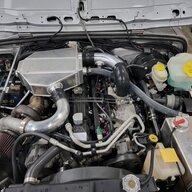
Do both the intake header and exhaust header if you can. Catalytic converters are optional but will noticeably reduce underhood and underfloor heat.

Piston coat is only available in two colors. I went with the default gold:
https://www.cerakote.com/shop/cerakote-coating/V-136/piston-coat-oven-cure
There is also a metallic red version:
https://www.cerakote.com/shop/cerakote-coating?finishes=cera_low_thermal

Since it has low both low emissivity and low absorbtivity, it greatly reduces the amount of heat transferred by radiation, as well as adding an additional layer to slow convective heat transfer.

I thought about wrapping as well, but decided the additional risk of cracking the exhaust header wasn't worth it.

That is a very reasonable price. Its going on the wish list
 
  • Like
Reactions: ColoJeep
I built this heat sheild from 1/4" fiberglass backed aluminium. Wove it between the intake and headers trimming the glass off the back in a few areas, cutting out a gap for the double exhaust port at the middle and secured it with some stainless steel zip ties. Unfortunately, it was as the seasons went from temps around 30 to over 60 and I'll have to wait several months to get logs to compare IATs in those colder temps, but I think it's been effective. It's holding up well and was like $20 and not a ton of time.Down the road I'm definitely thinking Cerakote on the headers and intake and maybe building one of these from the basalt backed fiber instead.

20250429_213021.jpg


20250429_153538.jpg
 
I've never done this sort of stuff on intakes before so I don't really know where to start on some of these pieces, like the center 45° and the fitting for the PCV hose, but I really like how clean this setup looks, @Jezza.

1753132482992.png


I'm used to dealing with the plumbing section at Home Depot so there's no telling what I'd end up with, left to my own devices. 🤣

I've picked up a Windstar air cleaner box on eBay to get started.
 
I've never done this sort of stuff on intakes before so I don't really know where to start on some of these pieces, like the center 45° and the fitting for the PCV hose, but I really like how clean this setup looks, @Jezza.

View attachment 632024

I'm used to dealing with the plumbing section at Home Depot so there's no telling what I'd end up with, left to my own devices. 🤣

I've picked up a Windstar air cleaner box on eBay to get started.

There are a number of threads with parts lists and how to modify the housing.My build thread is one of them Post in thread 'Project Basketcase!' https://wranglertjforum.com/threads/project-basketcase.67755/post-1649352
 
Last edited:
I loved your "I'm not a fan" comment on electric fans.

Two reasons I'd consider electric... theoretical gas mileage improvements. Trail dust... getting blasted out in Washington a week or so ago by the dust kicked up by the engine fan...me relocating the fan shroud didn't help there at all.

Great video!

-Mac
 
New episode is up. "Fun with Fans" was bittersweet for me.


Another great video!

I think you're right on the money with the locked up fan at high rpm. Looks like it's in stall (flow separating from the blades, just like an aircraft wing when it stops generating lift).

I do think that new fan clutch probably benefitted from not warming up, at least on the low end. 170F air coming off the radiator, long enough to warm up the fan clutch, is what it's supposed to take to lock up. If you re-ran it (not asking you to, just saying you could...), you could run a clear hose up between the fan and radiator, down and back up somewhere in the engine compartment, put some water in it and mark it in 1/4" increments for a few inches above and below the water surface on each side (make a u-tube manometer) and film it during the run, we could see the pressure difference and calculate the CFM from the power difference vs the no fan run. Pulling that much power it's almost certainly pulling far more than any electric fan but having an approx CFM would really help illustrate it for your anti-electric fan discussions. 😉
 
For fan clutches, we generally assume that unlocked is usually in the range of 10-20% RPM and locked is in the range of 70-80% (sometimes 90% for HD clutches) of water pump shaft speed. In reality, the percentage probably actually varies with the engine speed in a non-linear fashion due to the non-linear torque relationship of fan speed versus RPM. But even using these basic assumptions, it's pretty easy to demonstrate the difference between them.

A fun fact is that the fan clutch is actually less mechanically efficient unlocked than locked. The torque across the fan clutch is conserved (in steady-state), but since RPM in does not equal RPM out, a significant portion of shaft power is simply converted to heat. (Hence why fan clutches have cooling fins.)

If we're assuming 20% for an unlocked clutch, it it takes say 0.02 horsepower to spin the fan at that speed, we're also burning up 0.08 horsepower as heat in the clutch, for a total of 0.10 horsepower. Meanwhile, if we lock it at that same speed (assuming 80% for locked), the fan affinity laws will tell us that the 4x in shaft speed will result in 64x the power consumption and 16x the torque for the fan itself. Meanwhile for the clutch, since it only slips at a quarter of the RPM, the 16x torque only means a 4x increase in power loss in the clutch. So in this case, the fan now takes 1.28 horsepower, and the clutch now burns up 0.32 horsepower, for a total of 1.60 horsepower. So in terms of mechanical efficiency, the clutch fan is only 20% efficient unlocked, but is 80% efficient locked. However, power consumption is still far higher with the locked clutch.
(The horsepower units here are of arbitrary magnitude.)

Meanwhile, the electric fan has a relatively fixed energy loss ratio largely driven by the alternator and the motor itself. Using the marginal efficiency for the alternator (not overall efficiency, because it already exists), multiplied by the overall efficiency of the fan motor, you usually end up with about 50-60% overall efficiency ratio in converting rotational energy at the engine to rotational energy at the fan.

Interestingly, because alternators will react to maintain constant power output, shaft torque actually drops inversely with engine RPM, unlike a mechanical fan, in which it increases with the square of engine RPM.

The final distinct advantage of an electric fan is that the control scheme can be way more complex than for a clutch fan. This is the biggest driver of efficiency in OEM applications. Since the control scheme can be more complex, you can make the fan run only when needed, and only as much as needed. So there is significantly less energy wasted creating excess airflow.

 
You can’t get more horse power from a tractor motor.

1753545870174.gif


Personally, I like the quietness of converting to electric. Especially when you hear that thing whirring when it’s 20 degrees when I have zero need for a fan in my commute.
 
  • Like
Reactions: Jezza
In my time on the trails, I've seen electric fans fail more and not cool properly in many cases. Is this most likely an issue with the person who installed it or how it was installed? Yes.

Did my Camaro's stock electric fan stop in the middle of a cruise in and get to boiling before I could get somewhere to shut it down or get up to speed enough for airflow to cool IT? Also yes.

Offroad and towing, I will always choose an engine driven clutch fan just for dependability. If all else fails, some bailing wire or a shoe string tied between the fan blades and a bolt will get me off the trail.
 
  • Like
  • Love
Reactions: Jezza and ColoJeep
You can’t get more horse power from a tractor motor.

View attachment 632921

Personally, I like the quietness of converting to electric. Especially when you hear that thing whirring when it’s 20 degrees when I have zero need for a fan in my commute.

That's my angle, too. I've been mulling it over and playing with Arduino controls for almost a year now, have a lot of the parts lined up to do it (except for the fan itself), and stalled due to some other stuff going on. It drives me crazy to listen to that fan roar down a mountain pass in 4 low, kicking up a bunch of dust, in 50F air and the ECT sitting on 192 with the thermostat barely cracked open.
 
For fan clutches, we generally assume that unlocked is usually in the range of 10-20% RPM and locked is in the range of 70-80% (sometimes 90% for HD clutches) of water pump shaft speed. In reality, the percentage probably actually varies with the engine speed in a non-linear fashion due to the non-linear torque relationship of fan speed versus RPM. But even using these basic assumptions, it's pretty easy to demonstrate the difference between them.

A fun fact is that the fan clutch is actually less mechanically efficient unlocked than locked. The torque across the fan clutch is conserved (in steady-state), but since RPM in does not equal RPM out, a significant portion of shaft power is simply converted to heat. (Hence why fan clutches have cooling fins.)

If we're assuming 20% for an unlocked clutch, it it takes say 0.02 horsepower to spin the fan at that speed, we're also burning up 0.08 horsepower as heat in the clutch, for a total of 0.10 horsepower. Meanwhile, if we lock it at that same speed (assuming 80% for locked), the fan affinity laws will tell us that the 4x in shaft speed will result in 64x the power consumption and 16x the torque for the fan itself. Meanwhile for the clutch, since it only slips at a quarter of the RPM, the 16x torque only means a 4x increase in power loss in the clutch. So in this case, the fan now takes 1.28 horsepower, and the clutch now burns up 0.32 horsepower, for a total of 1.60 horsepower. So in terms of mechanical efficiency, the clutch fan is only 20% efficient unlocked, but is 80% efficient locked. However, power consumption is still far higher with the locked clutch.
(The horsepower units here are of arbitrary magnitude.)

Meanwhile, the electric fan has a relatively fixed energy loss ratio largely driven by the alternator and the motor itself. Using the marginal efficiency for the alternator (not overall efficiency, because it already exists), multiplied by the overall efficiency of the fan motor, you usually end up with about 50-60% overall efficiency ratio in converting rotational energy at the engine to rotational energy at the fan.

Interestingly, because alternators will react to maintain constant power output, shaft torque actually drops inversely with engine RPM, unlike a mechanical fan, in which it increases with the square of engine RPM.

The final distinct advantage of an electric fan is that the control scheme can be way more complex than for a clutch fan. This is the biggest driver of efficiency in OEM applications. Since the control scheme can be more complex, you can make the fan run only when needed, and only as much as needed. So there is significantly less energy wasted creating excess airflow.


Did you have numbers for the hp required to generate given watts in your fan thread?


I'm curious what it costs in hp for the camaro fan to generate an equivalent cfm to the stock setup at max flow. Also,it doesn't sound like it is linear with flow or rpm because of the fan/air/rpm relationship.
 
Did you have numbers for the hp required to generate given watts in your fan thread?


I'm curious what it costs in hp for the camaro fan to generate an equivalent cfm to the stock setup at max flow. Also,it doesn't sound like it is linear with flow or rpm because of the fan/air/rpm relationship.

Max power of the Camaro/SPAL fan is about 850 watts if I recall correctly, but I think it is RPM-limited in practice. The highest power I've seen is about 750 watts, or almost exactly a horsepower. Even if we assume 50% marginal alternator efficiency, that is at worst 2 HP.

That said, almost all of the operation is in the less than 200-watt range, and the majority is less than 100 watts. So in the majority of cases you're seeing power loss equivalent to that of turning on the factory headlights.

The fan module tracks very well with the fan affinity laws. Power increase is very gradual through the first ~75% of max speed zone, and then increases very rapidly in the final 25%.

Overall, what matters most for fan efficiency is simply fan diameter. I'd have to double check the math, but I think increasing fan size vs speed to get the same flow has a difference of power to the 5th power (P^5), so the absolute #1 thing to look for is simply a large diameter fan.

The SPAL fan has a diameter about the same as the OEM fan, so the fan blade assembly efficiency is probably in the same ballpark. Though I suspect the SPAL fan also has a more efficient blade design than the OEM.
 
Did you have numbers for the hp required to generate given watts in your fan thread?


I'm curious what it costs in hp for the camaro fan to generate an equivalent cfm to the stock setup at max flow. Also,it doesn't sound like it is linear with flow or rpm because of the fan/air/rpm relationship.

Also I did post a chart with fan RPM versus power consumption in there, and it follows the cube trend almost perfectly.
 
New episode is up. "Fun with Fans" was bittersweet for me.


Pro job Jezza ! , even when the results on top showed gains , you showed the real results . I totally agree with sticking with mechanical fan , stupid simple and reliable and with the new clutch look how close the pull numbers are to 4000 r.p.m. Not worth doing anything other than functioning stock fan stuff .
I love what you are sharing with the rest of us , we don't have a dyno , and wouldn't have actual hood down data . THANK YOU !!!!
 
Pro job Jezza ! , even when the results on top showed gains , you showed the real results . I totally agree with sticking with mechanical fan , stupid simple and reliable and with the new clutch look how close the pull numbers are to 4000 r.p.m. Not worth doing anything other than functioning stock fan stuff .
I love what you are sharing with the rest of us , we don't have a dyno , and wouldn't have actual hood down data . THANK YOU !!!!

More than 15 years ago there was a lot of discussion in the XJ community concerning swapping from the clutch fan to the electric fan.
Granted there have been changes in todays electric fan motor market with the fans and controllers that are available, but the problem at the time was getting the enough CFMs to keep the engine cool, locating a durable controller and overall dependability on the trail.
I had converted from a factory radiator the a high quality aluminum radiator and used the factory condenser cooling fan along with another fan and a high quality controller. The aftermarket fan died several times and the controller overheated due to desert temperatures in the Anza Borrego Desert.
Finally converted back to the OEM set up and replaced the aluminum radiator after it sprung several leaks at the tube welds.
The OEM setup continued to work flawlessly until I sold the Jeep.
 
More than 15 years ago there was a lot of discussion in the XJ community concerning swapping from the clutch fan to the electric fan.
Granted there have been changes in todays electric fan motor market with the fans and controllers that are available, but the problem at the time was getting the enough CFMs to keep the engine cool, locating a durable controller and overall dependability on the trail.
I had converted from a factory radiator the a high quality aluminum radiator and used the factory condenser cooling fan along with another fan and a high quality controller. The aftermarket fan died several times and the controller overheated due to desert temperatures in the Anza Borrego Desert.
Finally converted back to the OEM set up and replaced the aluminum radiator after it sprung several leaks at the tube welds.
The OEM setup continued to work flawlessly until I sold the Jeep.

XJ's have a hard time with cooling , the radiator is small and airflow is not great due to so much stuff in the small engine compartment. I know both our TJ's cool better than our 4 XJ's . Remember the big engine for the XJ was a 2.8 Chevy V-6 when they designed it , and the 2.5 I-4 was the main engine .
 
Novak Conversions Jeep Wrangler TJ engine mounts