A/C problems

NoleyPoley807

New Member
Original poster
Joined
Apr 6, 2025
Messages
16
Location
Tallahassee, FL, United States
Hello all.

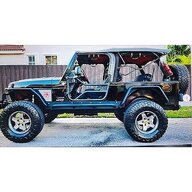
I bought a 2001 TJ from a college buddy about 6 months ago. I have put a lot of work into it to get in running properly with tons of headscrathers that I believe I have all resolved now.

Since all of that is done, I want to get onto the AC ( it is HOT in Florida)

Awhile back I added r134a because the compressor was kicking on and off. Well, it stopped working altogether. I bought a manifold gauge set and checked pressures today. I evacuated some refrigerant and it started kicking on and off again. But, now I am a bit lost with the low high side pressure. I'll attached some pictures and a video. Any help would be much appreciated. Thanks in advance!

Compressor kicks on
Low side - 36psi
High side - 35psi

Compressor kicks off
Low side - 55psi
High side - 55psi

 
Hello all.

I bought a 2001 TJ from a college buddy about 6 months ago. I have put a lot of work into it to get in running properly with tons of headscrathers that I believe I have all resolved now.

Since all of that is done, I want to get onto the AC ( it is HOT in Florida)

Awhile back I added r134a because the compressor was kicking on and off. Well, it stopped working altogether. I bought a manifold gauge set and checked pressures today. I evacuated some refrigerant and it started kicking on and off again. But, now I am a bit lost with the low high side pressure. I'll attached some pictures and a video. Any help would be much appreciated. Thanks in advance!

Compressor kicks on
Low side - 36psi
High side - 35psi

Compressor kicks off
Low side - 55psi
High side - 55psi

From your readings, when the compressor is kicking on, it appears that both the low and high side pressures are quite close to each other (36psi low and 35psi high). This could either mean that the system might be undercharged or there’s a possible blockage / issue in the system, preventing it from flowing properly.

When the compressor kicks off, the equalization of the pressures (55psi on both sides) suggests that it might not be able to maintain the right pressure differential.

Here are a few things you might want to check:
  • Expansion Valve / Orifice Tube: If there's a blockage here, it can prevent proper refrigerant flow and cause the pressures to equalize. Inspect and consider replacing it if necessary.
  • Refrigerant Charge: You mentioned adding R134a; the system might still be undercharged. A proper charge is crucial for the AC system to function correctly. Maybe try adding a bit more refrigerant while monitoring the gauges—just make sure you don’t overcharge!
  • Compressor Function: While the compressor is technically turning on, it might not be providing the necessary flow. Check for any unusual sounds when it kicks on/off, which can be a sign of internal failure.
  • Condenser and Evaporator: Ensure that both components are clean and unobstructed. If the condenser is blocked, it won't dissipate heat effectively, and the system won't perform well.
  • Electrical Issues: Lastly, it could be something like a faulty pressure switch or electrical connection causing the compressor to turn off prematurely. Inspect the wires and connectors for wear or corrosion.
 
looks like it is turning off too early, and turning on too early? Are both high and low pressure switches bad? My impression as a total hack, is that it shouldn't cut off until around 20-28 low side.

But before ANY of that, you need to have the entire system evacuated and sucked dry with a vacuum pump, and then the exact correct charge of refrigerant and oil added. Who knows what's in there now, and what damage it's doing.
 
  • Like
Reactions: John Cooper
looks like it is turning off too early, and turning on too early? Are both high and low pressure switches bad? My impression as a total hack, is that it shouldn't cut off until around 20-28 low side.

But before ANY of that, you need to have the entire system evacuated and sucked dry with a vacuum pump, and then the exact correct charge of refrigerant and oil added. Who knows what's in there now, and what damage it's doing.

I have not checked the switches. My main concern was the pressures being the same as the high side should be a lot higher than the low side.

I plan to evacuate the system and start fresh. Do I added the oil in the low side? Or?
 
From your readings, when the compressor is kicking on, it appears that both the low and high side pressures are quite close to each other (36psi low and 35psi high). This could either mean that the system might be undercharged or there’s a possible blockage / issue in the system, preventing it from flowing properly.

When the compressor kicks off, the equalization of the pressures (55psi on both sides) suggests that it might not be able to maintain the right pressure differential.

Here are a few things you might want to check:
  • Expansion Valve / Orifice Tube: If there's a blockage here, it can prevent proper refrigerant flow and cause the pressures to equalize. Inspect and consider replacing it if necessary.
  • Refrigerant Charge: You mentioned adding R134a; the system might still be undercharged. A proper charge is crucial for the AC system to function correctly. Maybe try adding a bit more refrigerant while monitoring the gauges—just make sure you don’t overcharge!
  • Compressor Function: While the compressor is technically turning on, it might not be providing the necessary flow. Check for any unusual sounds when it kicks on/off, which can be a sign of internal failure.
  • Condenser and Evaporator: Ensure that both components are clean and unobstructed. If the condenser is blocked, it won't dissipate heat effectively, and the system won't perform well.
  • Electrical Issues: Lastly, it could be something like a faulty pressure switch or electrical connection causing the compressor to turn off prematurely. Inspect the wires and connectors for wear or corrosion.

This is mostly what I have found online. My major concern were the pressures being the same when the high side should be a lot higher.
 
I recently had gauges on mine.

With the AC off, both high and low were around 80 psi.
With AC on, low decreases to around 40 psi, and high increases to around 250 psi.

The system will shut off if the low pressure drops to around 25 psi.
I do not know exactly what the high pressure cut-off is, but I think it's something like 400 psi.
 
  • Like
Reactions: JKP
I recently had gauges on mine.

With the AC off, both high and low were around 80 psi.
With AC on, low decreases to around 40 psi, and high increases to around 250 psi.

The system will shut off if the low pressure drops to around 25 psi.
I do not know exactly what the high pressure cut-off is, but I think it's something like 400 psi.

Good info, thank you.

My compressor would not kick on at all when I added freon. I only got it to kick on when I took some out, that's what made me think it was over charged.
 
Hello all.

I bought a 2001 TJ from a college buddy about 6 months ago. I have put a lot of work into it to get in running properly with tons of headscrathers that I believe I have all resolved now.

Since all of that is done, I want to get onto the AC ( it is HOT in Florida)

Awhile back I added r134a because the compressor was kicking on and off. Well, it stopped working altogether. I bought a manifold gauge set and checked pressures today. I evacuated some refrigerant and it started kicking on and off again. But, now I am a bit lost with the low high side pressure. I'll attached some pictures and a video. Any help would be much appreciated. Thanks in advance!

Compressor kicks on
Low side - 36psi
High side - 35psi

Compressor kicks off
Low side - 55psi
High side - 55psi

Close the knobs on the gauges
 
Good info, thank you.

My compressor would not kick on at all when I added freon. I only got it to kick on when I took some out, that's what made me think it was over charged.

No AC
L - 70
H - 70

Ac turns on and goes to:
L - 20
H - 140

Builds to:
L - 59
H - 100

Ac turns back on and goes to:
L - 20
H - 140

Does this over and over.
 
Low on refrigerant, which would mean a leak look for oil traces at the condenser in front of the radiator. If you can get some refrigerant with dye in it you can recharge the system with dye to lock for a leak.
 
At 90 degrees you should be at approximately 50/250.

2 cheap things to do is to change the accumulator and oriface. If that doesn't work, it gets expensive.

After replacing these two items, Leave your vacuum pump on overnight to make sure the system is good and dry. Then let it sit with the vacuum for a few hours, the pressure should not change at all. If it does, fix the leak.

Here is my guess...somewhere along the line someone used stop leak and that has plugged up the system.

Oil...you don't add oil as it is already in the system. If you change the compressor you might have to add oil if the new compressor was not filled when you bought it. If you drain the oil you will need to add oil.
 
1752881304651.png
 
Alright, update time.

Harbor freight magically had a sale on the manifold pressure test kit and a vacuum pump.

I vacuumed the system and left it and it stayed at -30m for an hour or so. Seems there is no leak.

Added one can of freon and when I went to switch to the second can do get to 20oz the yellow hose started leaking (this was the second one from harbor freight after exchanging the first).

Ordered a new yellow hose from Amazon and added another few ounces. Pressures looked good and have cold air now!

Thanks all for the help!