Novak Conversions Jeep Wrangler TJ radiator

180 degree thermostat: good, bad, ugly?

Gemma

New Member
Original poster
Joined
Nov 7, 2020
Messages
23
Location
Flagstaff
QUESTION: Will a 180 thermostat and an idle operating temperature of (185-188) confuse the computer, create a rich mixture, and harm the engine?

Here is the back story. Because I know that people are going to ask, “Why would you want to install a 180 thermostat?”

I have been chasing higher-than-normal temps with my 4.6L Golen Stroker Engine. (Example: 227-degree at steep Incline for 3 miles 2,700 RPM - 3,000 RPMs - Between 4th &5th Gear - Speed varies)

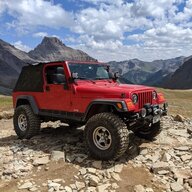
This is my fourth Jeep. I was lucky enough to find this Jeep, already built out. However, It has not been without it's unique issues... LOL

In the process of chasing the higher temps, I replaced the 195 thermostat with a 180 thermostat, along with a new high-flow water pump and new high-flow Thermostat housing.

In the end, the Spal high-performance electric fan was the problem!!!

I have since replaced the electric fan with the OEM fan. No more high Temps!!! The temp at idle is between185-188 degrees. Now, at high RPMs 197 degree, whereas before 227 degrees.

However, I still have the 180 thermostat installed!!!

Again, will a 180 thermostat andan operating temperature of (185-197) confuse the computer, create arich mixture, and harm the engine?

I live a 7,000 in northern AZ summertemps 85-95 degrees
Setup:
2003 TJ with a 4.6 L Golen Engine
Aluminum radiator
Hood louvers
OEM Fan and shroud
high-flow water pump
high-flow Thermostat housing
180-degree thermostat.
4" long-arm lift kit
33" X 12.50 tires

 
I’m no expert, but I’d replace that high flow water pump with just a standard flow. Flow the water too fast and you will never achieve heat transfer.
 
  • Like
Reactions: Ken Perkins
From my own observation 185 is still enough for the PCM to go into closed loop, so it probably doesn't hurt much, but it's also important to note that it doesn't help one bit because all it does is set the "floor" to the operating temp and has zero impact on the "ceiling".
 
  • Like
Reactions: L J and ColoJeep
I’m no expert, but I’d replace that high flow water pump with just a standard flow. Flow the water too fast and you will never achieve heat transfer.

It doesn't quite work that way. The water won't gain as many degrees in the block or lose as many degrees as it moves through the radiator, but since there is more mass flowing, the actual BTU/hr (or kW for the metric inclined) is basically unchanged. Once you have enough flow to be turbulent, the heat transfer is much less a function of flow.

Q=m*Cp*dT

Where,
Q heat transferred
m mass flow rate of the fluid
Cp specific heat of the fluid
dT temperature difference of the fluid between the outlet and inlet

What ends up happening as you increase m is dT shrinks and Q stays more or less rhe same.

The end result would be a similar average temperature but extremes closer together. The block might run a little warmer and the head a little cooler, but not likely enough to really do anything meaningful in terms of engine life or reliability.

FlowKooler talks the increased flow creating a higher water jacket pressure in their marketing materials, decreasing the formation of localized bubbles that impede heat transfer. The concept isn't completely out of left field but in a system that already has an 18psi rad cap I doubt the extra flow creates enough extra pressure to be significant, and I'd be kinda surprised if the coolant was moving slow enough for localized boiling to take place.

All in all I wouldn't buy one, but I wouldn't swap one out just to get rid of it, either .
 
Wow. That is way above my head. My experience is actually from making beer. When it came time to cool the wort, I could slow the flow of wort thru my copper coil that is immersed in cold water. When I slowed the flow, the heat coming thru the coil would increase enough that you would immediately remove your hand from the heat transfer. It was pretty interesting to adjust the flow and feel the exchange of heat.
Maybe engine\radiator application is a bit different. Then again maybe the beer was doing a bit of talking😁
 
QUESTION: Will a 180 thermostat and an idle operating temperature of (185-188) confuse the computer, create a rich mixture, and harm the engine?

Here is the back story. Because I know that people are going to ask, “Why would you want to install a 180 thermostat?”

I have been chasing higher-than-normal temps with my 4.6L Golen Stroker Engine. (Example: 227-degree at steep Incline for 3 miles 2,700 RPM - 3,000 RPMs - Between 4th &5th Gear - Speed varies)

This is my fourth Jeep. I was lucky enough to find this Jeep, already built out. However, It has not been without it's unique issues... LOL

In the process of chasing the higher temps, I replaced the 195 thermostat with a 180 thermostat, along with a new high-flow water pump and new high-flow Thermostat housing.

In the end, the Spal high-performance electric fan was the problem!!!

I have since replaced the electric fan with the OEM fan. No more high Temps!!! The temp at idle is between185-188 degrees. Now, at high RPMs 197 degree, whereas before 227 degrees.

However, I still have the 180 thermostat installed!!!

Again, will a 180 thermostat andan operating temperature of (185-197) confuse the computer, create arich mixture, and harm the engine?

I live a 7,000 in northern AZ summertemps 85-95 degrees
Setup:
2003 TJ with a 4.6 L Golen Engine
Aluminum radiator
Hood louvers
OEM Fan and shroud
high-flow water pump
high-flow Thermostat housing
180-degree thermostat.
4" long-arm lift kit
33" X 12.50 tires

I’m not going to go down the rathole of arguments about these components. I will say, that Engineers designing cars, do put some thought to it.

I know your engine isn’t stock, but I believe it uses the same cooling system if you will, and the PO changed a lot on your rig.

I’d go back to mechanical fan (you did), a stock or OEM thermostat and water pump. Do the work to flush it all well, I went through mine meticulously, and you can see the result on my readout Monday. I did the Thermocure, with the Thermostat out it’s way faster, you don’t have to wait for it to cool to drain, fill, cool drain, fill, to get it all out.

It’s wicked hot in August here in Texas, we call it Summer, same every year. And I’m between 200 and 210 with AC on climbing hills (up 2222) in the hill country. I just see no reason to change what was designed.


85E9D38F-2FCA-4516-8107-FF73F21D65F5.jpeg
 
Last edited:
  • Like
Reactions: TJ Jim
Wow. That is way above my head. My experience is actually from making beer. When it came time to cool the wort, I could slow the flow of wort thru my copper coil that is immersed in cold water. When I slowed the flow, the heat coming thru the coil would increase enough that you would immediately remove your hand from the heat transfer. It was pretty interesting to adjust the flow and feel the exchange of heat.
Maybe engine\radiator application is a bit different. Then again maybe the beer was doing a bit of talking😁

Perfect illustration! What you saw was that the wort reached a cooler temperature when moving more slowly, and in that scenario, the temperature is the goal. Heat transferred (Q) was the same, but you reduced m to result in an increased dT.

The key difference is in a closed system like an engine cooling system, temperature is a byproduct, and will be what it needs to be to produce the necessary rate of heat transfer at a given flow.
 
  • Like
Reactions: Woodrow
Perfect illustration! What you saw was that the wort reached a cooler temperature when moving more slowly, and in that scenario, the temperature is the goal. Heat transferred (Q) was the same, but you reduced m to result in an increased dT.

The key difference is in a closed system like an engine cooling system, temperature is a byproduct, and will be what it needs to be to produce the necessary rate of heat transfer at a given flow.

Awesome!
 
If any issues ever show up, it would be in the winter. Thermostats ensure that you reach the minimum temperature, which with a stock thermostat would be 195 degrees. The cooling load from summer itself brings you to the maximum temperature naturally, which is around 210. You could have no thermostat and you would still warm up fully in the summer.

You may or may not have issues with the 180 in winter. I'm not sure exactly where closed loop starts. Personally, I'd just change the thermostat back to stock just because. Now that you got rid of the garbage fan, your issues should stay away despite the temp of the thermostat.

For the record, electric fans like that are notorious for being problematic, for multiple reasons. Simply put, they (aftermarket e-fans) don't offer the CFM of a well designed clutch fan. They are also not intelligently controlled. Factory electric fans in other vehicles usually have multiple speeds, a computer to control it (for example so you can get Max AC while sitting at idle), and they are well built enough that they flow appropriate amounts of air, similar to a clutch fan. Aftermarket cheap fans have none of that engineering. They are typically just a fan that bolts up to wherever they say it does. Other than that, they have none of the engineering needed to do a proper job.
 
  • Like
Reactions: freedom_in_4low
It's simple, stick with the factory specified 195 degree temperature rating thermostat which the PCM was programmed around. It will NOT (!!!!!!!!!!!!!) run any cooler in hot conditions with a 165 or 180 degree thermostat than it will with the correct 195 degree model. Keep in mind a thermostat only sets the engine's minimum operating temperature and helps the engine warm up faster, it has no effect on how hot it will get in hot conditions.
 
Simply put, they (aftermarket e-fans) don't offer the CFM of a well designed clutch fan. They are also not intelligently controlled. Factory electric fans in other vehicles usually have multiple speeds, a computer to control it (for example so you can get Max AC while sitting at idle), and they are well built enough that they flow appropriate amounts of air, similar to a clutch fan. Aftermarket cheap fans have none of that engineering. They are typically just a fan that bolts up to wherever they say it does. Other than that, they have none of the engineering needed to do a proper job.

Well said. The fan and radiator are engineered as a package. Electric fans are power limited due to the current that can be practically drawn in a 12V system without overloading the alternator or requiring heavy and expensive wiring...generally less than 1/2hp. A clutch fan is only limited by the transmission capability of the belt drive. A radiator applied with an electric fan needs to be designed to offer appropriate heat transfer capacity at the reduced air flow.
 
Wow. That is way above my head. My experience is actually from making beer. When it came time to cool the wort, I could slow the flow of wort thru my copper coil that is immersed in cold water. When I slowed the flow, the heat coming thru the coil would increase enough that you would immediately remove your hand from the heat transfer. It was pretty interesting to adjust the flow and feel the exchange of heat.
Maybe engine\radiator application is a bit different. Then again maybe the beer was doing a bit of talking😁

What is the pressure in your system?
 
Well said. The fan and radiator are engineered as a package. Electric fans are power limited due to the current that can be practically drawn in a 12V system without overloading the alternator or requiring heavy and expensive wiring...generally less than 1/2hp. A clutch fan is only limited by the transmission capability of the belt drive. A radiator applied with an electric fan needs to be designed to offer appropriate heat transfer capacity at the reduced air flow.

The best part about e-fans is watching the historical offerings. One of the big e-fan companies early on came out with a kit for the TJ and it achieved all of the expected results, the folks that loved it didn't live where it actually matters. The folks that hated it because it didn't work as well as OEM, lived where it matters. In short order, the company started offering a package with some whiz bang radiator.

One of these days (read as likely never) I'll learn to bookmark and save the interesting tidbits I've run across. Someone posted up an OEM chart that showed the CFM ratings at a given RPM for the commonly used fan set ups. The TJ fan on that chart was good for about 10,000 max CFM.

The other big issue that I see with a big enough e-fan that could potentially work pretty well is just how durable the controller has to be. I see lots of folks trying to solve frequent failed controllers. I'd guess two things are going on. The current spike when they fire up is hell on contacts for a relay system and most aren't robust enough for OEM levels of usage.

If you build a proper controller, it isn't going to be cheap.
 
From my own observation 185 is still enough for the PCM to go into closed loop, so it probably doesn't hurt much, but it's also important to note that it doesn't help one bit because all it does is set the "floor" to the operating temp and has zero impact on the "ceiling".

It helped me to understand how it all works by describing it as the thermostat just controls the low side temps or minimum operating temp. The efficiency of the cooling bits, pump, radiator, air flow, etc. control the high side. If the efficiency isn't there, it doesn't matter what thermostat is in there, it will still overheat.
 
The best part about e-fans is watching the historical offerings. One of the big e-fan companies early on came out with a kit for the TJ and it achieved all of the expected results, the folks that loved it didn't live where it actually matters. The folks that hated it because it didn't work as well as OEM, lived where it matters. In short order, the company started offering a package with some whiz bang radiator.

One of these days (read as likely never) I'll learn to bookmark and save the interesting tidbits I've run across. Someone posted up an OEM chart that showed the CFM ratings at a given RPM for the commonly used fan set ups. The TJ fan on that chart was good for about 10,000 max CFM.

The other big issue that I see with a big enough e-fan that could potentially work pretty well is just how durable the controller has to be. I see lots of folks trying to solve frequent failed controllers. I'd guess two things are going on. The current spike when they fire up is hell on contacts for a relay system and most aren't robust enough for OEM levels of usage.

If you build a proper controller, it isn't going to be cheap.

I frequent the TacomaWorld forum quite a bit as I've owned one for a year and three months. They are still running a traditional mechanical fan as of the 2023 model year.

Several years ago, a fellow who supposedly worked at GM in the Corvette division (at least, that's what I gathered but he was pretty vague about it) started a thread titled something along the lines of "cooling problems? not anymore" or something like that. He was introducing an "OEM validated" electric fan option to the Tacoma market to solve all the cooling problems he had seen. Personally, I have never seen one legit cooling issue on that massive forum, but I digress. Anyways, he was introducing an e-fan to the market to replace the clutch fan and solve all the cooling problems. I believe the "OEM validated" attribute was to express that in his time with GM doing whatever it is he does, he had used this fan or a very similarly spec'd fan on Corvettes and that it was the real deal.

He was using a Lingenfelter controller which is supposed to be really good/robust/ideal. I would think he would know, being that he supposedly designs for an OEM.

After some time his purchase thread finally came about in November 2020. $900. A decent number of folks jumped on board. As you may expect, numerous isues presented themselves almost immediately, from overheating, to controllers burning up, fans turning on too late, or running for too long. Very few worked kits worked for folks as intended. He helped troubleshoot for about 6 months. Didn't do much besides simple suggestions like "are you sure that's hooked up right?", "hmmmm I'm surprised it's not kicking on when such and such happens", etc. After May 2021, he never posted on the forum again, though he has visited the forum repeatedly and last visited in March 2023. Surprised he still has his active status showing on the profile. The listing was removed from the website, of course.

Anyways, it's sorta funny but mostly sad that he came to the forum with this kit that solves so many invisible problems, got folks on board with it, the majority had problems and then after a few months, support completely stopped once he realized he sold a bunch of kits that introduced problems he couldn't solve all while being advertised to solve problems that didn't exist.

I don't know where I'm really going with this, I just saw your story of the fan from long ago and it reminded me of this story. They all pretty much go about the same: folks tinker with something that works and install something that doesn't work, and then have problems. In this case, the guy supposedly was using a "good" controller, and folks still had numerous problems. This is what happens when well enough is not left alone.

The weird part is, in that guy's threads, nobody has called him out for going incommunicado.
 
  • Wow
Reactions: L J
The weird part is, in that guy's threads, nobody has called him out for going incommunicado.
There is a bunch more of that which goes on than really should. The folks that liked it get called fanbois. The folks with issues are accused of shilling for a competitor or being inept morons who shouldn't touch tools. He created a solution for a problem that doesn't exist. The folks that actually know how shit works get ignored fully. Sounds suspiciously like a Jeep forum.
 
There is a bunch more of that which goes on than really should. The folks that liked it get called fanbois. The folks with issues are accused of shilling for a competitor or being inept morons who shouldn't touch tools. He created a solution for a problem that doesn't exist. The folks that actually know how shit works get ignored fully. Sounds suspiciously like a Jeep forum.

In those specific threads, it was very reminiscent of a Jeep forum or worse, a Jeep FB group. And the naysayers were definitely either ignored or talked down to by the fanbois as if they couldn't possibly have any idea what they're talking about when saying the e-fan is a bad idea. Oh well, the fanbois eventually lived and learned.
 
  • Sad
Reactions: psrivats
In those specific threads, it was very reminiscent of a Jeep forum or worse, a Jeep FB group. And the naysayers were definitely either ignored or talked down to by the fanbois as if they couldn't possibly have any idea what they're talking about when saying the e-fan is a bad idea. Oh well, the fanbois eventually lived and learned.

If I could get an automatic reply that gets posted in every cooling system "upgrade" thread that states to find out where the great reviewer lives to apply a value to the recommendation, that would be just fucking awesome.
 
  • Like
Reactions: psrivats and Chris
Novak Conversions Jeep Wrangler TJ radiator