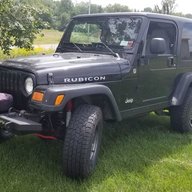
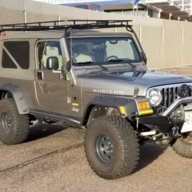
Novak Conversions Jeep Wrangler TJ engine mounts

Interesting long tube header design

Fact is the lower your torque or hp peak the longer your primaries should be. Then theres the primary pipe sizing and exhaust size.did i read right that system has a 3" final size?

I do like a lifetime guarantee though.

Its not often you see small bore engines making a lot of tq down low. But if you really are dead set on a good header but disagree with the ARH solution, why not just call the guys that build these engines everyday and ask them whats going on? Maybe there is something we are all missing as to why these work and or a lack of properly sized primaries as you claim.
 
Its not often you see small bore engines making a lot of tq down low. But if you really are dead set on a good header but disagree with the ARH solution, why not just call the guys that build these engines everyday and ask them whats going on? Maybe there is something we are all missing as to why these work and or a lack of properly sized primaries as you claim.
I wasn't saying their header is mis sized,i don't know the primary size. Or that it isn't a great header.What i said was it is a compromise. If it works great for a 500hp engine then it isn't optimized for a 250hp engine.

I'm trying to have a discussion about header design for low rpm.not be told "just buy xxx". I already knew about the ARH.

I have already talked to a good six engine builder but keep getting steered toward rpm and hp.lots of good advise though and a great motor coming together.

At every step i need to remind myself what the goal is(off idle torque improvement) so i don't get carried away with go fast parts.

I already have a 550hp/1000lbft truck that peels out at 70mph. I just want a better tractor!
 
Similar to what I'm doing for my motor, lots of low end torque, but will poop out above 4.5K rpm. I'm sure you know to use a conservatively rated "RV" cam. Very little valve overlap and an early intake closing angle to maximize the DCR.
 
A comp 68-232-4 was recommended by russ pottenger. I also wonder if a stock 97 would be nice with an adjustable timing set
?
 
Should be a good cam for low end, not much overlap and the intake .050 closes early. It also has more exhaust duration so it should help with the smaller exhaust port flow. Some have used an adjusted stock cam but you give up the extra valve lift.

I installed a Mopar P4529229 cam.
 
Last edited:
You will have minimal benefits on a straight 6 engine. Headers really only improve higher end breathing. Also the lack of flex joints has been shown to increase exaust manifold/header cracking at the mounting flange.
Not true, airplanes only run 2100-2700 rpms in cruise, headers increase the torque up to 15%. So properly tuned headers do have a great affect.
 
In looking at manifold options it appears some people have converted from early one piece manifolds to the later 4.0 that uses two small cast iron stubby manifolds with a twin downpipe collector. Used stubby cast manifolds are all over for dirt cheap, any power loss using that setup?

The exhaust ports aren't the same. It can be done but you block off part of the exhaust port doing so. If you look at the Edelbrock Aluminum head they used the early exhaust port design and it says it's not compatible with the 2000 and newer exhaust manifolds and that you have to run an early style manifold.
 
  • Like
Reactions: GASnBRASS
Not true, airplanes only run 2100-2700 rpms in cruise, headers increase the torque up to 15%. So properly tuned headers do have a great affect.
Thought we were talking about a straight 6 4.0 engine in a jeep. Not an airplane engine. Believe it or not elevation effects engine performance.
The easiest most effective way to improve low end torque in a Jeep I6 engine is to increase stroke. Helps to increase compression, total cylinder volume, and crankshaft leverage.
I'm a little confused now that this so called "tractor engine" is running at 20,000 ft. So is it an aircraft engine now too? Talk about versatile!
 
It was the point that you were saying that a long tube header has no affect on a LOW RPM engine that the inline six is, when in fact headers will provide performance.
 
  • Like
Reactions: Brian83
I've swapped out a few of these cracked headers over the years.

Top= Original 99 XJ Classic header on my 150K engine. Cracked.
Middle= Engine swapped junkyard motor with 50K miles. Cracked header
Bottom= New header with flex joints attached

Without flex joints they will crack at the welds. Not sure how Banks is set up weld-wise, though, but I don't see flex joints.
dscf1529w.jpg
 
Not true, airplanes only run 2100-2700 rpms in cruise, headers increase the torque up to 15%. So properly tuned headers do have a great affect.

Not a jeep comparison but a classic example of exhaust tuning failure that took several years to correct.
We have found exactly this in the current 4 stroke motocross race bikes. Yamaha took a departure from the classic design and leaned their 450 cylinder back and turned it around so the exhaust comes out the rear of the cylinder. They struggled for years with the exhaust because if was too short for good power. The exhaust pipe on the latest model comes out the back of the motor and circles around the front to the other side of the cylinder (270 degrees) in order to get enough header length to get good low end power.

The first design pipe.

YZ450 pipe 2.jpg

The current design 7 years later.

YZ450 pipe 3.jpg
 
I've had three with flex joints crack counting the cracked one on my Jeep right now. They've all cracked in the same area.
That's strange. I wonder if there has been a lawsuit. I've replaced my own and several others without issues later on. Admittedly, I've not put on a great deal of miles on my own before selling it. Also swapped out the motor mounts while I was doing the engine swap too.
 
Novak Conversions Jeep Wrangler TJ engine mounts