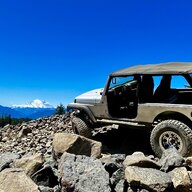
I recently pickup up another TJ with a weeping pinion seal on the dana 35, so I decided to through a $10 seal at it. Full disclosure, I know I'm taking a short cut here by replacing the seal without replacing the crush washer, but I'm trying to preserve a newly paved driveway and I don't have the time to remove the carrier in the immediate future.
I did try to go about this in most scientific hack way possible and before removing the pinion nut I did the following:
- center-punched the relationship between the pinion, nut, and yoke at the pinion's 6 o'clock position.
-used calipers to measure the distance between the top of the pinion and the top of the nut at 9 and 3 o'clock positions in an effort to confirm the nut will be back to the same depth/position. (.22, .21)
-counted the number of exposed threads above the nut (4 threads)
-counted the number of turns required to remove the pinion nut. (14.5 turns)
Here is where things get interesting.
I was curious about the torqued value of the nut so before disturbing the nut from its installed position, using a shitty torque wrench I incrementally increased the setting on the torque wrench until the nut ever so slightly loosened. The value reached was only 35ft-lbs. I took the nut off and reinstalled with a good wrench and it took a value of 35# to set the nut back to its noted relationship with the pinion and yoke per the above. At face value, this torque seems so minimal, but the axle was good, no noises, no play in the yoke, just a very slight weep of the seal. It doesn't exhibit any symptoms of the nut backing off at all in the 2k miles that I've driven it.
My other TJ has a 44 and is the only comparison I have at the moment. The nut looks similar in terms of thread count to the dana 35.
This got me thinking - Is there a scenario where after using a torque of say 160ish ft-lbs to initally compress the crush sleeve, the preload then results in a torque of roughly 35ft-lbs on the pinion nut once the sleeve collapses?
Any one have any related experience with this?
I did try to go about this in most scientific hack way possible and before removing the pinion nut I did the following:
- center-punched the relationship between the pinion, nut, and yoke at the pinion's 6 o'clock position.
-used calipers to measure the distance between the top of the pinion and the top of the nut at 9 and 3 o'clock positions in an effort to confirm the nut will be back to the same depth/position. (.22, .21)
-counted the number of exposed threads above the nut (4 threads)
-counted the number of turns required to remove the pinion nut. (14.5 turns)
Here is where things get interesting.
I was curious about the torqued value of the nut so before disturbing the nut from its installed position, using a shitty torque wrench I incrementally increased the setting on the torque wrench until the nut ever so slightly loosened. The value reached was only 35ft-lbs. I took the nut off and reinstalled with a good wrench and it took a value of 35# to set the nut back to its noted relationship with the pinion and yoke per the above. At face value, this torque seems so minimal, but the axle was good, no noises, no play in the yoke, just a very slight weep of the seal. It doesn't exhibit any symptoms of the nut backing off at all in the 2k miles that I've driven it.
My other TJ has a 44 and is the only comparison I have at the moment. The nut looks similar in terms of thread count to the dana 35.
This got me thinking - Is there a scenario where after using a torque of say 160ish ft-lbs to initally compress the crush sleeve, the preload then results in a torque of roughly 35ft-lbs on the pinion nut once the sleeve collapses?
Any one have any related experience with this?