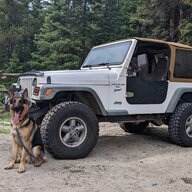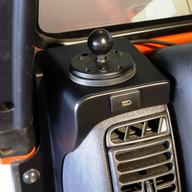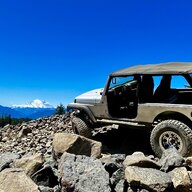
Novak Conversions Jeep Wrangler TJ engine mounts

Savvy off-road sold? (the unofficial Savvy customer support and Savvy rant thread)

I think they’ll function similarly to a trophy truck trailing arm. I believe they run a hard poly bushing on the frame side to prevent the arm from rotating and damaging the shocks that are mounted to it. Then i believe they run a large heim to get the most amount of misalignment on the axle side. It works there but i dont know the specifics such as any downfalls.

Arms don't just flex on one end. In order to get the twist and full flexibility of the narrow joint, the RK joint has to flex just as much. You can test it by rotating your arms to see how they both move together. There's some discussion about front panhard bars where Blaine mentions this.

The specifics of trophy truck trailing arms and bushings on one end I'm not sure, but I do know that if they run a heim on one end and a bushing on the other, both will misalign the same amount to acheive a twist.

Edit: The only thing I could think, is if the axle is twisted and moving the Heim itself and the arm stays "straight." Though I'm not entirely certain to what degree that happens.

Edit 2: Now that I have time to think a little harder, I don't see how it would solely rotate the ball in the heim, considering the pivot point of the axle would not fall on exactly the position of the joint.
 
Last edited:
  • Like
Reactions: The4bangertj
Arms don't just flex on one end. In order to get the twist and full flexibility of the narrow joint, the RK joint has to flex just as much. You can test it by rotating your arms to see how they both move together. There's some discussion about front panhard bars where Blaine mentions this.

The specifics of trophy truck trailing arms and bushings on one end I'm not sure, but I do know that if they run a heim on one end and a bushing on the other, both will misalign the same amount to acheive a twist.

Edit: The only thing I could think, is if the axle is twisted and moving the Heim itself and the arm stays "straight." Though I'm not entirely certain to what degree that happens.

Edit 2: Now that I have time to think a little harder, I don't see how it would solely rotate the ball in the heim, considering the pivot point of the axle would not fall on exactly the position of the joint.

Whichever end has the least resistance will misalign the most during suspension articulation. This is true on JJs where one end has more lubrication than the other. It is true if one end is a cleavite bushing where the resistance to misalignment is greater than a Johnny Joint. The difference is that the bushing will initiate a return to center, while a pair of Johnny joints will float and wander around together within their range of misalignment.

One single JJ has enough misalignment to account for all but the most extreme amounts of suspension articulation. My 12" travel shocks only create about 14° of misalignment in that scenario. To rephrase that, my frame side track bar JJ has no problem accommodating that 12" of shock travel at articulation.

The track bar deal has to do with the side to side movement of the axle. The joints and bushings all need to misalign side to side with the axle shift as the suspension cycles. Control arms like JKS or split bushings are not good at this movement and will create stress on the control arm mounts.
 
The difference is that the bushing will initiate a return to center, while a pair of Johnny joints will float and wander around together within their range of misalignment.
Can you feel this "float and wander" on the road driving?
 
Can you feel this "float and wander" on the road driving?

Josh is referring to the arm itself...because of the JJ design, the arm is floating between its mounting points. Its free to pivot about the ball in the joint. You won't feel it in the jeep, because no matter how much the arm will rotate around the ball, the joint itself is still tight in its mounts and its rigid in its length. Re-reading that, its a piss poor explaination...Let me try to do better...

Imagine a piece of rigid tubing. It can spin about its central (long) axis, right? But, you can't compress the ends toward each other. That is kinda what the arm does in a control arm with JJ on both ends. It can spin about its long axis up to the limits of the joint, but it doesn't bend or compress, so it won't lose control of the axle, thus, you won't feel it in the rig
 
Josh is referring to the arm itself...because of the JJ design, the arm is floating between its mounting points. Its free to pivot about the ball in the joint. You won't feel it in the jeep, because no matter how much the arm will rotate around the ball, the joint itself is still tight in its mounts and its rigid in its length. Re-reading that, its a piss poor explaination...Let me try to do better...

Imagine a piece of rigid tubing. It can spin about its central (long) axis, right? But, you can't compress the ends toward each other. That is kinda what the arm does in a control arm with JJ on both ends. It can spin about its long axis up to the limits of the joint, but it doesn't bend or compress, so it won't lose control of the axle, thus, you won't feel it in the rig

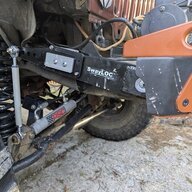
Those of us with Antirocks and SwayLocs also know this because the links have a pair of rod ends that wander and float together within their range of misalignment. But we do not feel or hear it happening. Except when a joint is worn and the ball is knocking around in the housing.
 
Whichever end has the least resistance will misalign the most during suspension articulation. This is true on JJs where one end has more lubrication than the other. It is true if one end is a cleavite bushing where the resistance to misalignment is greater than a Johnny Joint. The difference is that the bushing will initiate a return to center, while a pair of Johnny joints will float and wander around together within their range of misalignment.
And this always messes with my OCD when I get back from a run and none of them are "centered" in the mount. Raise your hand if you get down under there and straighten them back up with crescent wrench 🙋‍♂️😆
 
And this always messes with my OCD when I get back from a run and none of them are "centered" in the mount. Raise your hand if you get down under there and straighten them back up with crescent wrench 🙋‍♂️😆

Raise your hand if you do weird things for no reason.
 
Josh is referring to the arm itself...because of the JJ design, the arm is floating between its mounting points. Its free to pivot about the ball in the joint. You won't feel it in the jeep, because no matter how much the arm will rotate around the ball, the joint itself is still tight in its mounts and its rigid in its length. Re-reading that, its a piss poor explaination...Let me try to do better...

Imagine a piece of rigid tubing. It can spin about its central (long) axis, right? But, you can't compress the ends toward each other. That is kinda what the arm does in a control arm with JJ on both ends. It can spin about its long axis up to the limits of the joint, but it doesn't bend or compress, so it won't lose control of the axle, thus, you won't feel it in the rig

Awesome. Great explanation thank you. And in contrast to when my adjustable arm locknut got loose and stripped the threads and then the length changed and it was absolutely horrible to drive. Thanks
 
  • Like
Reactions: Mike_H
Whichever end has the least resistance will misalign the most during suspension articulation. This is true on JJs where one end has more lubrication than the other. It is true if one end is a cleavite bushing where the resistance to misalignment is greater than a Johnny Joint. The difference is that the bushing will initiate a return to center, while a pair of Johnny joints will float and wander around together within their range of misalignment.

One single JJ has enough misalignment to account for all but the most extreme amounts of suspension articulation. My 12" travel shocks only create about 14° of misalignment in that scenario. To rephrase that, my frame side track bar JJ has no problem accommodating that 12" of shock travel at articulation.

The track bar deal has to do with the side to side movement of the axle. The joints and bushings all need to misalign side to side with the axle shift as the suspension cycles. Control arms like JKS or split bushings are not good at this movement and will create stress on the control arm mounts.

I think one of the hard parts to visualize is how the bushing "returns" the arm to "center." If say a bushing is on the frame end and JJ on the other, the arm will want to center according to the frame- which would explain why arm-mounted shocks would benefit from it. On the reverse end, the bushing would center the arm with the axle. There would be no difference in misalignment amount, it would just cumulate to the JJ on the frame end and "twist" the arm relative to the local plane of the axle. I believe that I have that correctly written, point out if I don't, please.

I actually do want to test some differences in movement of different joints for control arms. I have a few different simulation programs to test and will send photos and a write up of it all to share. I've played with them already for countless hours and from what I've seen, if there is enough rotation on the axis parallel to the vehicle on one end of the arms, there doesn't need to be ANY rotation along the same axis on the other end. I will show photos and whatnot, but the way I've tested this is by making arms out of u-joints that do not bind (essentially 2 bearings), and sticking a third bearing rotating along the axis parallel to the vehicle on the axle end. The frame end "u-joint" did not need the third bearing for total articulation of the axle.
 
20250219004851_1.jpg
20250219004906_1.jpg
20250219004924_1.jpg
20250219004929_1.jpg
20250219004947_1.jpg
20250219004951_1.jpg


Here is a neat little game that I like to use to quickly build some basic suspension designs. There is no "inaccurate physics" for this as it is just bearing movement. The only "issue" is that there are no bushings in the game and there's no limit you can set for the "u-joints" and bearings to realistically replicate the limits of a Johnny Joint or Heim. The links are yellow, axle is green, bearings are blue, and "u-joints" are red. Ignore the panhard because I just want to focus on the regular control arms.

These first 6 images show the control arms with just a u-joint on either end, allowing for 2 axes of rotation on each end: horizontally parallel to the axle, and vertically perpendicular to the ground. They do not allow rotation along the axis parallel to the arms. As you can see, this allows the axle to fully bump and droop as far as the panhard will extend; however, it does not allow articulation of the axle at all. With having a panhard, the arms need at least these 2 axes of rotation on BOTH ends of the arms to allow for full motion without articulation.

20250219005310_1.jpg
20250219005316_1.jpg

20250219005430_1.jpg
20250219005435_1.jpg

20250219005533_1.jpg
20250219005540_1.jpg


These next 6 images show the same exact thing except for there are now bearings on each arm on the axle side that allow rotation horizontally parallel to the arms (or vehicle). This basically means there are 2 axes of rotation on each arm on the frame end, and 3 axes on the axle end. This extra axis allows for full movement INCLUDING articulation of the axle. (since the "u-joints cannot bind and the bearings free-spin, the axle can actually flip over onto itself by articulating too much).

This may be common knowledge to most and not needed a post, but I think this is a neat way to visualize it for most people.
 
I think one of the hard parts to visualize is how the bushing "returns" the arm to "center." If say a bushing is on the frame end and JJ on the other, the arm will want to center according to the frame- which would explain why arm-mounted shocks would benefit from it. On the reverse end, the bushing would center the arm with the axle. There would be no difference in misalignment amount, it would just cumulate to the JJ on the frame end and "twist" the arm relative to the local plane of the axle. I believe that I have that correctly written, point out if I don't, please.
...

The arm does not know or care which direction it is facing.

....
I actually do want to test some differences in movement of different joints for control arms. I have a few different simulation programs to test and will send photos and a write up of it all to share. I've played with them already for countless hours and from what I've seen, if there is enough rotation on the axis parallel to the vehicle on one end of the arms, there doesn't need to be ANY rotation along the same axis on the other end. I will show photos and whatnot, but the way I've tested this is by making arms out of u-joints that do not bind (essentially 2 bearings), and sticking a third bearing rotating along the axis parallel to the vehicle on the axle end. The frame end "u-joint" did not need the third bearing for total articulation of the axle.

If no other misalignment was needed other than articulation, one end of the control arm could be a solid block bolted to it's mount and the other end with a JJ would supply all the misalignment.
 
What the heck is going on? This ain’t steel or aluminum.

View attachment 592202

I am a total dumbass and I struggle to visualize the size of things easily. I was talking to @mrblaine and he explained how big this rope is in a way I could start to comprehend. Savvy midarm LCAs are 2" diameter. Now think of a rope BIGGER than that.

Still need more help? The MONSTER in the front right in the screen grab below is the 2.5" size rope. The top left is 1.5" dia, right of it is 2" dia and then you have the 2.5" in front of it. Screengrab from this video.

1739946604003.png


More pics to show the real size of this thing. It's fucking insane.

1739946779553.png
1739946842653.png
 
  • Wow
Reactions: lBasket and JMT
I am a total dumbass and I struggle to visualize the size of things easily. I was talking to @mrblaine and he explained how big this rope is in a way I could start to comprehend. Savvy midarm LCAs are 2" diameter. Now think of a rope BIGGER than that.

Still need more help? The MONSTER in the front right in the screen grab below is the 2.5" x30ft size rope. The top left is 1.5" dia, right of it is 2" dia and then you have the 2.5". Screengrab from this video -

View attachment 594224

More pics to show the real size of this thing. It's fucking insane.

View attachment 594225 View attachment 594227

If you want to buy 30ft...
Screenshot_20250218_201309_Chrome.jpg
 
  • Wow
Reactions: lBasket
The arm does not know or care which direction it is facing.

Thats exactly my point? Though I'm sure the shocks care a little if they are mounted to the arm, just as @The4bangertj mentioned.
If no other misalignment was needed other than articulation, one end of the control arm could be a solid block bolted to it's mount and the other end with a JJ would supply all the misalignment.

Edit: Realized you weren't disagreeing with me. It came across as such, apologies.
 
Last edited:
  • Like
Reactions: The4bangertj
Thats exactly my point? Though I'm sure the shocks care a little if they are mounted to the arm, just as @The4bangertj mentioned.
...

If a shock was mounted to the arm (and the frame), the arm would still not know or care which joint or bushing was on what end. The same would be true of the joints or bushings used in the shock eyes.

The only minor caveat would be if the arm design required a return to center, then a bushing or wobble stopper washers would be needed at one of the mounting points. A shaped control arm might need this. A track bar is a control arm. The old Currie front track bar used a bonded rubber bushing at the axle side to achieve this. The current RockJock front track bar uses wobble stopper washers on the axle side Johnny Joint.
 
I am a total dumbass and I struggle to visualize the size of things easily. I was talking to @mrblaine and he explained how big this rope is in a way I could start to comprehend. Savvy midarm LCAs are 2" diameter. Now think of a rope BIGGER than that.

Still need more help? The MONSTER in the front right in the screen grab below is the 2.5" size rope. The top left is 1.5" dia, right of it is 2" dia and then you have the 2.5" in front of it. Screengrab from this video.

View attachment 594224

More pics to show the real size of this thing. It's fucking insane.

View attachment 594225 View attachment 594227

My BIGGER question actually was, “What rigs would need that diameter rope?” or “What is the purpose of that rope in an off-road context?”

I knew it was very big because my dad was in the Navy and used to tell me stories about the 3” rope in some of the rigging. When we toured some ships he showed me some of it. He said they had a guy on ship whose job it was to sharpen knives. Everyone had to have a standard Navy knife issued and carry it at all times to be able to cut that rope like butter. If the rope shifted it could easily crush a man’s hand or arm. Crazy stuff.

What is the application of that rope in an off-road context?
 
Novak Conversions Jeep Wrangler TJ engine mounts