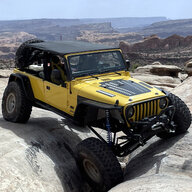
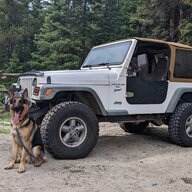
Wrapped up the rear stretch this past weekend. Turned out pretty good, look forward to getting it out for a shakedown.
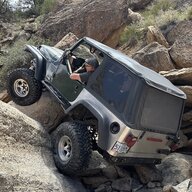
While at Golden Mtn last month, I had a steering issue on my jeep. I have been running a West Texas Offroad ported Mercedes box (2003-2006) with a PSC 6" hydro assist ram, a PSC hi-flow pump (with attached aluminum reservoir), and the BMB inline cooler for a few years with no issues. Well that streak ended. While hammering it pretty hard on some slick muddy rocks, the steering got real clunky, and then it stopped working all together. I could not turn left or right at all, it was locked in place. I disconnected the hydro assist ram from the axle and drag link and zip tied it to the bumper and was able to turn the wheel both left and right but only had manual steering, no power steering at all. Was able to use the manual steering to get the Jeep back to camp and then parked it and jumped in with Jeff. Next morning I went to put the jeep on the trailer and I had power steering again, it was a little clunky but it worked. When I got home and unloaded the jeep I had perfect power steering, I even drove it around the block just to see.
I did not know if it was the power steering pump or the steering box (more on that later). The box was leaking and had some play on the input side so I decided I wanted to replace it no matter what, so I purchased the PSC Big Bore XD box which has the 2003-2006 mount locations. I also decided to go ahead and replace the pump and purchased the PSC high flow pump and the reservoir with 12AN and 8AN return.
The PSC Big Bore box is much larger than the removed Mercedes box so I had to trim my bumper a little to get it to fit, I also had to shorten the intermediate shaft and move the heim that I have on the intermediate shaft. After I got it installed, the hydro assist ports are in a different location on the PSC box than on the removed mercedes box so I had to figure out the hose routing for the hydro ram (no big issue, just had to swap lines with some spares that I had), I also had to change the Hi pressure line from the pump to box to a pre-2003 line and then the return was a dandy to figure out, I had Blaine's adapter with a 90 deg 8AN fitting on the mercedes box, but that was not going to work and I knew that Blaine shipped a 45 deg 8AN but finding it in my garage had me scratching my head and saying a few cuss words, I then found it, just where I put it. The 45 deg with a slightly longer hose to the cooler was the ticket. I mounted the reservoir on the inner fender and ran a new 8AN line from the cooler to the reservoir and then a 12AN line from reservoir to the pump. Overall a days work, but not a bad day. Bled the system and took it for a drive around the block and all seems good, I will drive it to work one day this week for a good test and hopefully all will be ready to go wheel.
So late last night, I took the steering box apart and I could not find any smoking gun in the box, everything looked good and the valve appears to be operating correctly.
I then took the pump apart and again could not find anything apparent wrong, there was no metal debris, everything turned nice and seemed to work as it should. But I don't want to rely on the pump as-is as a spare, because it may have been the culprit and I wouldn't know it until it got heated up.
So I got to thinking (which is dangerous) to try and figure out what could have happened:
This is what I came up with as my theory. I honestly don't have any solid basis for anything that follows, this is just what I put together from taking apart the box and pump, so take it all with a grain of salt, it could all be wrong, or it could be right on, I do not know, this is just late night hanging out in the garage.
It appears that the way the steering box works is that there is a screw (input shaft) that moves a piston in and out. That piston has teeth on the side that turns the sector shaft. That is the manual part of the steering box. The power comes from fluid being on both sides of the piston and as the screw is turned and meets resistance it turns the valve one way or the other and this provides pressure to one side or the other on the piston.
It appears that the directional valve in the box is a 4 port, 3 way floating or open center valve with Pressure (P), Tank (T), A and B chambers.
A is LH turn and B is RH turn.
Steering ram- the box was tapped so that the fluid from each side of the piston flows to the ram. So it basically makes the box piston chamber larger. So you turn the wheel to the LH and it pressurizes the A side of the box and thus the ram and with LH input the B side flows back to Tank (reservoir).
Since it is a floating center valve, the A and B sides are also connected to the T (reservoir) when there is no input supplied. Thus, if you have a valve failure, you can still manually drive the piston with the screw because it would release the opposite side of the piston to tank, even if you have ram installed. Same applies if you have no pressure coming from the pump, you would still have manual steering because you can still manually drive the piston with the screw because it would release the opposite side of the piston to tank, this is the definition of a floating center, it is connected to T.
So why did the steering not work at all when the ram was hooked up (with ram hooked up the steering was locked in place) and then it provided manual steering when the ram was disconnected?
My theory is that something happened in the pump. Something in the pump pressurized the reservoir (T), thus preventing fluid from floating from the A and B chambers to the reservoir (T). With the fluid not able to flow back to the reservoir the box and ram now become a closed system. But even with the closed system, If the box and ram pistons move together from A to B then the fluid would flow from A to B and the manual steering would function properly. However, since the screw is now pressurizing the "opposite " side chamber with the way my hydro assist ram is configured it would actually restrict the pistons from moving. See attached figures.
Normally to turn left the A chambers are pressurized and B chambers go to Tank. In the figures the box piston would move down and the Ram piston would move left, both are turning the wheels to the Left. However, we actually are now doing the opposite, we are applying pressure via the screw, so to push the box piston down it pressurizes the B side which pushes the ram to the right and they fight each other. Thus you can't turn the wheels. If we disconnect the ram from the mounting points, now the ram rod is free to move in either direction and when we pressurize the B chamber with the screw it pushes the ram (opposite of what was intended, but since it is not hooked up it moves) and the fluid is free to flow. So with the ram disconnected we get manual steering capability. It was witnessed that with the ram zip tied to the bumper that the ram rod was extending in and out, this makes sense (even with no hydraulic pressure) because for the fluid to move from the A to B sides it would have to move the piston in the ram. It was most likely moving opposite of what it should have been to turn the wheels.
Next day the pump was cold, whatever was malfunctioning in the pump to allow the pressure to equalize across the P and T sides has now shrunk or seal has reseated, etc... and I again have power steering.
Anyway, if anyone with hydraulics or power steering experience reads this and wants to chime in on how off base I am, I would appreciate it. It would be nice to know what actually happened so if it ever happens in the future I will know.