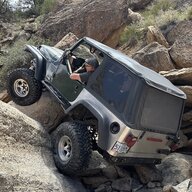
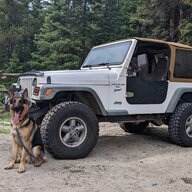
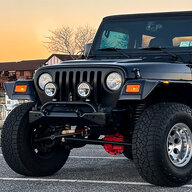
Woodrow's 97 Green TJ Moderate Build

Wildman beat me to it. You could also use the flush mount valve stem as a plug for that hole. There is such a thing as a valve stem hole plug, but I've only ever seen them for the larger 5/8" DIA hole for TPMS units. Maybe someone makes one for the smaller 29/64" valve stem hole. If not, you could drill out the old hole to 5/8" and install the TPMS valve stem hole plug.

Never seen or heard of those. I’ll look. The hole is 5/8” or at least a 5/8” well nut is a snug fit.
 
  • Like
Reactions: Wildman and sab
Wildman beat me to it. You could also use the flush mount valve stem as a plug for that hole. There is such a thing as a valve stem hole plug, but I've only ever seen them for the larger 5/8" DIA hole for TPMS units. Maybe someone makes one for the smaller 29/64" valve stem hole. If not, you could drill out the old hole to 5/8" and install the TPMS valve stem hole plug.

Found some:
https://www.amazon.com/Haltec-inch-0-625-Wheel-Hole/dp/B0C28RTR5R?tag=wranglerorg-20
These seem better than well nuts. I’ll try them next (however, so far the experimental tire is holding air).
 
  • Like
Reactions: JMT and sab
Dyno tune day!

IMG_0663.jpeg


Its been 4 years since I installed my Golen 4.6L stroker and until today, I’ve been running the stock tune (which Golen says works well). However, with the recent cowl intake mod and previously done header and full 2.5” exhaust including high flow cat, I thought the engine might be able to benefit from tuning. Both Flyin’ Ryan and my local tuner told me not to expect much change in absolute numbers but both also felt there were gains to be had “under the curve”. I went with an actual dyno tune with the tuner local to me rather than a remote tune. For those of you with a Tic Toc or Instagram attention span, The answer is +7 hp and +10 ft lbs at WOT. Here is the before and after with stock tune (dashed) and adjusted tune (solid).

IMG_0666.jpeg


Now for some detail for folks with greater interest/attention span:

In addition to modest across the board gains in tq and hp, you can also see the air:fuel mixture is more consistent with max Lambda being 0.96 (14.1 stoichiometric) pre-tune and 0.89 (13.1 stoichiometric) post-tune. I don’t really know, but the consistency and slightly richer mix may be better?

Interestingly, today’s base pull and the ‘21 stroker pull are nearly identical. I was surprised given the presumably relevant changes (33 to 35” tires, 4.11 to 5.13 gears and stock air box to cowl intake). @Jezza showed us 5-10 hp from the cowl intake. This is possibly not realized under my test conditions with an open hood and lower ambient temps. I assumed the larger tires would reduce power because of rotational mass and effectively higher gearing, But I also assumed the 5.13 gears would show higher dyno tq and hp because gears are torque multipliers and on the street, the 5.13s are the single most noticeable performance upgrade I’ve done.

However, it turns out lower gears (numerically higher) actually DECREASE dyno recorded output. A internet search shows that faster drivetrain rotational mass acceleration saps energy which would otherwise be put into roller acceleration and so recorded output is less. Don’t just take my word or the internet for it. How about some actual data? We ran all pulls today and previously in 4th gear (1:1 in an AX-15) except an additional pull before any tuning changes today in 3rd gear (1.44:1 in the AX-15). The result was -8 hp and -9 ft. lbs for 3rd gear (dashed) vs. 4th gear (solid):

IMG_0662.jpeg


So the 5.13 gearing probably hurt the numbers despite being better in real life. The tires were probably a push at best with 6% higher effective gearing but also 20% more rotational mass. And the cowl intake didn’t give cooler air although flow is probably better (and it sounds cool😎). All of this may explain why the base dyno numbers today were pretty close to 4 years ago.

Next, some fuel and spark maps for the tuning nerds.
Fuel; stock ‘97 ECM (purple and pink are numbers which were subsequently changed in the custom tune):

IMG_0657.jpeg


Fuel, post-custom tune:

IMG_0655.jpeg


Spark advance; stock ‘97 ECM (purple and pink are numbers which were subsequently changed in the custom tune):

IMG_0658.jpeg


Spark advance, post- custom tune:

IMG_0659.jpeg


I have very little to say about all of that at this point, but I am interested to learn more.

A couple of other tuning notes: max injector duty was 87% so I suppose my 24# injectors are fine in this application. Speed limit was changed from 112mph to 140mph, you know, just in case…

To sum up, the graph below has my original 4.0L data from ‘21 (dashed) and the post tune Golen 4.6L stroker data from today (solid):

IMG_0651.jpeg


+37 hp (up 27% from 136 to 173) and +48 ft. lbs. (up 29% 167 to 215) at the rear wheels despite the negative factors of gearing and tire size changes. At this point, I have no butt dyno results to report with regard to the possible under the curve improvements. I drove it home in the rain and my MT tires are sketchy AF in the rain on the street so no shenanigans were indicated.

 
Last edited:
Cool info. Those numbers don't sound huge, but since you are about that much higher across the entire RPM range, I could see it still feeling a lot better when driving. Hopefully you can get a chance to test it out soon
 
max Lambda being 0.96 stoichiometric) pre-tune and 0.89 (13.1 chiometric) post-tune. I don’t really know, but the consistency and slightly richer mix may be better

Can you explain what that means?

What was your pre and post tune w.o.t. mixture?That is one thing the stock tune can't compensate for i wonder about with mine
 
  • Like
Reactions: Woodrow
Can you explain what that means?

What was your pre and post tune w.o.t. mixture?That is one thing the stock tune can't compensate for i wonder about with mine

“max Lambda being 0.96 (14.1 stoichiometric) pre-tune and 0.89 (13.1 stoichiometric) post-tune” is from my post.

The first graph has mixture info (green but looks black) for pre (dashed) and post (solid) expresses as lambda. With pump gas, a stoichiometric mixture (meaning just enough air to burn all the fuel ideally) is 14.7:1 air mass to fuel mass. Using lambda instead of mass ratio, stoichiometry is at 1.0. Above 1 is lean (excess air) and below is rich (excess fuel). To convert lambda to air:fuel for pump gas, multiply lambda x 14.7.

Pre-tune, the mixture varies from around 0.95 lambda (A:F 14.0) at low RPM to as low as 0.80 (A:F 11.76) lambda at high RPM. Post-tune it is more steady at 0.86-0.89 lambda (A:F 12.6-13.1) across most of the range at WOT.
 
Last edited:
  • Like
Reactions: Rickyd and srimes
So, it seems the tuner used a very conservative tune for you. That’s good. Do you know if he tried going lean? I always thought there was more power to be had going slightly lean vs rich…but I also know some engine reaction differently than others.

It’s like timing…just enough, but going to far is bad…real bad.
 
  • Like
Reactions: Woodrow
Cool stuff. Should the stock power plant in my TJ ever fail a stroker would be my route.. so, I follow all the stroker posts with great interest. That said.... I want to hear about the seat-of-the-pants impressions please....

Butt dyno.jpg
 
  • Like
Reactions: Woodrow
So, it seems the tuner used a very conservative tune for you. That’s good. Do you know if he tried going lean? I always thought there was more power to be had going slightly lean vs rich…but I also know some engine reaction differently than others.

It’s like timing…just enough, but going to far is bad…real bad.

We talked some about that. I don't know enough to speak intelligently on the topic. He did say he will go leaner in race cars but also said there is some risk in hot conditions which made me think Moab when its 120 deg ambient.
 
“max Lambda being 0.96 (14.1 stoichiometric) pre-tune and 0.89 (13.1 stoichiometric) post-tune” is from my post.

The first graph has mixture info (green but looks black) for pre (dashed) and post (solid) expresses as lambda. With pump gas, a stoichiometric mixture is 14.7:1 air mass to fuel mass. Using lambda instead of mass ratio, stoichiometry is at 1.0. Above 1 is lean and below is rich. To convert lambda to air:fuel for pump gas, multiply lambda x 14.7.

Pre-tune, the mixture varies from around 0.95 lambda (A:F 14.0) at low RPM to as low as 0.80 (A:F 11.76) lambda at high RPM. Post-tune it is more steady at 0.86-0.89 lambda (A:F 12.6-13.1) across most of the range at WOT.

Ok,thanks for clarifying the mixture graph is all WOT.stock tune wasn't ideal for sure but not scary
 
  • Like
Reactions: Wildman and Woodrow
Peak power is usually found with a slightly-rich mixture. It's also safer for the engine. That post-tune line looks much better.

As for power readings vs. gearing, there are 2 things going on here. 1st, as you said, the energy absorbed by the rotating mass (mainly tires) accelerating faster absorbs more power on an inertia dyno, so the dyno just doesn't "see" the power being generated like it would on a brake dyno. The is the main difference.

The other thing is that the bigger the gear ratio the more energy is lost. 5:13s will run hotter and sap more power than 4.11s. But the difference is pretty small.
 
I would like to get mine on a dyno at some point just to see what it's making...

Once you've got some seat time with it I'm looking forward to hearing what you think about it and how it compares to the stock tune.

I wonder what if anything you could do to maybe help improve the HP & TQ numbers? Hotter spark? Larger gapped plugs? While 87% injector duty isn't bad I wonder if running a larger one where you were under 75% duty would be better? They'd run cooler? I think that is what I remember...
 
Peak power is usually found with a slightly-rich mixture. It's also safer for the engine. That post-tune line looks much better.

As for power readings vs. gearing, there are 2 things going on here. 1st, as you said, the energy absorbed by the rotating mass (mainly tires) accelerating faster absorbs more power on an inertia dyno, so the dyno just doesn't "see" the power being generated like it would on a brake dyno. The is the main difference.

The other thing is that the bigger the gear ratio the more energy is lost. 5:13s will run hotter and sap more power than 4.11s. But the difference is pretty small.

You made me go look up the differences between dynos. Here's a Hot Rod article I read: https://www.hotrod.com/how-to/hrdp-0405-chassis-dyno-guide
 
  • Like
Reactions: srimes
I would like to get mine on a dyno at some point just to see what it's making...

Once you've got some seat time with it I'm looking forward to hearing what you think about it and how it compares to the stock tune.

I wonder what if anything you could do to maybe help improve the HP & TQ numbers? Hotter spark? Larger gapped plugs? While 87% injector duty isn't bad I wonder if running a larger one where you were under 75% duty would be better? They'd run cooler? I think that is what I remember...

I may get back to it at some some point, but assuming no weird behavior with the new tune, I'm satisfied. I need focus on the suspension for the next few months.
 
Dyno tune day!

View attachment 653154

Its been 4 years since I installed my Golen 4.6L stroker and until today, I’ve been running the stock tune (which Golen says works well). However, with the recent cowl intake mod and previously done header and full 2.5” exhaust including high flow cat, I thought the engine might be able to benefit from tuning. Both Flyin’ Ryan and my local tuner told me not to expect much change in absolute numbers but both also felt there were gains to be had “under the curve”. I went with an actual dyno tune with the tuner local to me rather than a remote tune. For those of you with a Tic Toc or Instagram attention span, The answer is +7 hp and +10 ft lbs at WOT. Here is the before and after with stock tune (dashed) and adjusted tune (solid).

View attachment 653141

Now for some detail for folks with greater interest/attention span:

In addition to modest across the board gains in tq and hp, you can also see the air:fuel mixture is more consistent with max Lambda being 0.96 (14.1 stoichiometric) pre-tune and 0.89 (13.1 stoichiometric) post-tune. I don’t really know, but the consistency and slightly richer mix may be better?

Interestingly, today’s base pull and the ‘21 stroker pull are nearly identical. I was surprised given the presumably relevant changes (33 to 35” tires, 4.11 to 5.13 gears and stock air box to cowl intake). @Jezza showed us 5-10 hp from the cowl intake. This is possibly not realized under my test conditions with an open hood and lower ambient temps. I assumed the larger tires would reduce power because of rotational mass and effectively higher gearing, But I also assumed the 5.13 gears would show higher dyno tq and hp because gears are torque multipliers and on the street, the 5.13s are the single most noticeable performance upgrade I’ve done.

However, it turns out lower gears (numerically higher) actually DECREASE dyno recorded output. A internet search shows that faster drivetrain rotational mass acceleration saps energy which would otherwise be put into roller acceleration and so recorded output is less. Don’t just take my word or the internet for it. How about some actual data? We ran all pulls today and previously in 4th gear (1:1 in an AX-15) except an additional pull before any tuning changes today in 3rd gear (1.44:1 in the AX-15). The result was -8 hp and -9 ft. lbs for 3rd gear (dashed) vs. 4th gear (solid):

View attachment 653155

So the 5.13 gearing probably hurt the numbers despite being better in real life. The tires were probably a push at best with 6% higher effective gearing but also 20% more rotational mass. And the cowl intake didn’t give cooler air although flow is probably better (and it sounds cool😎). All of this may explain why the base dyno numbers today were pretty close to 4 years ago.

Next, some fuel and spark maps for the tuning nerds.
Fuel; stock ‘97 ECM (purple and pink are numbers which were subsequently changed in the custom tune):

View attachment 653161

Fuel, post-custom tune:

View attachment 653160

Spark advance; stock ‘97 ECM (purple and pink are numbers which were subsequently changed in the custom tune):

View attachment 653157

Spark advance, post- custom tune:

View attachment 653156

I have very little to say about all of that at this point, but I am interested to learn more.

A couple of other tuning notes: max injector duty was 87% so I suppose my 24# injectors are fine in this application. Speed limit was changed from 112mph to 140mph, you know, just in case…

To sum up, the graph below has my original 4.0L data from ‘21 (dashed) and the post tune Golen 4.6L stroker data from today (solid):

View attachment 653164

+37 hp (up 27% from 136 to 173) and +48 ft. lbs. (up 29% 167 to 215) at the rear wheels despite the negative factors of gearing and tire size changes. At this point, I have no butt dyno results to report with regard to the possible under the curve improvements. I drove it home in the rain and my MT tires are sketchy AF in the rain on the street so no shenanigans were indicated.


Thanks for posting all this info, Mike. Very interesting, and nice work.

Sounds like you are ready for a drag race out in Sand Hollow in the spring?

🙂
 
Last edited: