
You are using an out of date browser. It may not display this or other websites correctly.
You should upgrade or use an alternative browser.
You should upgrade or use an alternative browser.

Bought my first Jeep, but it needs alterations (or I need to find a different TJ)
- Thread starter Jonny D.
- Start date

Also reached out to a local shop that specializes in off road lifts, gearing, mechanics, etc.
They’re going to squeeze me in for an hour diagnostic look over and give me some pricing.
I mainly want to do it for the information. I plan on doing almost all of the repairs myself.
They’re going to squeeze me in for an hour diagnostic look over and give me some pricing.
I mainly want to do it for the information. I plan on doing almost all of the repairs myself.
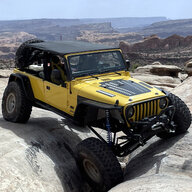
Feast Yer Eyes!
It does look like a drop Pitman arm.
There is obvious wear on the RC shocks, the randomly added stabilizers, etc.
Still saving for tires, and suspension replacement, and gearing changes…
View attachment 638809
View attachment 638810
View attachment 638811
View attachment 638812
View attachment 638813
View attachment 638814
View attachment 638815
View attachment 638816
Not a good pic, but there also appears to be a frame-side drop bracket on the track bar. If done correctly, that allows for decent geometry in conjunction with the dropped pitman. Don't remove the dropped pitman without also removing the dropped bracket. So we can verify - can you post a pic of the frame-side track bar mount?


Not a good pic, but there also appears to be a frame-side drop bracket on the track bar. If done correctly, that allows for decent geometry in conjunction with the dropped pitman. Don't remove the dropped pitman without also removing the dropped bracket. So we can verify - can you post a pic of the frame-side track bar mount?
You can see it in this picture. But it seems like the two still Don't match given the different angles of the drag link and track bar. Don't mind Fred in the corner....
You can see it in this picture. But it seems like the two still Don't match given the different angles of the drag link and track bar. Don't mind Fred in the corner....
View attachment 638896
Don't let the bend in the track bar fool you. The geometry is defined by the straight lines between the mount points of the track bar and the drag link. Those lines need to be parallel and equal length (in simple terms) to avoid bump steer.
Last edited:
This guy?Not a good pic, but there also appears to be a frame-side drop bracket on the track bar. If done correctly, that allows for decent geometry in conjunction with the dropped pitman. Don't remove the dropped pitman without also removing the dropped bracket. So we can verify - can you post a pic of the frame-side track bar mount?
Don't let the bend in the track bar fool you. The geometry is defined by the straight lines between the mount points the track bar and the drag link. Those lines need to be parallel (in simple terms) to avoid bump steer.
Yes, that is a drop bracket. Welded in place. That will have to be replaced in order to remove the dropped pitmam - and that will be a bunch of work. I’d leave it as is for now.
Yes, that is a drop bracket. Welded in place. That will have to be replaced in order to remove the dropped pitmam - and that will be a bunch of work. I’d leave it as is for now.
No, I believe it’s bolted on. Maybe the picture lied.
That is better news if you decide to remove it. As long as there are no clearance issues, and everything is tight, that setup is probably not hurting anything, or causing any problems.
Don't let the bend in the track bar fool you. The geometry is defined by the straight lines between the mount points of the track bar and the drag link. Those lines need to be parallel and equal length (in simple terms) to avoid bump steer.
Yes, but when you look at his picture from the front (pardon my rough line drawing, my red line is a bit too steep, but you see). Seems like even with the TB drop bracket, the drop pitman arm is still too long. I'll admit, it's far from the worst I've seen, and not the sole factor, but definitely a factor.
Yes, but when you look at his picture from the front (pardon my rough line drawing, my red line is a bit too steep, but you see). Seems like even with the TB drop bracket, the drop pitman arm is still too long. I'll admit, it's far from the worst I've seen, and not the sole factor, but definitely a factor.
View attachment 638930View attachment 638931
Look a bit closer. Your track bar line - red - is not lined up correctly. The frame side end of the track bar is much lower than you are showing.
Look a bit closer. Your track bar line - red - is not lined up correctly. The frame side end of the track bar is much lower than you are showing.
Yea, I even said my red line was off. But it still seems that if that pitman arm was raised a bit they would be more parallel. Again, far from the worst.

Don't let the bend in the track bar fool you. The geometry is defined by the straight lines between the mount points of the track bar and the drag link. Those lines need to be parallel and equal length (in simple terms) to avoid bump steer.
Factory is neither parallel, nor equal length. But Jeep got the relationship between the drag link and track bar figured out despite that.

Yea, I even said my red line was off. But it still seems that if that pitman arm was raised a bit they would be more parallel. Again, far from the worst.
I still think you are not understanding what is driving the geometry here, so for the OP's benefit I'll try to explain. Your red line is not off, it's not correct. You have traced it along the actual tubing of the track bar. That is what I meant above by "don't let the bend in the track bar fool you".
As I said, the geometry is driven by the line which connects the pivot points at either ends of the track bar and drag link. Here is what that means:
The yellow line is the track bar. Note that it connects the two end points at the mounts, and does not line up with the center - bent - section of the track bar.
I mentioned above that this is a simplified way to look at it, but it does help explain what is going on. What truly controls bump steer is the arc created by the axle-side track bar and drag link connections as the axle moves up and down. The intent of the geometry is to create an identical arc that each follow. This means that as the axle cycles, and the track bar moves the axle from side to side, the drag link also moves that exact distance side to side - therefore keeping the wheels pointed straight ahead.
Note that these lines are not exactly parallel (could have a bit to do with the perspective on the photo). But they are likely close enough to eliminate any bump steer. Do this exercise on a stock TJ, and you will see that these lines are not exactly parallel there either.
As I said, this setup should work fine - no need to swap it out at this point.
Factory is neither parallel, nor equal length. But Jeep got the relationship between the drag link and track bar figured out despite that.
Exactly why I said "in simple terms." You replied while I was typing my above response, but yes, you are correct. I touched on that as well.
I still think you are not understanding what is driving the geometry here, so for the OP's benefit I'll try to explain. Your red line is not off, it's not correct. You have traced it along the actual tubing of the track bar. That is what I meant above by "don't let the bend in the track bar fool you".
View attachment 638944
As I said, the geometry is driven by the line which connects the pivot points at either ends of the track bar and drag link. Here is what that means:
View attachment 638945
The yellow line is the track bar. Note that it connects the two end points at the mounts, and does not line up with the center - bent - section of the track bar.
I mentioned above that this is a simplified way to look at it, but it does help explain what is going on. What truly controls bump steer is the arc created by the axle-side track bar and drag link connections as the axle moves up and down. The intent of the geometry is to create an identical arc that each follow. This means that as the axle cycles, and the track bar moves the axle from side to side, the drag link also moves that exact distance side to side - therefore keeping the wheels pointed straight ahead.
Note that these lines are not exactly parallel (could have a bit to do with the perspective on the photo). But they are likely close enough to eliminate any bump steer. Do this exercise on a stock TJ, and you will see that these lines are not exactly parallel there either.
As I said, this setup should work fine - no need to swap it out at this point.
I understand it, I do. But I also see now that when I started on the track bar and made my line, I didn't account for that bracket and drew towards the factory mounting location. (I also drew it on my phone with my finger and I'm no artist lol). But yes, I do agree with the track bar line between the mounts and understand that. And I'll admit that when you make cleaner, precise lines, it is much closer than it first appeared. As you mention, maybe the perspective of the photo is influencing perception.
On an unrelated note, the more I look at the damper situation, the more I scratch my head.
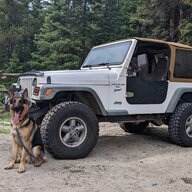
I still think you are not understanding what is driving the geometry here, so for the OP's benefit I'll try to explain. Your red line is not off, it's not correct. You have traced it along the actual tubing of the track bar. That is what I meant above by "don't let the bend in the track bar fool you".
View attachment 638944
As I said, the geometry is driven by the line which connects the pivot points at either ends of the track bar and drag link. Here is what that means:
View attachment 638945
The yellow line is the track bar. Note that it connects the two end points at the mounts, and does not line up with the center - bent - section of the track bar.
I mentioned above that this is a simplified way to look at it, but it does help explain what is going on. What truly controls bump steer is the arc created by the axle-side track bar and drag link connections as the axle moves up and down. The intent of the geometry is to create an identical arc that each follow. This means that as the axle cycles, and the track bar moves the axle from side to side, the drag link also moves that exact distance side to side - therefore keeping the wheels pointed straight ahead.
Note that these lines are not exactly parallel (could have a bit to do with the perspective on the photo). But they are likely close enough to eliminate any bump steer. Do this exercise on a stock TJ, and you will see that these lines are not exactly parallel there either.
As I said, this setup should work fine - no need to swap it out at this point.
Quality big brain response there Jeff

Exactly why I said "in simple terms." You replied while I was typing my above response, but yes, you are correct. I touched on that as well.
The quick and dirty explanation for how to deal with the dropped pitman and track bar is that they need to maintain the factory relationship. If one is lowered some amount, then both need to be lowered the same amount.
Similar threads

- Replies
- 21
- Views
- 2,042
- Replies
- 4
- Views
- 2,883


- Replies
- 16
- Views
- 1,936

- Replies
- 15
- Views
- 2,824

