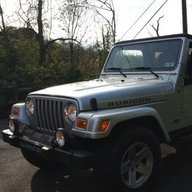
Steering Float

Say what now?

Anything above 28psi, for me, is an absolute horror. Uncomfortable, darty steering, jarring over bumps. Local shop as filled them to 35psi and it's like a being on those old metal wheeled roller skates. 45-50? Can't imagine it. Must wreck your tire wear.

Depends on your suspension setup and quality of maintenance. It will definitely exacerbate any issues you didn’t know you had.

I grease all joints liberally on a routine basis, and also use the RS5000X shocks, which are very soft. So the suspension generally does most of the work of absorbing bumps.

At very high pressures, especially over 50 PSI, you’ll start to notice issues with wheel hop going over bumps and potholes that can make hard acceleration or braking a bit more squirrelly. So above 50 does not seem to have much of an advantage. (I have tested from 24 PSI all the way up to 80 PSI.)

Higher pressures absolutely do make the steering feel more precise, which is one of the reasons I run higher than most. Simply put, the less sidewall deflection in a tire, the less “slop” that has to be taken out in order for the tire to begin to resist a lateral load. Up to a point, it also means less static sideslip. (Past a certain point, increasing pressure will actually increase sideslip.)

The other reason I run higher pressure is for the lower rolling resistance. Among a few mods and other things, I get ~18 MPG on 35x12.5 tires now, whereas I got ~12 MPG when I started on 35x12.5, and even only about 14-15 with the bone stock car. That also translates to more available power for acceleration and hill climbing.

Also vastly cuts down on tire wear since the tire has to deform less under load, meaning it stays cooler. Although very high pressures (in excess of 50 PSI) may begin to increase wear due to the effects of wheel hop.
 
  • Like
Reactions: Chris
... the less sidewall deflection in a tire, the less “slop” that has to be taken out in order for the tire to begin to resist a lateral load...

Same here :p:D

1740425512311.png
 
Depends on your suspension setup and quality of maintenance. It will definitely exacerbate any issues you didn’t know you had.

I grease all joints liberally on a routine basis, and also use the RS5000X shocks, which are very soft. So the suspension generally does most of the work of absorbing bumps.

At very high pressures, especially over 50 PSI, you’ll start to notice issues with wheel hop going over bumps and potholes that can make hard acceleration or braking a bit more squirrelly. So above 50 does not seem to have much of an advantage. (I have tested from 24 PSI all the way up to 80 PSI.)

Higher pressures absolutely do make the steering feel more precise, which is one of the reasons I run higher than most. Simply put, the less sidewall deflection in a tire, the less “slop” that has to be taken out in order for the tire to begin to resist a lateral load. Up to a point, it also means less static sideslip. (Past a certain point, increasing pressure will actually increase sideslip.)

The other reason I run higher pressure is for the lower rolling resistance. Among a few mods and other things, I get ~18 MPG on 35x12.5 tires now, whereas I got ~12 MPG when I started on 35x12.5, and even only about 14-15 with the bone stock car. That also translates to more available power for acceleration and hill climbing.

Also vastly cuts down on tire wear since the tire has to deform less under load, meaning it stays cooler. Although very high pressures (in excess of 50 PSI) may begin to increase wear due to the effects of wheel hop.

To each his own. I run the same shocks. 33x12.5 on 15x10. Every component in the suspension is new, well maintained, lubed regularly, properly aligned and no shitty parts. Daily driver on NY roads.
Anything above 30 psi and seat of the pants can pick it up immediately. The ride is awful. There's no trying to rationalize otherwise. But you gotta do you...
 
  • Like
Reactions: Harold&Cat and CMBD
If you are having to run 45-50psi tire pressure in a possibly sub 4000lb(ish) vehicle to address some drivability stuff, there is some other stuff you should really be looking at.
 
  • Like
Reactions: MikekiM
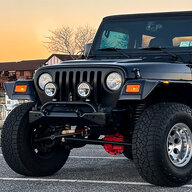
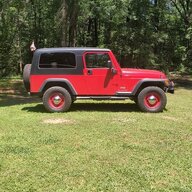
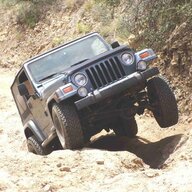
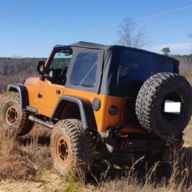
The pictures indicate stock control arms . When lifted it will rotate the axle therefore changing the castor and camber to some degree which would affect steering response . I am by no means a front end expert , but I'm sure one will come along and shed some light on it .
 
  • Like
Reactions: MikekiM
Also check the ujoint in the steering shaft. I had play in the steering wheel between 11 and 1. The ujoint in the steering shaft between the firewall and the steering box was worn out for me.

I got that on mine. Need to replace it but damn the shafts for 03-06 is expensive.
 
I got that on mine. Need to replace it but damn the shafts for 03-06 is expensive.

Yes. I was able to get one from Davey's Jeep in ohio. Maybe check Facebook see if anyone is parting out a TJ. Probably your cheapest/easiest option.

EDIT: I THINK someone on here once replaced the ujoint. It wasn't designed to be replaceable but someone did it...they did a small write up

edit edit: https://daveysjeeps.com/parts/?subcategories=189
 
Last edited: