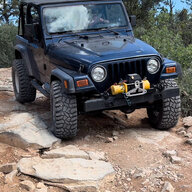
So with all the discussion about long arms, mid arms, and geometry correction there come a lot of questions and some terminology that goes along with it. My goal with this thread is to compile that information in one place so others do not have to spend as much time sharpening their google foo.
The infamous Pirate thread https://www.pirate4x4.com/threads/the-god-of-suspension-for-those-of-you-who-dont-know.7503/
Other Pirate threads:
https://www.pirate4x4.com/threads/link-suspensions-for-dummies.168577/https://www.pirate4x4.com/threads/front-3-link-design.307322/https://www.pirate4x4.com/threads/m...front-axle-on-rear-4-link-why-why-not.244442/https://www.pirate4x4.com/threads/roll-centers-vs-cog-for-going-fast.1680738/https://www.pirate4x4.com/threads/anti-squat-the-final-answer.208915/
This is a college paper based off the infamous Pirate thread https://digitalworks.union.edu/cgi/viewcontent.cgi?article=1015&context=theses A bit of a read but if I was to be asked to pick just one read this would be the one.
An article Fred Williams wrote with input from Drew Borroughs (aka Goat1, suspension engineer and owner of Goatbuilt) http://www.orcfab.com/tech/4link1.html
Crawlpedia article which includes links to the famous Triaged calculators https://www.crawlpedia.com/4_link_suspension.htm
For those that do not want to read Jake Burkey made some vids that are worth watching
Some basic terms:
Anti Squat:
Anti Squat is a term for suspension engineers to determine how much the suspension mechanism itself is resisting suspension compression. Anti-squat is suspension’s mechanical resistance to compression due to forces from the engine. Over 100% of anti-squat (AS) means suspension will extend under acceleration. With 100% AS suspension won’t either extend nor compress. Under 100% AS means tendency to compress under acceleration. It is determined based on actual linkage instant center and center of mass height.
Anti Dive:
Anti Dive is also a term for suspension engineers to determine how much the suspension mechanism is resisting suspension compression. Anti Dive is the suspensions mechanical resistance to compression due to forces from the brakes. Over 100% of anti dive (AD) means suspension will not compress under braking. With 100% AD suspension won't either nor compress. Under 100% AD means the tendency to compress under braking. It is determined based on actual linkage instant center and center mass of height.
Center of gravity:
Center of gravity, also known as center of mass, is that point at which a system or body behaves as if all its mass were centered at that point. Where the weight, and also all accelerative forces of acceleration, braking and cornering act through it.
Instant Center:
The instant center or “IC” is an imaginary point about which the chassis or a suspension member rotates in a given (instant) position. You can find it by simply projecting lines along suspension members to a point of intersection (for example, the respective bars of a four-link). Where they intersect is called the instant center.
Roll Center:
The roll center of a vehicle is the notional point at which the cornering forces in the suspension are reacted to the vehicle chassis.
Wheelbase:
Wheelbase is the distance between the centerline of the front and rear tires.
Some basic things to try and keep in mind:
What we need to understand is a link suspension for our purpose is what is being used to locate and control the twisting forces generated by the axles either from acceleration or braking throughout the axles range of motion. The links placement will dictate how those forces are transmitted into the chassis. We also have to remember that we live in a three dimensional world with many variables that have to be taken into account so any two dimensional analysis will never be able to account for all those variables.
The Triaged calculator is definitely an example of one of those things. It is a very useful tool as long as we remember a couple things. First is that without some serious work we do not know where our exact center of gravity is so the numbers produced are not 100% accurate. Second is that it is just a static model and while you can manipulate the numbers to provide some simulation of axle movement it will still not be a complete representation of the real world. But if we take those things into consideration what we can do is use it to provide a data point that we can use to then make comparisons of what behaviors change when we change those variable we want to change. Also if you are trying to use it to compare different suspension systems you have to make sure the values you are giving offer a direct comparison to one another. It does no good to compare a RE Long arm to a Savvy Mid arm if the measurements you took from either kit are not on the same springs as ride height directly affects the control arm angle and therefor all the other numbers you actually are trying to compare.
The infamous Pirate thread https://www.pirate4x4.com/threads/the-god-of-suspension-for-those-of-you-who-dont-know.7503/
Other Pirate threads:
https://www.pirate4x4.com/threads/link-suspensions-for-dummies.168577/https://www.pirate4x4.com/threads/front-3-link-design.307322/https://www.pirate4x4.com/threads/m...front-axle-on-rear-4-link-why-why-not.244442/https://www.pirate4x4.com/threads/roll-centers-vs-cog-for-going-fast.1680738/https://www.pirate4x4.com/threads/anti-squat-the-final-answer.208915/
This is a college paper based off the infamous Pirate thread https://digitalworks.union.edu/cgi/viewcontent.cgi?article=1015&context=theses A bit of a read but if I was to be asked to pick just one read this would be the one.
An article Fred Williams wrote with input from Drew Borroughs (aka Goat1, suspension engineer and owner of Goatbuilt) http://www.orcfab.com/tech/4link1.html
Crawlpedia article which includes links to the famous Triaged calculators https://www.crawlpedia.com/4_link_suspension.htm
For those that do not want to read Jake Burkey made some vids that are worth watching
Some basic terms:
Anti Squat:
Anti Squat is a term for suspension engineers to determine how much the suspension mechanism itself is resisting suspension compression. Anti-squat is suspension’s mechanical resistance to compression due to forces from the engine. Over 100% of anti-squat (AS) means suspension will extend under acceleration. With 100% AS suspension won’t either extend nor compress. Under 100% AS means tendency to compress under acceleration. It is determined based on actual linkage instant center and center of mass height.
Anti Dive:
Anti Dive is also a term for suspension engineers to determine how much the suspension mechanism is resisting suspension compression. Anti Dive is the suspensions mechanical resistance to compression due to forces from the brakes. Over 100% of anti dive (AD) means suspension will not compress under braking. With 100% AD suspension won't either nor compress. Under 100% AD means the tendency to compress under braking. It is determined based on actual linkage instant center and center mass of height.
Center of gravity:
Center of gravity, also known as center of mass, is that point at which a system or body behaves as if all its mass were centered at that point. Where the weight, and also all accelerative forces of acceleration, braking and cornering act through it.
Instant Center:
The instant center or “IC” is an imaginary point about which the chassis or a suspension member rotates in a given (instant) position. You can find it by simply projecting lines along suspension members to a point of intersection (for example, the respective bars of a four-link). Where they intersect is called the instant center.
Roll Center:
The roll center of a vehicle is the notional point at which the cornering forces in the suspension are reacted to the vehicle chassis.
Wheelbase:
Wheelbase is the distance between the centerline of the front and rear tires.
Some basic things to try and keep in mind:
What we need to understand is a link suspension for our purpose is what is being used to locate and control the twisting forces generated by the axles either from acceleration or braking throughout the axles range of motion. The links placement will dictate how those forces are transmitted into the chassis. We also have to remember that we live in a three dimensional world with many variables that have to be taken into account so any two dimensional analysis will never be able to account for all those variables.
The Triaged calculator is definitely an example of one of those things. It is a very useful tool as long as we remember a couple things. First is that without some serious work we do not know where our exact center of gravity is so the numbers produced are not 100% accurate. Second is that it is just a static model and while you can manipulate the numbers to provide some simulation of axle movement it will still not be a complete representation of the real world. But if we take those things into consideration what we can do is use it to provide a data point that we can use to then make comparisons of what behaviors change when we change those variable we want to change. Also if you are trying to use it to compare different suspension systems you have to make sure the values you are giving offer a direct comparison to one another. It does no good to compare a RE Long arm to a Savvy Mid arm if the measurements you took from either kit are not on the same springs as ride height directly affects the control arm angle and therefor all the other numbers you actually are trying to compare.
Last edited: